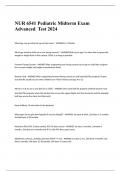
NUR 6541 Pediatric Midterm Exam Advanced Test 2024
What age can an infant sit up on their own? - ANSWES 6-7 Months What age limit of the carseat. GOAL is as long as possible Forward Facing Carseat - ANSWES After outgrowing rear facing carseat up to age or until they outgrow the carseats weight and height manufacturer limits would a child use a rear facing carseat? - ANSWES Birth up to age 4 or when the out grow the weight or height Booster Seat - ANSWES After outgrowing forward facing carseat or until seat belt fits properly. Proper seat belt fit usually occurs when children are 4 feet 9 inches and age 9 to 12 When is it ok to use a seat belt for a child? - ANSWES Once seat belt fits properly without booster seat Seat belt fits properly when the lap belt lays across the upper thighs (not the stomach) and the shoulder belt lays across the chest (not the neck) Keep children 12 and under in the backseat What ages do we give the Hepatitis B vaccine (HepB)? - ANSWES 1st dose at birth, 2nd dose 1-2 months, 3rd between 6-18 months Rotavirus (RV): RV1 (2-dose series), RV5 (3-dose series) - ANSWES 1st dose 2 months, 2nd dose 4 months, 3rd dose at 6 months only if it is the RV5 three part series. Diphtheria, tetanus, acellular pertussis (DTaP <7 yrs) - ANSWES 1st dose 2 mo, 2nd dose 4 months, 3rd dose 6 months, 4th dose 15-18 months, 5th dose 4-6 years old Haemophilus influenzae type b (Hib) - ANSWES 1st dose 2 months, 2nd dose 4 months, 3rd or 4th dose Pneumococcal conjugate (PCV13) - ANSWES 1st dose 2 mo, 2nd do 4 mo, 3rd dose 6 month, and then 4th dose btw 12-15 mo Inactivated poliovirus (IPV <18 yrs) - ANSWES 1st dose 2 mo, 2nd dose 4 mo, and 3rd dose between 6-18 months. 4th dose btw 4-6 years old Influenza (IIV) OR Influenza (LAIV) - ANSWES 1st dose for (IIV) 6 months-6 years old, 1st dose for (LAIV) starts at 2-3 years old until 4-6 years old. both 1-2 doses MMR-Measles Mumps & Rubella - ANSWES For high risk groups `st dose would be btw 6-9 months. otherwise 1st dose btw 12-15 months. 2nd dose btw 4-6 years Varicella (VAR) - ANSWES 1st dose btw 12-15 months, 2nd dose 4-6 years old Hep A - ANSWES High risk groups 6-9 months only. Otherwise its a 2 dose series given anytime between 12-23 months Tetanus, diphtheria, acellular pertussis (Tdap ≥7 yrs) - ANSWES 11-12 years old receives dose. What age are accidental fractures uncommon in children that would raise a red flag for abuse? - ANSWES · <18 months of age. · Rib Fractures are uncommon in infants and young children unless serious trauma · Once walking may have any type of fall including spiral or oblique, transverse or buckle ( these would be normal) what kind of fractures would make you suspicious of inflicted injury? - ANSWES · · Classic metaphysical fractures at the end of developing long bones are generally unique to the infant population and have high specificity for maltreatment · Scapular, spinous process and sternal fractures are uncommon accidental fractures and considered suspicious for inflicted injury. Child abuse- When should you be concerned with a child who has multiple bruises and not walking around and/or cruising around the furniture yet? - ANSWES · Unexplained bruising (or bruising without an acceptable explanation) in a child not independently mobile must always raise suspicion of maltreatment. Especially bruising on the child's trunk, ears, and neck. **The parent should be able to reasonably explain any bruise. 1. Child abuse- When should you be concerned with child suffering from a long bone fracture? - ANSWES When they are less than 18 months old (humerus) is concerning; if accidental it is usually after a fall and are often supracondylar injuries....inflicted fractures are more likely to be spiral or oblique and midshaft or proximally located. · Femur fracture in a non-ambulatory child is usually inflicted. 1. Child abuse- When is it necessary to report child abuse as a NP? Who do you report to? Do you risk anything by reporting? - ANSWES · As nurses we are mandated reporters of child abuse. · Each state has their own child abuse law. And who it is reported to. But typically, it is a child abuse hotline. There is a national line 1-800-4-A-CHILD · Child abuse is a HIPAA exception. So, no you will not get in trouble. Newborns- what type of vitamin deficiencies might cause certain problems in a newborn - ANSWES Vitamins A, B1, C, D, & K What kinds of problems occur in newborns from Vitamin A deficiency? - ANSWES Common in resource limited countries, associated with xeropthalmia and other ocular signs. Earliest symptom is night blindness, followed by xerosis (dryness of conjunctive and cornea-image). Progression leads to ulcerations, perforation and scarring of cornea. Other symptoms may include hyperkeratosis, pruritus, growth retardation and increased risk to infection. Vitamin B1 deficiency in newborns cause what? - ANSWES o Involved in cellular metabolic activities, and nerve impulses. o Causes: 1. Clinical beriberi= typically between 2-3 months, typically breast fed by women with thiamine deficiency. SS=cardiomegaly, tachy, loud piercing cry, cyanosis, dyspnea, and vomiting 2. Wernicke-korsakoff syndrome=complication of thiamine def. acute syndrome requiring emergent care=two syndrome: 1. Wernicke's encephalopathy- nystagmus, ophthalmoplegia, ataxia and confusion (seen in alcoholics) 2. Korsakoff syndrome=chronic neuro condition as consequence of WE. Foods high in: yeast, legumes, pork, brown rice, cereals with whole grains. Vit C deficiency in newborn/infants - ANSWES · Vitamin C o Ascorbic acid or scurvy=Prominent cutaneous signs: petechiae, perifollicular hemorrhage, and bruising, gingivitis, arthralgias, and impaired wound healing. Typically appears within few months of being deficient. Foods: Citrus fruits, tomatoes, potatoes, Brussel sprouts, cauliflower, broccoli strawberries, cabbage and spinach. Breast milk typically provides adequate source of Vit C! Vit D deficiency in newborns/infants - ANSWES Vitamin D o Dietary deficiency and inadequate exposure to sunlight causing hypocalcemia, hypophos and rickets. This will cause defective bone growths, poorly supported tissue and skeletal abnormalites- enlargement and delayed closure of anterior fontanelle, frontal bossing of skull, delayed eruption of teeth, beading of ribs, bowlegs in older infants, and green stick fractures in long bones. Vit K deficiency in newborn/infants - ANSWES o Bleeding diathesis. Skin, GI tract, GU, gingiva, lungs, joints or CNS
Written for
- Institution
- NRNP
- Course
- NRNP
Document information
- Uploaded on
- January 24, 2024
- Number of pages
- 4
- Written in
- 2023/2024
- Type
- Exam (elaborations)
- Contains
- Questions & answers
Subjects
-
nur 6541 pediatric midterm exam advanced test 202

Also available in package deal