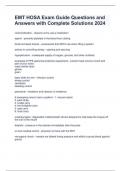
EMT HOSA Exam Guide Questions and Answers with Complete Solutions 2024
contraindication - reasons not to use a medication aspirin - prevents platelets in the blood from clotting boots and back braces - accessories that EMTs use when lifting a pateint actions in controlling airway - opening and securing hypoperfusion - inadequate supply of oxygen, glucose, and other nutrients examples of PPE (personal protective equipment) - pocket mask (covers mouth and part of your nose) mask (whole face) gloves gown basic skills for emt - infection control airway control ventilation bleeding control parenteral - inhalation and injection of medience 6 emergency way to carry a patient - 1. rescuer assist 2. pack strap 3. cradle carry 4. the firefighter carry 5. seat carry 6. chair carry oropharyngeal - disposable molded plastic device designed to help keep the tongue off the roof of the mouth diastolic - pressure in the arteries immediately after the pulse on-line medical control - physician is there with the EMT neurogenic shock - vessels are dilated losing pressure and ability to pump blood against gravity extrinsic diseases - diseases that are contagious and able to spread bronchodilators - increases airflow by increasing bronchioles diameter (i.e. inhaler) direct lift - from floor to bed discs - shock absorbers in the back that can cause pain what do you administer if there is respiratory difficulty or patient suspected to be in shock, had stroke or seizure - oxygen Vector - a living creature involved in the transmission of the disease (humans, dogs, cats, chicken) crowing - a sound that can occur when muscles around the larynx spasm Auscultation - the act of listening vital signs - should be repeated every 10-15 minutes snoring - tongue blocks the airway septic shock - caused by an infection that results in dilated blood vessels EMTs should be able to lift at least ____lbs - 125 signs of shock - tachycardia (rapid heart rate) tachypnea (rapid breathing) nausea thirst confusion cool and pale skin questions when handling medication - right medication? right patient? right route? right date? right dose? tracheostomy and stoma - holes that are surgically created and used to create airways normal breathing rate (adult) - 12-20 bpm normal breathing rate (child) - 15-30 bpm normal breathing rate (infant) - 25-50 bpm sequence for basic airway control - open
Written for
- Institution
- EMT Hosa
- Course
- EMT Hosa
Document information
- Uploaded on
- January 23, 2024
- Number of pages
- 7
- Written in
- 2023/2024
- Type
- Exam (elaborations)
- Contains
- Questions & answers
Subjects
- emt hosa exam
- emt hosa
-
emt hosa exam guide questions and answers

Also available in package deal