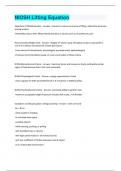
NIOSH Lifting Equation Questions with 100 % correct answers
Objectives of NIOSH Equation - Answer--Prevent or reduce occurrence of lifting-related low back pain among workers -Potentially reduce other lifting-related disorders or injuries such as shoulder/arm pain Recommended Weight Limit - Answer--Weight for which nearly all healthy workers could perform over 8 hrs without increased risk of back pain/injury -Uses criteria of biomechanics, physiological, psychophysical, epidemiological -Produces recommendation based on most conservative of these criteria NIOSH Biomechanical Criteria - Answer--Examines forces and torques on body, particularly lumbar region of back because that is the most vulnerable NIOSH Physiological Criteria - Answer--energy requirements of task -mean capacity for 50th percentile female is 9.5 kcal/min or 4000 kcal/day NIOSH Psychophysical Criteria - Answer--perceived ability to perform task -maximum acceptable weight maximum includes 99% males, 75% females Exceptions to Lifting Equation: Lifting/Lowering - Answer--with one hand -for > 8 hrs -while seated or kneeling -in restricted work space -unstable objects -while carrying, pushing, or pulling -with wheelbarrows or shovels -with high speed motion (> 30 inches/second) -with low coefficient of friction between hand & object -in an unfavorable environmentLoad Constant (LC) - Answer-maximum weight that could be lifted under ideal circumstances (symmetric lifting, occasional lifts, <25 cm vertical distance) Horizontal Multiplier (HM) - Answer-disc compression increases as horizontal spine-load distance increases Vertical Multiplier (VM) - Answer-lifting from floor is more stressful than lifting from greater heights Distance Multiplier (DM) - Answer-physical stress increases as vertical distance of lifting increases RWL = ? - Answer-LC x HM x VM x DM x AM x FM x CM Asymmetric Multiplier (AM) - Answer-torso twisting is more harmful than a straight back Coupling Multiplier (CM) - Answer-lifting is easier when coupling is good (ex: handles) Frequency Multiplier (FM) - Answer-more frequently lifted loads are more stressful than low frequency lifting Lifting Index - Answer--provides risk estimate of the lifting task -risk associated with various index values is not fully understood Lifting Index (LI) equation - Answer-=(Weight Lifted) / RWL If LI > 1... - Answer-lifting task poses an increased risk for some workers
Written for
- Institution
- NIOSH Lifting Equation
- Course
- NIOSH Lifting Equation
Document information
- Uploaded on
- January 22, 2024
- Number of pages
- 2
- Written in
- 2023/2024
- Type
- Exam (elaborations)
- Contains
- Questions & answers
Subjects

Also available in package deal