Unit 32: P1, P2, M1
Ossification
What are the types of ossification? What is ossification?
There are two types of ossification; Ossification is commonly known as the
these are known as intramembranous, process of remodelling bone by laying
endochondral ossification. down new bone material, this is done by
cells called osteoblasts. It is synonymous
with bone tissue formation.
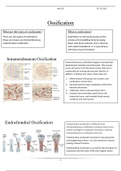
Intramembranous ossification happens during foetal
development typically around 8 weeks. This process
occurs primarily in the flat bones of the skull and is
responsible for forming the jaw and clavicles. In
addition, it follows four steps, these steps are:
1. Mesenchymal cells group into clusters, and
ossification centres form.
2. Secreted osteoid traps osteoblasts, which then
become osteocytes.
3. Trabecular matrix and periosteum form.
4. Compact bone develops superficial to the
trabecular bone, and crowded blood vessels
condense into red marrow.
Endochondral Ossification Endochondral ossification is different from
intramembranous ossification primarily since it uses
hyaline cartilage for long bone formation, whereas
intramembranous ossification does not.
Endochondral ossification involved in natural growth
and lengthening of bone. It is also involved in natural
healing of bone fractures.
Endochondral ossification is crucial for the formation of
long bones and the ends of flat and irregular bones.
1
Ossification
What are the types of ossification? What is ossification?
There are two types of ossification; Ossification is commonly known as the
these are known as intramembranous, process of remodelling bone by laying
endochondral ossification. down new bone material, this is done by
cells called osteoblasts. It is synonymous
with bone tissue formation.
Intramembranous ossification happens during foetal
development typically around 8 weeks. This process
occurs primarily in the flat bones of the skull and is
responsible for forming the jaw and clavicles. In
addition, it follows four steps, these steps are:
1. Mesenchymal cells group into clusters, and
ossification centres form.
2. Secreted osteoid traps osteoblasts, which then
become osteocytes.
3. Trabecular matrix and periosteum form.
4. Compact bone develops superficial to the
trabecular bone, and crowded blood vessels
condense into red marrow.
Endochondral Ossification Endochondral ossification is different from
intramembranous ossification primarily since it uses
hyaline cartilage for long bone formation, whereas
intramembranous ossification does not.
Endochondral ossification involved in natural growth
and lengthening of bone. It is also involved in natural
healing of bone fractures.
Endochondral ossification is crucial for the formation of
long bones and the ends of flat and irregular bones.
1