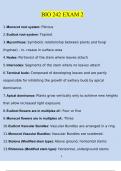
1 / BIO 242 EXAM 2
1.Monocot root system: Fibrous
2.Eudicot root system: Taproot
3.Mycorrhizae: Symbiotic relationship between plants and fungi (hyphae) - in- crease in surface area
4.Nodes: Portion(s) of the stem where leaves attach
5.Internodes: Segments of the stem where no leaves attach
6.Terminal buds: Composed of developing leaves and are partly responsible for inhibiting the growth of axillary buds by apical dominance.
7.Apical dominance: Plants grow vertically only to achieve new heights that allow increased light exposure.
8.Eudicot flowers are in multiples of:: Four or five
9.Monocot flowers are in multiples of:: Three
10.Eudicot Vascular Bundles: Vascular Bundles are arranged in a ring
11.Monocot Vascular Bundles: Vascular Bundles are scattered.
12.Stolons (Modified stem type): Above ground, horizontal stems
13.Rhizomes (Modified stem type): Horizontal, underground stems .Tubers (Modified stem type): End tips of the rhizomes
15.Leaves (Modified stem type): Photosynthetic organ of plants. Eudicot version has a flattened blade and a petiole. Monocot version does not have a petiole.
16.Tendrils (Leaf modification): Attachment to a leaf
17.Spines (Leaf modification): Defense against herbivores on the leaves of
plants
18.Bulbs: Leaf bases that can form a flower
19.Parenchyma: Least specialized plant cell; Primary wall are thin and flexible; Lack secondary walls; Living when functional; Performs most of the plant's metabolic function; Responsible for the repair and replace of plant organs;
20.Collenchyma: Thicker primary walls but are unevenly thickened; No
secondary walls; Grouped into strands or cylinders and help support the
young part of the plant shoot; Living when functioning;
21.Sclerenchyma: Thick secondary wall strengthened by lignin; Dead at
functional maturity; Compose the vessel elements and tracheids;
22.Dermal Tissue (Epidermis): Single layer of tightly packed parenchyma
cells that cover and protect the plant; Secrete a waxy coating - the 3 / cuticle; Produced by the protoderm;
23.Vascular Tissue: Transportation of materials between roots and shoots; Pro- duced by the procambium;
24.Ground Tissue: Divided into pith and cortex; Parenchyma cells; Involved in photosynthesis, storage and support; Produced by the ground meristem;
25.Xylem: Conveys water and dissolved minerals upward from the roots into the shoots; Utilizes tracheids and vessel elements to accomplish this;
1.Monocot root system: Fibrous
2.Eudicot root system: Taproot
3.Mycorrhizae: Symbiotic relationship between plants and fungi (hyphae) - in- crease in surface area
4.Nodes: Portion(s) of the stem where leaves attach
5.Internodes: Segments of the stem where no leaves attach
6.Terminal buds: Composed of developing leaves and are partly responsible for inhibiting the growth of axillary buds by apical dominance.
7.Apical dominance: Plants grow vertically only to achieve new heights that allow increased light exposure.
8.Eudicot flowers are in multiples of:: Four or five
9.Monocot flowers are in multiples of:: Three
10.Eudicot Vascular Bundles: Vascular Bundles are arranged in a ring
11.Monocot Vascular Bundles: Vascular Bundles are scattered.
12.Stolons (Modified stem type): Above ground, horizontal stems
13.Rhizomes (Modified stem type): Horizontal, underground stems .Tubers (Modified stem type): End tips of the rhizomes
15.Leaves (Modified stem type): Photosynthetic organ of plants. Eudicot version has a flattened blade and a petiole. Monocot version does not have a petiole.
16.Tendrils (Leaf modification): Attachment to a leaf
17.Spines (Leaf modification): Defense against herbivores on the leaves of
plants
18.Bulbs: Leaf bases that can form a flower
19.Parenchyma: Least specialized plant cell; Primary wall are thin and flexible; Lack secondary walls; Living when functional; Performs most of the plant's metabolic function; Responsible for the repair and replace of plant organs;
20.Collenchyma: Thicker primary walls but are unevenly thickened; No
secondary walls; Grouped into strands or cylinders and help support the
young part of the plant shoot; Living when functioning;
21.Sclerenchyma: Thick secondary wall strengthened by lignin; Dead at
functional maturity; Compose the vessel elements and tracheids;
22.Dermal Tissue (Epidermis): Single layer of tightly packed parenchyma
cells that cover and protect the plant; Secrete a waxy coating - the 3 / cuticle; Produced by the protoderm;
23.Vascular Tissue: Transportation of materials between roots and shoots; Pro- duced by the procambium;
24.Ground Tissue: Divided into pith and cortex; Parenchyma cells; Involved in photosynthesis, storage and support; Produced by the ground meristem;
25.Xylem: Conveys water and dissolved minerals upward from the roots into the shoots; Utilizes tracheids and vessel elements to accomplish this;