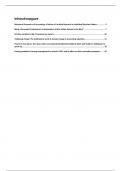
Inhoudsopgave
Behavioral Economics of Accounting: A Review of Archival Research on Individual Decision Makers...............2
Being a Successful Professional: An Exploration of Who Makes Partner in the Big 4*......................................7
Practice variation in Big-4 transparency reports............................................................................................ 10
Twittering change: The institutional work of domain change in accounting expertise....................................14
Friends in low places: how peer advice and expected leadership feedback affect staff auditors’ willingness to
speak up...................................................................................................................................................... 18
Passing probation: Earnings management by interim CEO’s and its effect on their promotion prospects........22
,Behavioral Economics of Accounting: A Review of
Archival Research on Individual Decision Makers
1. Introduction
It is commonly assumed that all decision makers are Homo economicus (i.e., an economic being) who
will make the same choice for a given situation by optimizing, and that formal institutions (e.g., rules,
laws, constitutions) govern the interactions between decision makers. We focus on a growing body of
positive accounting research that builds on behavioral economics. Following Thaler (2016), we use
the term “behavioral economics” to broadly refer to evidence-based economics that views individual
decision makers as Homo sapiens (i.e., a human being) in a real economy rather than Homo
economicus in an abstract economy. This view of individual decision makers extends traditional
positive accounting theory in two ways.
First, it recognizes that individual behavior depends not only on economic incentives and
accessible information, but also on individual preferences, abilities, experiences, and other
characteristics.
Second, it expands the constraints that structure human interactions to include informal
institutions.
There are four key elements that constitute the foundation for this recent archival research on
individual behavior in accounting:
(i) a behavioral theory of rational choice (Simon 1955; Tversky and Kahneman 1974;
Kahneman and Tversky 1979; Thaler 2000);
(ii) an upper echelons perspective of organizations (Hambrick and Mason 1984);
(iii) the individual fixed effects methodology (Bertrand and Schoar 2003); and
(iv) data on observable individual characteristics.
The availability of individual-level data allows us to develop refutable hypotheses and advance our
understanding of what people do (i.e., actual behavior) rather than what people should do.
Our review covers various players that shape the financial and information flows in the economy.
Panel A of Figure 1 presents the classical framework. We aim to understand the systematic effects of
individual characteristics on a wide spectrum of accounting phenomena including financial reporting,
disclosure, tax planning, auditing, and corporate social responsibility (CSR). We discuss research not
only on how personal characteristics (e.g., gender, race/ethnicity, appearance, experiences) shape an
individual’s behavior, but also on how these characteristics affect others’ perceptions of the
individual’s outputs.
To explain and predict individual behavior in accounting settings,
we need to rely on theories developed not only in economics and
finance, but also in psychology, biology, neuroscience,
organizational behavior, management science, strategy, linguistics,
and sociology.
A central takeaway from our review is that individual-level factors
significantly improve our ability to explain and predict accounting
phenomena beyond firm-, industry-, and market-level factors.
2. Conceptual framework
2.1. A historical perspective on the ‘managers matter’ view
Managers are interchangeable inputs into the production and
reporting functions, similar to machines and raw materials.7 Thus,
corporate decisions depend on an activity’s marginal benefits and
, marginal costs at the firm level, and similar firms will make the same choices regardless of their top
management teams (TMTs).
In contrast, positive accounting theory argues that managers have discretion inside their firms and
that they use this discretion to maximize their own utility. Managers are viewed as Homo sapiens
(i.e., a human being) whose characteristics determine their perception of a given situation and the
ultimate strategic choice. This “managers matter” view of corporate decisions is the focus of our
review.
2.2. Behavioral theory of rational choice
Individuals are assumed to maximize their expected utility. Behavioral research replaces Homo
economicus with Homo sapiens and tries to improve our ability to predict actual choices by
incorporating insights from other disciplines into the study of economic decisions. The goal of
behavioral research is to identify important patterns that can explain a range of behaviors.
We note three deviations from standard assumptions.
- First, people have cognitive limitations and, as a result, may engage in imperfect utility
maximization.
- Second, people tend to overweight their personal experiences because these events are easy
to remember.
- Third, people may exhibit nonstandard preferences.
2.3. Institutions
Institutions are constraints that structure human interactions. Institutions can be either formal (e.g.,
rules, laws, constitutions) or informal (e.g., norms, conventions, rituals). Traditional reseach in
accounting focuses on formal institutions. Our review focuses more on informal institutions, including
customs, traditions, norms, and religion, that are embedded in a society. Informal institutions change
very slowly—over the course of centuries or even millennia. Thus, they are taken as given when con-
sidering formal institutions.
Furthermore, the different kinds of social embeddedness—cognitive, cultural, structural, and political
—imply that it is inappropriate to extrapolate the performance effects of formal institutions from one
economy to another.
2.4. An application to CSR
First, the beliefs and preferences of various individuals can influence firm decisions due to the
interconnected nature of the economy. Second, disentangling whose preferences influence firm
decisions is important and can lead to different conclusions from both a governance and an effi-
ciency standpoint.
3. Managers and directors
-
4. Regulators and intermediaries
This section extends our discussion to other players in the capital markets, including audit partners
(section 4.1), analysts (section 4.2), regulators (section 4.3), and other intermediaries (section 4.4).
We use the schema developed for managers (see Figure 2) to organize our discussion of these
different players.
4.1. Audit partners
At this time, research on audit partners in the United States is in its early stage and existing evidence
is primarily based on audit partners in non-US jurisdictions where partner names have been disclosed
Behavioral Economics of Accounting: A Review of Archival Research on Individual Decision Makers...............2
Being a Successful Professional: An Exploration of Who Makes Partner in the Big 4*......................................7
Practice variation in Big-4 transparency reports............................................................................................ 10
Twittering change: The institutional work of domain change in accounting expertise....................................14
Friends in low places: how peer advice and expected leadership feedback affect staff auditors’ willingness to
speak up...................................................................................................................................................... 18
Passing probation: Earnings management by interim CEO’s and its effect on their promotion prospects........22
,Behavioral Economics of Accounting: A Review of
Archival Research on Individual Decision Makers
1. Introduction
It is commonly assumed that all decision makers are Homo economicus (i.e., an economic being) who
will make the same choice for a given situation by optimizing, and that formal institutions (e.g., rules,
laws, constitutions) govern the interactions between decision makers. We focus on a growing body of
positive accounting research that builds on behavioral economics. Following Thaler (2016), we use
the term “behavioral economics” to broadly refer to evidence-based economics that views individual
decision makers as Homo sapiens (i.e., a human being) in a real economy rather than Homo
economicus in an abstract economy. This view of individual decision makers extends traditional
positive accounting theory in two ways.
First, it recognizes that individual behavior depends not only on economic incentives and
accessible information, but also on individual preferences, abilities, experiences, and other
characteristics.
Second, it expands the constraints that structure human interactions to include informal
institutions.
There are four key elements that constitute the foundation for this recent archival research on
individual behavior in accounting:
(i) a behavioral theory of rational choice (Simon 1955; Tversky and Kahneman 1974;
Kahneman and Tversky 1979; Thaler 2000);
(ii) an upper echelons perspective of organizations (Hambrick and Mason 1984);
(iii) the individual fixed effects methodology (Bertrand and Schoar 2003); and
(iv) data on observable individual characteristics.
The availability of individual-level data allows us to develop refutable hypotheses and advance our
understanding of what people do (i.e., actual behavior) rather than what people should do.
Our review covers various players that shape the financial and information flows in the economy.
Panel A of Figure 1 presents the classical framework. We aim to understand the systematic effects of
individual characteristics on a wide spectrum of accounting phenomena including financial reporting,
disclosure, tax planning, auditing, and corporate social responsibility (CSR). We discuss research not
only on how personal characteristics (e.g., gender, race/ethnicity, appearance, experiences) shape an
individual’s behavior, but also on how these characteristics affect others’ perceptions of the
individual’s outputs.
To explain and predict individual behavior in accounting settings,
we need to rely on theories developed not only in economics and
finance, but also in psychology, biology, neuroscience,
organizational behavior, management science, strategy, linguistics,
and sociology.
A central takeaway from our review is that individual-level factors
significantly improve our ability to explain and predict accounting
phenomena beyond firm-, industry-, and market-level factors.
2. Conceptual framework
2.1. A historical perspective on the ‘managers matter’ view
Managers are interchangeable inputs into the production and
reporting functions, similar to machines and raw materials.7 Thus,
corporate decisions depend on an activity’s marginal benefits and
, marginal costs at the firm level, and similar firms will make the same choices regardless of their top
management teams (TMTs).
In contrast, positive accounting theory argues that managers have discretion inside their firms and
that they use this discretion to maximize their own utility. Managers are viewed as Homo sapiens
(i.e., a human being) whose characteristics determine their perception of a given situation and the
ultimate strategic choice. This “managers matter” view of corporate decisions is the focus of our
review.
2.2. Behavioral theory of rational choice
Individuals are assumed to maximize their expected utility. Behavioral research replaces Homo
economicus with Homo sapiens and tries to improve our ability to predict actual choices by
incorporating insights from other disciplines into the study of economic decisions. The goal of
behavioral research is to identify important patterns that can explain a range of behaviors.
We note three deviations from standard assumptions.
- First, people have cognitive limitations and, as a result, may engage in imperfect utility
maximization.
- Second, people tend to overweight their personal experiences because these events are easy
to remember.
- Third, people may exhibit nonstandard preferences.
2.3. Institutions
Institutions are constraints that structure human interactions. Institutions can be either formal (e.g.,
rules, laws, constitutions) or informal (e.g., norms, conventions, rituals). Traditional reseach in
accounting focuses on formal institutions. Our review focuses more on informal institutions, including
customs, traditions, norms, and religion, that are embedded in a society. Informal institutions change
very slowly—over the course of centuries or even millennia. Thus, they are taken as given when con-
sidering formal institutions.
Furthermore, the different kinds of social embeddedness—cognitive, cultural, structural, and political
—imply that it is inappropriate to extrapolate the performance effects of formal institutions from one
economy to another.
2.4. An application to CSR
First, the beliefs and preferences of various individuals can influence firm decisions due to the
interconnected nature of the economy. Second, disentangling whose preferences influence firm
decisions is important and can lead to different conclusions from both a governance and an effi-
ciency standpoint.
3. Managers and directors
-
4. Regulators and intermediaries
This section extends our discussion to other players in the capital markets, including audit partners
(section 4.1), analysts (section 4.2), regulators (section 4.3), and other intermediaries (section 4.4).
We use the schema developed for managers (see Figure 2) to organize our discussion of these
different players.
4.1. Audit partners
At this time, research on audit partners in the United States is in its early stage and existing evidence
is primarily based on audit partners in non-US jurisdictions where partner names have been disclosed