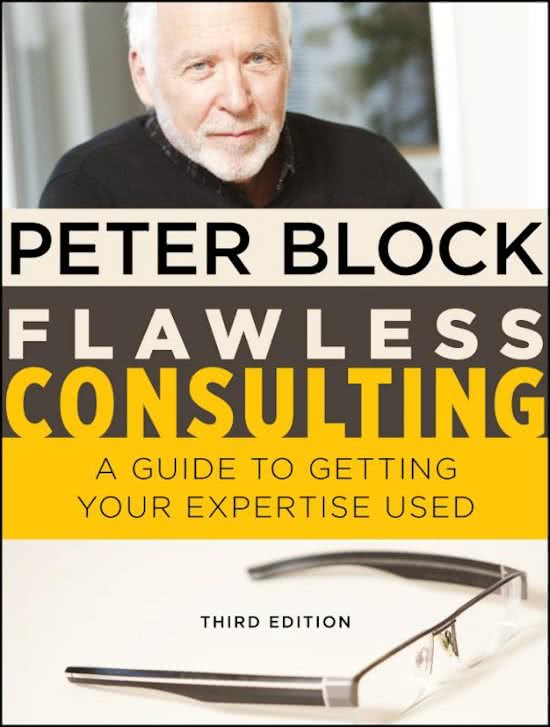
Peter Block (2015):
“Flawless consulting: A guide to getting your expertise used” 3rd Edition summary
Chapters 1-17
Ch. 1 - A consultant by any other name …
Definitions and distinctions
Prevailing skepticism about consultants is that the traditional consultant has tended to act solely as
an agent of management. The difference is that managers have direct control and responsibility over
the action, while consultants have some influence control over an individual/ group/ organization but
lack authority and have no direct power to make changes or implement programs.
People in staff or support roles in organizations are really consultants even if it’s not in their job title.
Support people function in any organization by planning, recommending, assisting, or advising in
matters like HR, system analysis, market research etc.
The recipients of all this advice are called clients; they can be an individual, a group, a department or
a whole organization. The client is who the consultant wants to infuence.
In organizations, clients for the services provided by support people are called line managers they
have to labor under the advice of support groups, but by definition, any support function has no
direct authority over anything but its own time, its own internal staff, and the nature of the service it
offers. This tension is a central piece.
The goal or end product in any consulting activity is some kind of change and it comes in two
varieties:
a) create change in the line organization of a structural, policy, or procedural nature
ex: a new compensation package, a new reporting process
b) change resulting in one person/ many people in the line organization learning something new
ex: how to involve people more directly in setting goals, or how to conduct better performance
evaluations.
In its most general use, consultation describes any action you take with a system of which you are
not a part. The consultant’s objective is to engage in successful actions that result in people or
organizations managing themselves differently.
For each of these moments of consultation, there are three kinds of skills you need to do a good job:
1. Technical skills: expertise about the question. In college/ our first job, we were trained in a specific
field (engineering, sales, accounting etc.). This is our basic training. Only after acquiring some
technical expertise can we start consulting.
2. Interpersonal skills: put ideas into words, to listen, to give support, to disagree reasonably, to
basically maintain a relationship
3. Consulting skills: each consulting project goes through five stages, all of them sequential. Skillful
consulting is being competent in the execution of each of these steps.
,The five phases of consulting
Phase 1: Entry and Contracting
- initial contact with a client about the project
- are you the right consultant, what is your role?
- includes setting up the first meeting, exploring the problem, the client’s expectations, the
consultant’s expectations and how to get started
Phase 2: Discovery and Dialogue
- consultants need to come up with their own sense of the problem and the strengths the client has;
they should help the client do the same
- questions here include who is going to be involved in defining the problem, what methods will be
used, what kind of data should be collected, how long will it take etc.
Phase 3: Analysis and the Decision to Act
- inquiry and dialogue must be organized and reported; in giving feedback, there is always some
resistance to data & the consultant must handle it before an appropriate decision can be made about
how to proceed
- setting ultimate goals for the project and selecting the best action steps or changes; this stage is
also called “planning”
Phase 4: Engagement and Implementation
- carrying out the planning of stage 3
- when you finally do something with enough impact to be noticeable to many people in the
organization, and they have the expectation that change, or learning, will occur because of that
event
- some projects start implementation with an educational event could be a series of meetings to
introduce some change, a single meeting to get different parts of the organization together to
address a problem, or a training session.
Phase 5: Extension, Recycle, or Termination
- learning from the engagement; making the decision whether to extend the process to a larger
segment of the organization
- sometimes it is not until after implementation that the real problem emerges; in this case, the
process recycles and a new contract needs to be discussed
- if the implementation was either a huge success or a moderate-to-high failure, termination of
further involvement on this project may be in the offing
, The promise of flawless consultation
As a support person or consultant, you are working with a line manager in a context in which there is
no clear boss-subordinate relationship between you. The power balance in lateral relationships is
always open to ambiguity— and to negotiation.
Flawless consultation (consulting without error) concentrates on the preliminary events because
competence in contracting, discovery, and feedback creates the foundation for successful outcomes
in the implementation stage.
Each act that expresses trust in ourselves and belief in the validity of our own experience is always
the right path to follow. Flawless consulting offers the possibility of letting our behavior be consistent
with our beliefs and feelings and also to be successful in working with our clients.
“Flawless consulting: A guide to getting your expertise used” 3rd Edition summary
Chapters 1-17
Ch. 1 - A consultant by any other name …
Definitions and distinctions
Prevailing skepticism about consultants is that the traditional consultant has tended to act solely as
an agent of management. The difference is that managers have direct control and responsibility over
the action, while consultants have some influence control over an individual/ group/ organization but
lack authority and have no direct power to make changes or implement programs.
People in staff or support roles in organizations are really consultants even if it’s not in their job title.
Support people function in any organization by planning, recommending, assisting, or advising in
matters like HR, system analysis, market research etc.
The recipients of all this advice are called clients; they can be an individual, a group, a department or
a whole organization. The client is who the consultant wants to infuence.
In organizations, clients for the services provided by support people are called line managers they
have to labor under the advice of support groups, but by definition, any support function has no
direct authority over anything but its own time, its own internal staff, and the nature of the service it
offers. This tension is a central piece.
The goal or end product in any consulting activity is some kind of change and it comes in two
varieties:
a) create change in the line organization of a structural, policy, or procedural nature
ex: a new compensation package, a new reporting process
b) change resulting in one person/ many people in the line organization learning something new
ex: how to involve people more directly in setting goals, or how to conduct better performance
evaluations.
In its most general use, consultation describes any action you take with a system of which you are
not a part. The consultant’s objective is to engage in successful actions that result in people or
organizations managing themselves differently.
For each of these moments of consultation, there are three kinds of skills you need to do a good job:
1. Technical skills: expertise about the question. In college/ our first job, we were trained in a specific
field (engineering, sales, accounting etc.). This is our basic training. Only after acquiring some
technical expertise can we start consulting.
2. Interpersonal skills: put ideas into words, to listen, to give support, to disagree reasonably, to
basically maintain a relationship
3. Consulting skills: each consulting project goes through five stages, all of them sequential. Skillful
consulting is being competent in the execution of each of these steps.
,The five phases of consulting
Phase 1: Entry and Contracting
- initial contact with a client about the project
- are you the right consultant, what is your role?
- includes setting up the first meeting, exploring the problem, the client’s expectations, the
consultant’s expectations and how to get started
Phase 2: Discovery and Dialogue
- consultants need to come up with their own sense of the problem and the strengths the client has;
they should help the client do the same
- questions here include who is going to be involved in defining the problem, what methods will be
used, what kind of data should be collected, how long will it take etc.
Phase 3: Analysis and the Decision to Act
- inquiry and dialogue must be organized and reported; in giving feedback, there is always some
resistance to data & the consultant must handle it before an appropriate decision can be made about
how to proceed
- setting ultimate goals for the project and selecting the best action steps or changes; this stage is
also called “planning”
Phase 4: Engagement and Implementation
- carrying out the planning of stage 3
- when you finally do something with enough impact to be noticeable to many people in the
organization, and they have the expectation that change, or learning, will occur because of that
event
- some projects start implementation with an educational event could be a series of meetings to
introduce some change, a single meeting to get different parts of the organization together to
address a problem, or a training session.
Phase 5: Extension, Recycle, or Termination
- learning from the engagement; making the decision whether to extend the process to a larger
segment of the organization
- sometimes it is not until after implementation that the real problem emerges; in this case, the
process recycles and a new contract needs to be discussed
- if the implementation was either a huge success or a moderate-to-high failure, termination of
further involvement on this project may be in the offing
, The promise of flawless consultation
As a support person or consultant, you are working with a line manager in a context in which there is
no clear boss-subordinate relationship between you. The power balance in lateral relationships is
always open to ambiguity— and to negotiation.
Flawless consultation (consulting without error) concentrates on the preliminary events because
competence in contracting, discovery, and feedback creates the foundation for successful outcomes
in the implementation stage.
Each act that expresses trust in ourselves and belief in the validity of our own experience is always
the right path to follow. Flawless consulting offers the possibility of letting our behavior be consistent
with our beliefs and feelings and also to be successful in working with our clients.