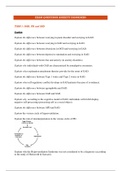
EXAM QUESTIONS ANXIETY DISORDERS
TASK 1: GAD, PD and SAD
Explain
Explain the difference between worrying in panic disorder and worrying in GAD.
Explain the difference between worrying in SAD and worrying in GAD.
Explain the difference between obsessions in OCD and worrying in GAD.
Explain the difference between depressive rumination and worrying in GAD.
Explain the difference between fear and anxiety (in anxiety disorders).
Explain why individuals with GAD are characterized by nonadaptive awareness.
Explain what explanation attachment theories provide for the onset of GAD.
Explain the difference between Type 1 worry and Type 2 worry in GAD.
Explain what self-regulatory conflict develops in GAD patients (because of avoidance).
Explain the difference between agoraphobia and SAD.
Explain the difference between GAD and SAD.
Explain why, according to the cognitive model of SAD, individuals with GAD display
negative self-processing (processing self as a social object).
Explain the difference between APD and SAD.
Explain the vicious circle of hyperventilation.
Explain the role of misinterpretation in the vicious circle of PD.
Explain why the Hyperventilation Syndrome was not considered to be a diagnoses (according
to the study of Hornsveld & Garssen).
, True or false
True or false: worrying can be divided in two subgroups, namely normal and pathological.
True or false: GAD is not characterized by motoric avoidance. Therefore, exposure
techniques, as used in other anxiety disorders, are not applicable to patients with GAD.
True or false: individuals with GAD show no behavioral avoidance like avoiding discussion
of certain subjects with others.
True or false: GAD patients show no sympathetic hyperactivity, except for muscle tension.
True or false: people with GAD try to supress Type I worry as a coping strategy.
True or false: GAD is characterized by both specific Type I worry and a high negative
metacognition, whereas PD is characterized by only specific Type I worry.
True or false: positive beliefs about worrying (causing the usage of Type I worry) are
common and not necessarily pathological.
True or false: fainting is a common characteristic of anxiety-caused hyperventilation.
True or false: the most effective treatment of PD is cognitive behavioral therapy (CBT).
True or false: there is a causal relationship between childhood abuse and SAD.
True or false: the prevalence of SAD is higher in individuals who live in rural areas than in
those who live in urban areas.
True or fase: interpretation in PD does not influence the degree of hyperventilation.
Complete
Complete the model:
TASK 1: GAD, PD and SAD
Explain
Explain the difference between worrying in panic disorder and worrying in GAD.
Explain the difference between worrying in SAD and worrying in GAD.
Explain the difference between obsessions in OCD and worrying in GAD.
Explain the difference between depressive rumination and worrying in GAD.
Explain the difference between fear and anxiety (in anxiety disorders).
Explain why individuals with GAD are characterized by nonadaptive awareness.
Explain what explanation attachment theories provide for the onset of GAD.
Explain the difference between Type 1 worry and Type 2 worry in GAD.
Explain what self-regulatory conflict develops in GAD patients (because of avoidance).
Explain the difference between agoraphobia and SAD.
Explain the difference between GAD and SAD.
Explain why, according to the cognitive model of SAD, individuals with GAD display
negative self-processing (processing self as a social object).
Explain the difference between APD and SAD.
Explain the vicious circle of hyperventilation.
Explain the role of misinterpretation in the vicious circle of PD.
Explain why the Hyperventilation Syndrome was not considered to be a diagnoses (according
to the study of Hornsveld & Garssen).
, True or false
True or false: worrying can be divided in two subgroups, namely normal and pathological.
True or false: GAD is not characterized by motoric avoidance. Therefore, exposure
techniques, as used in other anxiety disorders, are not applicable to patients with GAD.
True or false: individuals with GAD show no behavioral avoidance like avoiding discussion
of certain subjects with others.
True or false: GAD patients show no sympathetic hyperactivity, except for muscle tension.
True or false: people with GAD try to supress Type I worry as a coping strategy.
True or false: GAD is characterized by both specific Type I worry and a high negative
metacognition, whereas PD is characterized by only specific Type I worry.
True or false: positive beliefs about worrying (causing the usage of Type I worry) are
common and not necessarily pathological.
True or false: fainting is a common characteristic of anxiety-caused hyperventilation.
True or false: the most effective treatment of PD is cognitive behavioral therapy (CBT).
True or false: there is a causal relationship between childhood abuse and SAD.
True or false: the prevalence of SAD is higher in individuals who live in rural areas than in
those who live in urban areas.
True or fase: interpretation in PD does not influence the degree of hyperventilation.
Complete
Complete the model: