ARMRIT-Practice Test (part 1: Mri Physics and Ins.) with Complete Solutions.
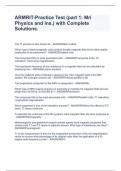
The T1 process is also known as: - ANSWERSpin Lattice Which type of electromagnetic coils produce smaller magnetic field which allow spatial localization to be performed? - ANSWERGradient coils The component Mxy is most associated with: - ANSWERTransverse to Bo; T2 relaxation; Transverse magnetization The resonance frequency of any substance in a magnetic field can be calculated by employing the: - ANSWERLarmor equation Once the patient's area of interest is placed in the main magnetic field of the MRI system, the hydrogen protons will: - ANSWERPrecess parallel to Bo The longitudinal component of the NMV is designated: - ANSWERMz Which type of MRI magnet requires no electricity to maintain it's magnetic field and can weigh from 18,000 lb. to 200,000 lb.? - ANSWERPermanent The component Mz is the most associated with: - ANSWERParallel to Bo; T1 relaxation; Longitudinal magnetization Which statement is true of the relaxation process? - ANSWERWithout the effects of T2* (star), T2 decay continues To describe the uniformity of the Mri systems main magnetic field, the term employed is: - ANSWERHomogeneity Methemoglobin and gadolinium based contrast agents have magnetic properties that shorten both T1 and T2 values in adjacent tissues. What type of substances are they? - ANSWERParamagnetic T1 is the measurement of time for the longitudinal component of the net magnetization vector to recover what percentage of its original value after the application of a 90 degree radio-frequency pulse? - ANSWER63%
Written for
- Institution
- ARMRIT-
- Course
- ARMRIT-
Document information
- Uploaded on
- January 21, 2024
- Number of pages
- 3
- Written in
- 2023/2024
- Type
- Exam (elaborations)
- Contains
- Questions & answers
Subjects
-
armrit practice test part 1 mri physics and ins
-
armrit practice test stuvia

Also available in package deal