ARMRIT PHYSICS PRACTICE TEST WITH COMPLETE SOLUTIONS.
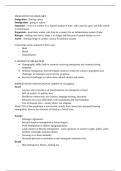
The tissue characteristic that depends heavily on the relative content of fat molecules and free water is: - ANSWER-Hydrogen concentration. T1 is the measurement of time for the longitudinal component of the net magnetization vector to recover what percentage of its original value after the application of a 90 degree radio-frequency pulse? - ANSWER-63% Immediately after an initial 90 degree radio-frequency pulse is turned off, the hydrogen protons will begin to: - ANSWER-Dephase A 90 degree radio-frequency pulse will alter the net magnetization vector. Another effect is: - ANSWER-The hydrogen protons will dephase The basic process of MR signal generation contains two basic steps, they are: - ANSWER-Stimulation and relaxation. An equation derived to predict the MR signal intensity of a particular tissue as the result of a Spin-echo pulse sequence is the: - ANSWER-Bloch equation The component Mxy is most associated with: - ANSWER-Transverse to B0; T2 relaxation; transverse magnetization After a 90 degree radio-frequency pulse, the net magnetization vector begins to return to equilibrium. When the NMV is half-way between transverse and equilibrium, what are the magnitudes of the longitudinal component and the transverse component? - ANSWER-Longitudinal component = greater than zero/transverse component = greater than zero. When is the net magnetization vector at its maximum magnitude? - ANSWER-At equilibrium. The Larmor frequency of hydrogen protons in a 1.5 Tesla magnetic field is: - ANSWER-63.9 MHz/Tesla. To describe the uniformity of the MRI system's main magnetic field, the term employed is: - ANS
Written for
- Institution
- ARMRIT PHYSICS
- Course
- ARMRIT PHYSICS
Document information
- Uploaded on
- January 21, 2024
- Number of pages
- 3
- Written in
- 2023/2024
- Type
- Exam (elaborations)
- Contains
- Questions & answers
Subjects
-
armrit physics practice test with comple
-
armrit physics practice test stuvia

Also available in package deal