

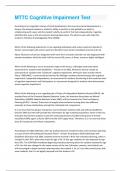
MTTC Cognitive Impairment Test Questions And Answers Rated A+ New Update Assured Satisfaction
According to Lev Vygotsky's theory of social development, the zone of proximal development is... - Answer the distance between a student's ability to perform a task guided by an adult or collaborating with a peer and the student's ability to perform that task independently. Vygotsky identified this zone as the area wherein learning takes place. The adult or peer who helps the student is the More Knowledgeable Other (MKO); Which of the following statements is true regarding individuals with autism spectrum disorders? - Answer some people with autism spectrum disorders have mental retardation and some do not About 50 percent of persons diagnosed with some form of autistic disorder are also diagnosed with mental retardation, while the other half has normal IQ scores; of these, many are highly intelligent. Which of the following is not an assessment type on MI-Access, a Michigan state alternative assessment for students with disabilities? - Answer As of 2005, MI-Access did not include an assessment for students with "profound" cognitive impairment. MI-Access does include Interim Phase 2 BRIGANCE, a commercial test tailored for Michigan students demonstrating mild cognitive impairment; Supported Independence, an assessment for students functioning at the moderate level of cognitive impairment; and Participation, an assessment designed for students who demonstrate severe cognitive impairment. Which of the following is true regarding the of Scales of Independent Behavior-Revised (SIB-R), the standard form of the Vineland Adaptive Behavior Scales, the American Association on Mental Retardation (AAMR) Adaptive Behavior Scales (ABS), and the Inventory for Client and Agency Planning (ICAP)? - Answer These tests all supply intercorrelations among their own different subscales to show relationships among their individual test components. It is not true that they all give comparison scores between students with and without disabilities. Only the SIB-R and the ICAP provide this information for age-matched populations. None of the four tests give discriminant analyses to aid with school placements and determining level of mental retardation (MR); again, only the SIB-R and the ICAP supply these. Therefore, it is not true that these tests all incorporate all of these components. According to the IDEA 2004 law, when do students become involved in their own transition planning as a part of their IEP (Individual Education Plan)? - Answer According to IDEA (Individuals with Disabilities Education Act) 2004, students become involved in their own transition planning, which is included in their IEPs, when they reach the age of 16. At this age, students are also expected to sign their IEPs. The 1994 IDEA mandated beginning transition planning when the student reached the age of 14, but this was changed in the newer version of the law. Educators, parents, and students are still encouraged to begin transition planning when the student is 14, as it can take several years with some students, but it is not legally required until the student is 16.# 1 Example of a 36 month old child showing language delay - Answer B. 36 month old child has an oral expression vocab of 20 words and does not combine words in her speech # 2 A third grade autistic student will most likely show difficulty with the following task - Answer A. working cooperatively with other students on class projects # 3 a leading prenatal cause of cognitive impairments is - Answer C. exposure to substance abuse # 4 teaching mild to moderate c.i. students to cross the street with these steps (stop, look, listen, walk) is successful if - Answer D. students practice as often as possible in the actual setting where they will use these steps # 5 in a standardized adaptive behavior assessment of a student with c.i., normative data should be used to provide which type of information - Answer A. a comparison of student's conceptual, social and practical abilities with those of students without cognitive impairments # 6 when interviewing parents of a student demonstrating difficulties in all academic areas and demonstrates inappropriate social behaviors which of the following questions would provide the most useful information to the teacher? A. when did you first notice student using language to communicate his needs B. what kind of toys does he play with C. does he follow a routine at home D. is he involved in community activities - Answer A. when did you first notice the student using language to communicate his needs # 7 a good assessment to provide AT to a student with cerebral palsy for eating assistance is - Answer B. an informal assessment at lunch to introduce student to various AT devices and observe which is easiest and most effective for student to use # 8 communicating test results to parents who have just moved to the U.S. and primary language not english - Answer A. present all information to parents in their native language using a professional education interpreter and translator
Document information
- Uploaded on
- January 19, 2024
- Number of pages
- 28
- Written in
- 2023/2024
- Type
- Exam (elaborations)
- Contains
- Questions & answers


