

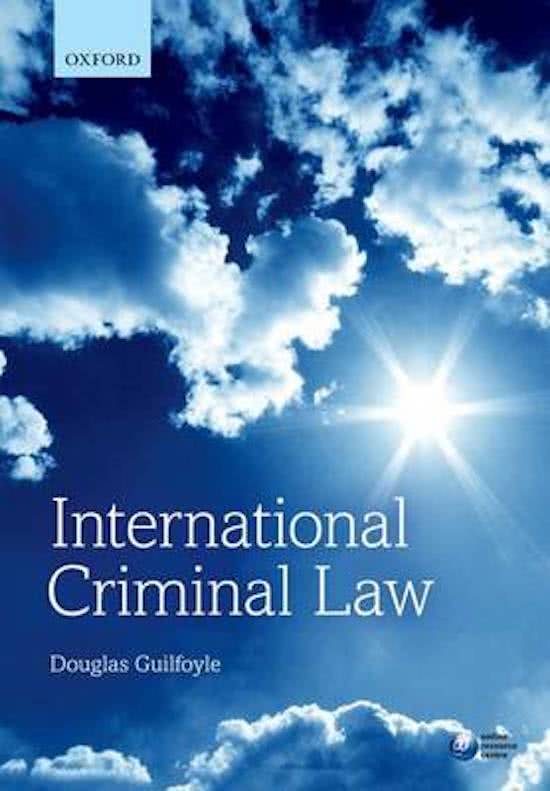
Notes on Guilfoyle’s ‘International Criminal Law’ (Introductory Chapter)
Article 38(1) of the Statute of the International Court of Justice: ‘The court, whose function is to
decide in accordance with international law such disputes as are submitted to it, shall apply a)
international conventions, whether general or particular, establishing rules expressly recognised by
the contesting states; b) international custom, as evidence of a general practice accepted as law
[better understood as the general practice of States as evidence of customary law]; c) the general
principle of law recognised by civilised nations; d) judicial decisions and the teachings of the most
highly qualified publicists of the various nations, as subsidiary means for the determination of rules
of law.’
Preliminary question as to WHY rules re binding on a subject of a legal system. Positivist
theory relates that a state is bound by international law to which it has consented, this
consent is sometimes presumed or at best theoretical but this is the dominant theory
applied by international courts and tribunals.
Article 38 is not a hierarchy of sources.
Subsidiary sources do not have the status of formal law but merely serve as evidence of
what the law is.
There is no hierarchy between courts or doctrine of precedent in international law. ICJ
decisions do not bind other international courts or tribunals and technically do not even
bind the ICJ itself. However other courts will often treat decisions as persuasive at least.
Treaty Law
Legally binding agreement between 2 or more subjects of international law in written form. Can be
used to create new rules relatively quickly and have the advantage of certainty. However it operates
INTER PARTES (binds only those party to it).
Customary International Law
Form of unwritten law which is binding on all States. These have to be deduced from what States do
or say. A rule of custom is evidenced by consistent State behaviour coupled with OPINIO JURIS (a
subjective belief held by States that this behaviour is required by law, and is not merely followed
for courtesy or convenience). It binds all States but faces difficulty of proof and lacks specificity.
General Principles
Used where treaty and customary law cannot answer the questions asked by international
court/tribunals. For criminal law, this may be used as a secondary argument for deducing the
elements of a crime and the elements or limits of a defence, where no other source of law can ‘fill
the gap’. However use of general principles is always subsidiary.
Eminent publicists and judicial decisions
Only subsidiary. United Nations International Law Commission has special role of codifying and
progressively developing international law through extensive research or specialised debate which
normally results in the adoption of a set of ‘Draft Articles’ which may be adopted into a treaty. These
drafts are made with extensive explanatory commentaries. The ILC is a body of 34 independent
international law experts elected for 5 yea terms by the UN General Assembly. Rare for international
courts to rely on eminent publicists but ILC still often referred to as persuasive evidence of the law.
Sometimes guidance documents from the International Committee of the Red Cross are considered
similarly to ILC documents, but many accuse the Red Cross of blurring the line between LEX LATA
Article 38(1) of the Statute of the International Court of Justice: ‘The court, whose function is to
decide in accordance with international law such disputes as are submitted to it, shall apply a)
international conventions, whether general or particular, establishing rules expressly recognised by
the contesting states; b) international custom, as evidence of a general practice accepted as law
[better understood as the general practice of States as evidence of customary law]; c) the general
principle of law recognised by civilised nations; d) judicial decisions and the teachings of the most
highly qualified publicists of the various nations, as subsidiary means for the determination of rules
of law.’
Preliminary question as to WHY rules re binding on a subject of a legal system. Positivist
theory relates that a state is bound by international law to which it has consented, this
consent is sometimes presumed or at best theoretical but this is the dominant theory
applied by international courts and tribunals.
Article 38 is not a hierarchy of sources.
Subsidiary sources do not have the status of formal law but merely serve as evidence of
what the law is.
There is no hierarchy between courts or doctrine of precedent in international law. ICJ
decisions do not bind other international courts or tribunals and technically do not even
bind the ICJ itself. However other courts will often treat decisions as persuasive at least.
Treaty Law
Legally binding agreement between 2 or more subjects of international law in written form. Can be
used to create new rules relatively quickly and have the advantage of certainty. However it operates
INTER PARTES (binds only those party to it).
Customary International Law
Form of unwritten law which is binding on all States. These have to be deduced from what States do
or say. A rule of custom is evidenced by consistent State behaviour coupled with OPINIO JURIS (a
subjective belief held by States that this behaviour is required by law, and is not merely followed
for courtesy or convenience). It binds all States but faces difficulty of proof and lacks specificity.
General Principles
Used where treaty and customary law cannot answer the questions asked by international
court/tribunals. For criminal law, this may be used as a secondary argument for deducing the
elements of a crime and the elements or limits of a defence, where no other source of law can ‘fill
the gap’. However use of general principles is always subsidiary.
Eminent publicists and judicial decisions
Only subsidiary. United Nations International Law Commission has special role of codifying and
progressively developing international law through extensive research or specialised debate which
normally results in the adoption of a set of ‘Draft Articles’ which may be adopted into a treaty. These
drafts are made with extensive explanatory commentaries. The ILC is a body of 34 independent
international law experts elected for 5 yea terms by the UN General Assembly. Rare for international
courts to rely on eminent publicists but ILC still often referred to as persuasive evidence of the law.
Sometimes guidance documents from the International Committee of the Red Cross are considered
similarly to ILC documents, but many accuse the Red Cross of blurring the line between LEX LATA

