

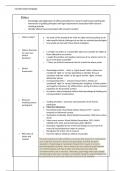
Cornell notes template
o Ethical o Research conduct
Ethics
challenges for o Participants / subjects (humans and animals)
- Knowledge and application
scientists/ of ethical
o Data collection, principles
handling andfor research with human participants
publication
- Awareness
psychologists of guiding principles and legal
o Conflicts of interest requirements associated with research
involving animalso Public relations
- Identify ethical issues associatedofwith
o Application research conduct
psychological knowledge – application of research
ethics to appropriate groups
o What is ethics? o the study of the standards for what are right and wrong things to do
o what specific ethical challenges do we face as scientists/psychologists
o how would we deal with these ethical challegnes
o What is the basis
o I consider my duties as a responsible agent and consider the rights of
for your own
those affected by my actions
ethical
o I weight the positive and negative outcomes of my actions and try to
decisions?
do as much good as possible
o ^^there are ethical frameworks that lie in both the above points
o Ethical
frameworks o Deontological ethics – ‘duty’ or ‘rights-based’ ethics. Actions are
considered ‘right’ or ‘wrong’ depending on whether they are
consistent with the ‘duties’ of the agent and the ‘rights’ of those
affected by actions
o Consequential ethics – ‘outcome based’ ethics. Actions are
considered ‘right’ or ‘wrong’ following the ‘weighing’ of their positive
and negative outcomes. Eg. Utilitarianism, aiming to achieve maximal
happiness for the greatest number
o In practice, ethical standards reflects both deontological thinking and
consequentialist considerations
o Research
involving human o Guiding principles : autonomy and protection of the human
participants participant
o Historical milestones:
o Nuremberg Code, Nuremberg military tribunal 1947 – special
emphasis on informed consent
o Declaration of Helsinki, World Medical Association 1963 (last revision
2013)
o Most recent version: World Medical Association, 2013, JAMA
310(20):2191-2194. doi:10.1001/jama.2013.281053
o Nowadays regulated by law of the land (things we must not do in
research) and professional codes of conduct
o Recognises the active role in research
o BPS codes of o Have the right to withdraw without any penalty
ethics and
conduct The main purpose of codes of ethics is to ensure that research is conducted in
such a way that no harm is done to any participant, and that the good
reputation of psychology is maintained. Researchers may be in a real or
perceived position of power, and so need to be very careful that participants
are treated properly and that all tasks and measures have been fully
considered before use in research. Ultimately, psychology relies upon people
volunteering to take part in studies, so the good reputation of psychology must
be maintained to ensure that volunteers continue to be available
o Ethical o Research conduct
Ethics
challenges for o Participants / subjects (humans and animals)
- Knowledge and application
scientists/ of ethical
o Data collection, principles
handling andfor research with human participants
publication
- Awareness
psychologists of guiding principles and legal
o Conflicts of interest requirements associated with research
involving animalso Public relations
- Identify ethical issues associatedofwith
o Application research conduct
psychological knowledge – application of research
ethics to appropriate groups
o What is ethics? o the study of the standards for what are right and wrong things to do
o what specific ethical challenges do we face as scientists/psychologists
o how would we deal with these ethical challegnes
o What is the basis
o I consider my duties as a responsible agent and consider the rights of
for your own
those affected by my actions
ethical
o I weight the positive and negative outcomes of my actions and try to
decisions?
do as much good as possible
o ^^there are ethical frameworks that lie in both the above points
o Ethical
frameworks o Deontological ethics – ‘duty’ or ‘rights-based’ ethics. Actions are
considered ‘right’ or ‘wrong’ depending on whether they are
consistent with the ‘duties’ of the agent and the ‘rights’ of those
affected by actions
o Consequential ethics – ‘outcome based’ ethics. Actions are
considered ‘right’ or ‘wrong’ following the ‘weighing’ of their positive
and negative outcomes. Eg. Utilitarianism, aiming to achieve maximal
happiness for the greatest number
o In practice, ethical standards reflects both deontological thinking and
consequentialist considerations
o Research
involving human o Guiding principles : autonomy and protection of the human
participants participant
o Historical milestones:
o Nuremberg Code, Nuremberg military tribunal 1947 – special
emphasis on informed consent
o Declaration of Helsinki, World Medical Association 1963 (last revision
2013)
o Most recent version: World Medical Association, 2013, JAMA
310(20):2191-2194. doi:10.1001/jama.2013.281053
o Nowadays regulated by law of the land (things we must not do in
research) and professional codes of conduct
o Recognises the active role in research
o BPS codes of o Have the right to withdraw without any penalty
ethics and
conduct The main purpose of codes of ethics is to ensure that research is conducted in
such a way that no harm is done to any participant, and that the good
reputation of psychology is maintained. Researchers may be in a real or
perceived position of power, and so need to be very careful that participants
are treated properly and that all tasks and measures have been fully
considered before use in research. Ultimately, psychology relies upon people
volunteering to take part in studies, so the good reputation of psychology must
be maintained to ensure that volunteers continue to be available


