

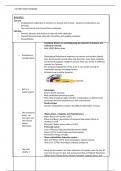
Cornell notes template
Part one
Emotion
o Emotional - Emotions are states elicited by rewarding or aversive stimuli (S+ or S-)
Part one
states and and their omission ( ) or termination (!).
o Studying brain substrates of emotions in animals and humans – general considerations and
associated - These states comprise thoughts (“feelings“) and
concepts physiological/behavioural responses to emotional (i.e., rewarding or
responses in
o Fear and anxiety and relevant brain substrates
aversive) stimuli.
humans and
Part two animals
o Reward, pleasure and desire and relevant brain substrates
o Overlap between brain substrates of positive and negative emotions
o Recapitulation
- Physiological/behavioural responses to
emotional stimuli can unambiguously be measured in humans and
nonhuman animals.
- Rolls (2000) Behav Brain
o Evolutionary
- Physiological/behavioural responses to aversive and positive stimuli
considerations
have fundamental survival value and, therefore, have been relatively
preserved throughout evolution and are often very similar in different
animals incl. humans.
- The principal organization of the brain is very similar among all
mammalian species, including humans.
- all brains have a similar footprint -
o Rat as a Advantages
model system - Easy to breed and keep
- Well-established behavioural tests
- Brain large enough to apply selective manipulations to distinct brain
structures and brain anatomy very well characterized
Disadvantages
- Genetic manipulations (used to be) difficult (alternative: mouse)
o The emotional
- Hippocampus, amygdala, and hypothalamus:
brain – an
- Papez theory of emotion (1937)
overview and
- Klüver and Bucy‘s description of temporal lobe lesion effects in
short list of
monkeys (1939)
classic
- MacLean‘s limbic system theory (1949)
milestones
- Prefrontal cortex:
- Case of Phineas Gage described by Harlow (1868)
- Nauta (1971): Frontal lobes and interoception
- Personality change of Gage
- Meso-corticolimbic dopamine system :
- Olds and Milner (1954): Brain-stimulation induced reward
- Wise et al. (1978): Neuroleptic-induced anhedonia
o Fear and
- Much animal research on brain substrates of emotion over the last 30
anxiety 1 years has focused on fear and anxiety (Caroline and Robert Blanchard,
Jeffrey Gray, Michael Davis, Michael Fanselow, Joseph LeDoux, and
Part one
Emotion
o Emotional - Emotions are states elicited by rewarding or aversive stimuli (S+ or S-)
Part one
states and and their omission ( ) or termination (!).
o Studying brain substrates of emotions in animals and humans – general considerations and
associated - These states comprise thoughts (“feelings“) and
concepts physiological/behavioural responses to emotional (i.e., rewarding or
responses in
o Fear and anxiety and relevant brain substrates
aversive) stimuli.
humans and
Part two animals
o Reward, pleasure and desire and relevant brain substrates
o Overlap between brain substrates of positive and negative emotions
o Recapitulation
- Physiological/behavioural responses to
emotional stimuli can unambiguously be measured in humans and
nonhuman animals.
- Rolls (2000) Behav Brain
o Evolutionary
- Physiological/behavioural responses to aversive and positive stimuli
considerations
have fundamental survival value and, therefore, have been relatively
preserved throughout evolution and are often very similar in different
animals incl. humans.
- The principal organization of the brain is very similar among all
mammalian species, including humans.
- all brains have a similar footprint -
o Rat as a Advantages
model system - Easy to breed and keep
- Well-established behavioural tests
- Brain large enough to apply selective manipulations to distinct brain
structures and brain anatomy very well characterized
Disadvantages
- Genetic manipulations (used to be) difficult (alternative: mouse)
o The emotional
- Hippocampus, amygdala, and hypothalamus:
brain – an
- Papez theory of emotion (1937)
overview and
- Klüver and Bucy‘s description of temporal lobe lesion effects in
short list of
monkeys (1939)
classic
- MacLean‘s limbic system theory (1949)
milestones
- Prefrontal cortex:
- Case of Phineas Gage described by Harlow (1868)
- Nauta (1971): Frontal lobes and interoception
- Personality change of Gage
- Meso-corticolimbic dopamine system :
- Olds and Milner (1954): Brain-stimulation induced reward
- Wise et al. (1978): Neuroleptic-induced anhedonia
o Fear and
- Much animal research on brain substrates of emotion over the last 30
anxiety 1 years has focused on fear and anxiety (Caroline and Robert Blanchard,
Jeffrey Gray, Michael Davis, Michael Fanselow, Joseph LeDoux, and


