

Cornell notes template
Evolution of personality traits:
- Contemporary theories of the evolution and biology of personality traits
- Different evolutionary- models
Natural selection is
explaining about
the reducing variation
persistence to identify
of variance the most
in traits
adaptive trait for the environment the individual finds themselves in
- Why the nature-nurture debate is no longer relevant
and this characteristic is passed on across generations
- Mechanisms that can explain the personality-environment relationship
-- Darwinian • Natural selection is about reducing variation to identify the most
mechanisms adaptive trait for the environment the individual finds themselves in
and this characteristic is passed on across generations
• Traits have fitness, which indicates adaptation in terms of
(1) fecundity [number of offspring]
(2) survivorship [live long enough to reproduce – and make sur eas much
as those offspring survive]
Natural selection assesses whether the challenges match the environment
• Traits develop as fitness indicators
(Gregory, 2009)
- Sexual selection “arises from differences in reproductive success
caused by competition for access to mates” (Andersson, 1994)
- Inter sexual (mate competition- females get to see the ability of the
male in order to select them to reproduce) and intra sexual
(competition – e.g. brightly coloured feathers)
- Some traits are more desirable as they signal certain qualities
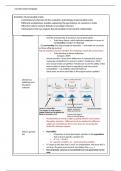
- Directional,
stabilising and
disruptive
selection
- No downside to having a high IQ, getting smarter and smarter
- Disruptive selection - Different levels are optimal for different
subgroups. Evolutionary forces over time are increasing the
distinction between species
- What is genetic • Heritability
her • Proportion of total phenotypic variation in the population
that is due to genetic variation (h2)
• h2 = Gv / (Gv+Ev)
Gv = genetic variation, Ev = environmental variation
• h2 based on the idea that G and E are independent. We know this is
not true. The gene-environment correlation (Gecorrelation )
• Not all genetic variance is transmitted from one generation to the
next
, Cornell notes template
• Only additive effects.
• Dominance (interaction of alleles at same locus of
chromosome) and epistasis (interaction of alleles at
different loci of chromosome) are not
• Overtime in the environment it is possible you become exposed to
certain types of substances (e.g. radiation), that can change your
genes and possibly e.g. cause cancer. But this is not passed onto
your offspring
- Penke, Denissen - PDM suggest 3 possible mechanisms for the evolution of personality
& Miller (2007) Selective neutrality, mutation selection and balancing selection
- Selection Fitness neutral mutations build up and lead to increased genetic variation in
neutrality the trait
Only affected by genetic drift
- Human Populations are too large
Traits do not influence fitness
- Traits affect many fitness outcomes
- Longevity, reproduction etc.
- Personality traits - Are there traits that maybe associated with reproductive success?
and fecundity - Examined in rural Senegal by Alvergne et al. (2010)
- Measures of the Five Factor Model
- Measures of Reproductive Success
- More children and children who live to 5 year
- Ultimate reproductive success = the number of children times the
mean survival of children to age 5, given their BMI
This relationship is
fuelled by social
status, characterised
by more adventurous
and social dominance
- Mutation Natural Selection (decreasing trait variance) balances the effects of mutation
Evolution of personality traits:
- Contemporary theories of the evolution and biology of personality traits
- Different evolutionary- models
Natural selection is
explaining about
the reducing variation
persistence to identify
of variance the most
in traits
adaptive trait for the environment the individual finds themselves in
- Why the nature-nurture debate is no longer relevant
and this characteristic is passed on across generations
- Mechanisms that can explain the personality-environment relationship
-- Darwinian • Natural selection is about reducing variation to identify the most
mechanisms adaptive trait for the environment the individual finds themselves in
and this characteristic is passed on across generations
• Traits have fitness, which indicates adaptation in terms of
(1) fecundity [number of offspring]
(2) survivorship [live long enough to reproduce – and make sur eas much
as those offspring survive]
Natural selection assesses whether the challenges match the environment
• Traits develop as fitness indicators
(Gregory, 2009)
- Sexual selection “arises from differences in reproductive success
caused by competition for access to mates” (Andersson, 1994)
- Inter sexual (mate competition- females get to see the ability of the
male in order to select them to reproduce) and intra sexual
(competition – e.g. brightly coloured feathers)
- Some traits are more desirable as they signal certain qualities
- Directional,
stabilising and
disruptive
selection
- No downside to having a high IQ, getting smarter and smarter
- Disruptive selection - Different levels are optimal for different
subgroups. Evolutionary forces over time are increasing the
distinction between species
- What is genetic • Heritability
her • Proportion of total phenotypic variation in the population
that is due to genetic variation (h2)
• h2 = Gv / (Gv+Ev)
Gv = genetic variation, Ev = environmental variation
• h2 based on the idea that G and E are independent. We know this is
not true. The gene-environment correlation (Gecorrelation )
• Not all genetic variance is transmitted from one generation to the
next
, Cornell notes template
• Only additive effects.
• Dominance (interaction of alleles at same locus of
chromosome) and epistasis (interaction of alleles at
different loci of chromosome) are not
• Overtime in the environment it is possible you become exposed to
certain types of substances (e.g. radiation), that can change your
genes and possibly e.g. cause cancer. But this is not passed onto
your offspring
- Penke, Denissen - PDM suggest 3 possible mechanisms for the evolution of personality
& Miller (2007) Selective neutrality, mutation selection and balancing selection
- Selection Fitness neutral mutations build up and lead to increased genetic variation in
neutrality the trait
Only affected by genetic drift
- Human Populations are too large
Traits do not influence fitness
- Traits affect many fitness outcomes
- Longevity, reproduction etc.
- Personality traits - Are there traits that maybe associated with reproductive success?
and fecundity - Examined in rural Senegal by Alvergne et al. (2010)
- Measures of the Five Factor Model
- Measures of Reproductive Success
- More children and children who live to 5 year
- Ultimate reproductive success = the number of children times the
mean survival of children to age 5, given their BMI
This relationship is
fuelled by social
status, characterised
by more adventurous
and social dominance
- Mutation Natural Selection (decreasing trait variance) balances the effects of mutation


