

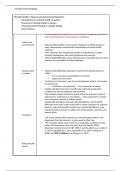
Cornell notes template
Mental health in typical and atypical development:
- Mental health • To be diagnosed, needs to be causing distress
- Introduction to mental health in autism
• Meet set criteria in DSM-V
- Theories of mental health in autism
• Clinical judgment
- Assessing mental health• For aautistic
in mental people
health problem to be diagnosed, this needs to be causing
- Interventions significant distress, meet set diagnostic criteria describing symptoms in
DSM-V.
• Clinical judgement is important to help arrive at a diagnosis, particularly
when many symptoms overlap between conditions.
- Autism and
mental health • Mental health problems can be hard to diagnose in autistic people as
many characteristics overlap with characteristics of mental health
problems
• Many clinicians aren’t specifically trained or experienced in autism,
meaning misdiagnoses and missed diagnoses are common.
• Mental health difficulties can be dismissed as an inevitable part of autism,
however this assumption is being challenged.
- Mental health • Mental health difficulties described in Kanners first clinical reports in
in autism 1940’s:
• Fear and anxiety around objects and events
• Depression also noted
• “Insistence on Sameness” part of current diagnostic criteria, and anxiety
commonly seen
• “Intolerance of uncertainty” – key component of anxiety
• Anxiety and depression have recently been explored among other
conditions to improve diagnosis and treatment
• Many autistic people experience anxiety about the unknown, which is
referred to in ‘intolerance of uncertainty’ – a key component in anxiety
but much more common in autistic people
• Despite high prevalence and early acknowledgment, mental health
difficulties have been under-researched in autism compared to cognitive
theories, and mental health research was recently identified as a top
priority for future research to address by autistic people and those who
support them.
- Prevalence
• 23% of the UK population experience a mental health problem, with
depression the most common, at some point in their lives
• 79% of autistic adults meet criteria for a psychiatric condition at some
point, with depression most common (Lever and Geurts, 2016)
• Depression/anxiety present in 30 – 50% of autistic adults (e.g. Cassidy et
al. 2014; Lugnegård et al. 2011; Hofvander et al. 2009; Sterling et al.
2008), and 30% of children (e.g. Strang et al. 2012)
- Risk/protective
factors
, Cornell notes template
Mental health in typical and atypical development:
- Mental health • To be diagnosed, needs to be causing distress
- Introduction to mental health in autism
• Meet set criteria in DSM-V
- Theories of mental health in autism
• Clinical judgment
- Assessing mental health• For aautistic
in mental people
health problem to be diagnosed, this needs to be causing
- Interventions significant distress, meet set diagnostic criteria describing symptoms in
DSM-V.
• Clinical judgement is important to help arrive at a diagnosis, particularly
when many symptoms overlap between conditions.
- Autism and
mental health • Mental health problems can be hard to diagnose in autistic people as
many characteristics overlap with characteristics of mental health
problems
• Many clinicians aren’t specifically trained or experienced in autism,
meaning misdiagnoses and missed diagnoses are common.
• Mental health difficulties can be dismissed as an inevitable part of autism,
however this assumption is being challenged.
- Mental health • Mental health difficulties described in Kanners first clinical reports in
in autism 1940’s:
• Fear and anxiety around objects and events
• Depression also noted
• “Insistence on Sameness” part of current diagnostic criteria, and anxiety
commonly seen
• “Intolerance of uncertainty” – key component of anxiety
• Anxiety and depression have recently been explored among other
conditions to improve diagnosis and treatment
• Many autistic people experience anxiety about the unknown, which is
referred to in ‘intolerance of uncertainty’ – a key component in anxiety
but much more common in autistic people
• Despite high prevalence and early acknowledgment, mental health
difficulties have been under-researched in autism compared to cognitive
theories, and mental health research was recently identified as a top
priority for future research to address by autistic people and those who
support them.
- Prevalence
• 23% of the UK population experience a mental health problem, with
depression the most common, at some point in their lives
• 79% of autistic adults meet criteria for a psychiatric condition at some
point, with depression most common (Lever and Geurts, 2016)
• Depression/anxiety present in 30 – 50% of autistic adults (e.g. Cassidy et
al. 2014; Lugnegård et al. 2011; Hofvander et al. 2009; Sterling et al.
2008), and 30% of children (e.g. Strang et al. 2012)
- Risk/protective
factors
, Cornell notes template


