

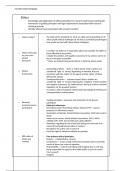
Cornell notes template
o Ethical - Research conduct
Ethics
challenges for - Participants / subjects (humans and animals)
- Knowledge and application
scientists/ of ethical
- Data collection, principles
handling andfor research with human participants
publication
- Awareness
psychologists of guiding principles and legal
- Conflicts of interest requirements associated with research
involving animals- Public relations
- Identify ethical issues associatedofwith
- Application research conduct
psychological knowledge – application of research
ethics to appropriate groups
o What is ethics? - the study of the standards for what are right and wrong things to do
- what specific ethical challenges do we face as scientists/psychologists
- how would we deal with these ethical challegnes
- I consider my duties as a responsible agent and consider the rights of
o What is the basis those affected by my actions
for your own - I weight the positive and negative outcomes of my actions and try to
ethical do as much good as possible
decisions? - ^^there are ethical frameworks that lie in both the above points
- Deontological ethics – ‘duty’ or ‘rights-based’ ethics. Actions are
o Ethical considered ‘right’ or ‘wrong’ depending on whether they are
frameworks consistent with the ‘duties’ of the agent and the ‘rights’ of those
affected by actions
- Consequential ethics – ‘outcome based’ ethics. Actions are
considered ‘right’ or ‘wrong’ following the ‘weighing’ of their positive
and negative outcomes. Eg. Utilitarianism, aiming to achieve maximal
happiness for the greatest number
- In practice, ethical standards reflects both deontological thinking and
consequentialist considerations
- Guiding principles : autonomy and protection of the human
o Research participant
involving human - Historical milestones:
participants - Nuremberg Code, Nuremberg military tribunal 1947 – special
emphasis on informed consent
- Declaration of Helsinki, World Medical Association 1963 (last revision
2013)
- Most recent version: World Medical Association, 2013, JAMA
310(20):2191-2194. doi:10.1001/jama.2013.281053
- Nowadays regulated by law of the land (things we must not do in
research) and professional codes of conduct
- Recognises the active role in research
- Have the right to withdraw without any penalty
o BPS codes of - Four primary ethical principles:
ethics and - Respect – confidentiality, consent
conduct - Competence – ensure a high professional standard and not provide
research above our realm of expertise
- Responsibility – must do everything with integrity due to not only
being responsible for ppts but the wider public in term of results
from research
- Integrity
o Ethical - Research conduct
Ethics
challenges for - Participants / subjects (humans and animals)
- Knowledge and application
scientists/ of ethical
- Data collection, principles
handling andfor research with human participants
publication
- Awareness
psychologists of guiding principles and legal
- Conflicts of interest requirements associated with research
involving animals- Public relations
- Identify ethical issues associatedofwith
- Application research conduct
psychological knowledge – application of research
ethics to appropriate groups
o What is ethics? - the study of the standards for what are right and wrong things to do
- what specific ethical challenges do we face as scientists/psychologists
- how would we deal with these ethical challegnes
- I consider my duties as a responsible agent and consider the rights of
o What is the basis those affected by my actions
for your own - I weight the positive and negative outcomes of my actions and try to
ethical do as much good as possible
decisions? - ^^there are ethical frameworks that lie in both the above points
- Deontological ethics – ‘duty’ or ‘rights-based’ ethics. Actions are
o Ethical considered ‘right’ or ‘wrong’ depending on whether they are
frameworks consistent with the ‘duties’ of the agent and the ‘rights’ of those
affected by actions
- Consequential ethics – ‘outcome based’ ethics. Actions are
considered ‘right’ or ‘wrong’ following the ‘weighing’ of their positive
and negative outcomes. Eg. Utilitarianism, aiming to achieve maximal
happiness for the greatest number
- In practice, ethical standards reflects both deontological thinking and
consequentialist considerations
- Guiding principles : autonomy and protection of the human
o Research participant
involving human - Historical milestones:
participants - Nuremberg Code, Nuremberg military tribunal 1947 – special
emphasis on informed consent
- Declaration of Helsinki, World Medical Association 1963 (last revision
2013)
- Most recent version: World Medical Association, 2013, JAMA
310(20):2191-2194. doi:10.1001/jama.2013.281053
- Nowadays regulated by law of the land (things we must not do in
research) and professional codes of conduct
- Recognises the active role in research
- Have the right to withdraw without any penalty
o BPS codes of - Four primary ethical principles:
ethics and - Respect – confidentiality, consent
conduct - Competence – ensure a high professional standard and not provide
research above our realm of expertise
- Responsibility – must do everything with integrity due to not only
being responsible for ppts but the wider public in term of results
from research
- Integrity


