

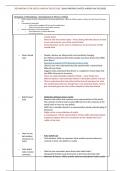
RED WRITING IS THE NOTES I MADE IN THE LECTURE | BLACK WRITING IS NOTES ALREADY ON THE SLIDES
Mind-
Ontogeny of Mentalising – Development of Theory of Mind
oo What
Theory of of mind? Introduction
is theory - Thetoinsight that
the classic people hold
experiments. Whenmental states
do children and
acquire that of
a theory these
mind?govern
Around 3/4years
Mind
old behaviour
o Is development stage-like?
- The mental states focused on when looking at development of children
o Evidence from traditional FB task and its modifications
o Evidence from FB tasks – e.g.implicit
using belief, desire, goals, etc..
measures
o - Allow us to make sense of the social world – to predict and explain
Factors contributing to ToM development
o people’s
Social experience & cultural actions
differences
o Executive functioning
- The understanding that people govern their behaviour around their
mental states
- Need to infer the mental states – hence being called the theory of mind
as we cant know for sure of the mental states
- Some behaviour can be seen as irrational as we do not know of their
mental state
o Desire based - People’s desires are idiosyncratic and constantly changing
ToM - Do children understand that other people may have desires that differ
from theirs?
- Repacholi & Gopnik (1997) Broccoli/Crackers study
- 18m but not 14m understood that the experimenter’s desired food
differed from theirs
- Suggests they understand that desire is a subjective mental state that
can differ from person to person
- There are understandably subjective things – some things have
different desires, what someone believes is desirable another may not
- 18m/o understood that she preferred the broccoli and gave her what
she wanted (broccoli) even though this is not what they desire, 14m/o
just constantly gave her the crackers despite of what she desired
o Belief based - Distinction between mind / world
ToM - Requires the notion that a person has a representation of the world,
the contents of which may be quite different from the contents of the
world itself or from our own beliefs
- Shift from a situation-based to a representation-based understanding of
behaviour
- Might not be a true reflection of reality
- A consequence of their representation of the reality (what they believe
is going to happen and act in accordance to this, despite the fact it
might not be true)
o How can we
tell whether - False belief task
someone has - Tests whether child can represent what another person believes in
ToM? contrast to their own beliefs or reality
o False belief
tasks revision - What do you remember about these false belief tasks?
summary… - Unexpected transfer task also known as the Maxi chocolate task
(Wimmer & Perner, 1983); and the Sally-Ann task (Baron-Cohen, Leslie
Mind-
Ontogeny of Mentalising – Development of Theory of Mind
oo What
Theory of of mind? Introduction
is theory - Thetoinsight that
the classic people hold
experiments. Whenmental states
do children and
acquire that of
a theory these
mind?govern
Around 3/4years
Mind
old behaviour
o Is development stage-like?
- The mental states focused on when looking at development of children
o Evidence from traditional FB task and its modifications
o Evidence from FB tasks – e.g.implicit
using belief, desire, goals, etc..
measures
o - Allow us to make sense of the social world – to predict and explain
Factors contributing to ToM development
o people’s
Social experience & cultural actions
differences
o Executive functioning
- The understanding that people govern their behaviour around their
mental states
- Need to infer the mental states – hence being called the theory of mind
as we cant know for sure of the mental states
- Some behaviour can be seen as irrational as we do not know of their
mental state
o Desire based - People’s desires are idiosyncratic and constantly changing
ToM - Do children understand that other people may have desires that differ
from theirs?
- Repacholi & Gopnik (1997) Broccoli/Crackers study
- 18m but not 14m understood that the experimenter’s desired food
differed from theirs
- Suggests they understand that desire is a subjective mental state that
can differ from person to person
- There are understandably subjective things – some things have
different desires, what someone believes is desirable another may not
- 18m/o understood that she preferred the broccoli and gave her what
she wanted (broccoli) even though this is not what they desire, 14m/o
just constantly gave her the crackers despite of what she desired
o Belief based - Distinction between mind / world
ToM - Requires the notion that a person has a representation of the world,
the contents of which may be quite different from the contents of the
world itself or from our own beliefs
- Shift from a situation-based to a representation-based understanding of
behaviour
- Might not be a true reflection of reality
- A consequence of their representation of the reality (what they believe
is going to happen and act in accordance to this, despite the fact it
might not be true)
o How can we
tell whether - False belief task
someone has - Tests whether child can represent what another person believes in
ToM? contrast to their own beliefs or reality
o False belief
tasks revision - What do you remember about these false belief tasks?
summary… - Unexpected transfer task also known as the Maxi chocolate task
(Wimmer & Perner, 1983); and the Sally-Ann task (Baron-Cohen, Leslie


