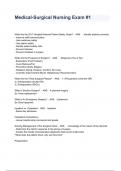
Medical-Surgical Nursing Exam #1 Questions With verified Solutions
Medical-Surgical Nursing Exam #1 Questions With verified Solutions What Are the 2017 Hospital National Patient Safety Goals? - ANS - Identify patients correctly - Improve staff communication - Use medicines safely - Use alarms safely - Identify patient safety risks - Prevent Infection - Prevent mistakes in surgery What Are the Purposes of Surgery? - ANS - Diagnosis (Yes or No) - Exploration (Find Problem) - Cure (Remove/Fix) - Prevention (Early Stages) - Palliation (Dying, Hospice, Comfort, No Cure) - Cosmetic Improvement (Burns, Mastectomy, Reconstruction) What Are the Three Surgical Phases? - ANS 1.) Preoperative (Until the OR) 2.) Intraoperative (Inside OR) 3.) Postoperative (PACU) What is Elective Surgery? - ANS A planned surgery Ex: Knee replacement What is An Emergency Surgery? - ANS Unplanned Ex: Burst appendix Inpatient vs. Outpatient - ANS Inpatient - Same day admission Outpatient (Ambulatory) - Leave hospital when recovered and awake Nursing Management of the Surgical Client - ANS - Knowledge of the nature of the disorder - Determine the client's response to the stress of surgery - Assess the results of preoperative diagnostic tests (Look at lab tests) *What does the patient know, why are they here* Preoperative: Client Interview - ANS 1.) Purpose: Where is the patient at mentally, most anxious, take vitals after a little while, reassurance 2.) Check documented information prior to the interview (Avoids repetition; see how nervous) 3.) Occurs in advance or on day of surgery Preoperative: Client Assessment - ANS 1.) Health Hx 2.) Medication Hx (Prescription and OTC) 3.) Diagnostic Testing 4.) Psychosocial Factors (Spiritual/Cultural) *Stop taking Ibuprofen before, stop smoking, when they last ate, etc* What Subjective Information is Important from the Preoperative Client Interview? - ANS - Psychosocial Assessment (Age, Current health) - Influencing Factors Fears: Past experiences, death, complications, disfigurement, disruption of life, disability, viruses, needles, etc. Pain: Pain medication and management Hope: To be cured, do not take away hope *Stress raises glucose levels; always ask about pain* *Identify caregivers, also the patient must know what is happening* Anxiety & Nursing Assessment - ANS Anxiety can arise from: - Lack of knowledge (More they know the better, use layman's terms) - Unrealistic expectations (I will have this surgery and be fine) - Information lessens anxiety Preoperative Nursing Assessment - ANS - Health Hx - Family Diseases (Anesthesia problems/malignant hypothermia) - Previous and Current Diagnoses medical conditions - Previous surgeries or problems - Menstrual/Obstetric History (Pregnant?) - Current Medications - Drug Intolerance (Allergies/Adverse Rxn) What Objective Information is Important from the Preoperative Client Interview? - ANS - Physical Exam - Lab Diagnostic Testing - Document Relevant findings and report to the perioperative team *Always have a CBC; electrolytes, blood sugars, EKG, Chest X-Ray, etc. Know the normal labs, LOW PLATELETS IS A BIG DEAL* Cardiovascular System Objective Data - ANS - Heart rate, blood pressure, skin color, sounds, capillary refill, edema, history of heart attack or cardiac problems, blood clots in legs? REPORT: Any cardiac problems so they can be monitored during the intraoperative period. The use of cardiac drugs, and the presence of a pacemaker/ICD (Implantable Cardioverter Defibrillator) Respiratory System Objective Data: - ANS - Respiratory rate, lung sounds, O2 Saturation REPORT: History of dyspnea, coughing, or hemoptysis (Blood) - COPD or Asthma (High risk for atelectasis and hypoxemia) - Smokers (Encourage to quit) Nervous System Objective Data: - ANS - Level of Consciousness, can they follow commands, sight, hearing - Evaluation of neurological functioning (Vision or hearing loss can influence results) - Cognitive function (Determine if any deficits are present) Genitourinary System Objective Data: - ANS - Kidney problems, frequency of urination, urgency, blood, period - History of renal diseases - Assess BUN, Creatinine, Specific Gravity Renal Dysfunction contributes to: - Fluid and electrolyte problems - Altered response to drugs - Increased risk of infection Hepatic System Objective Data: - ANS - Jaundice, Ascites - Liver involved in drug metabolism and clotting - Hepatic dysfunction may increase risk of postoperative complications Integumentary System Objective Data: - ANS - Ulcers - History of skin and musculoskeletal problems (Arthritis, stroke deficit problems, ask the patient if they are comfortable)
Written for
- Institution
- Medical-Surgical RN A Prophecy Relias
- Course
- Medical-Surgical RN A Prophecy Relias
Document information
- Uploaded on
- January 18, 2024
- Number of pages
- 8
- Written in
- 2023/2024
- Type
- Exam (elaborations)
- Contains
- Questions & answers
Subjects
-
medical surgical nursing exam 1

Also available in package deal