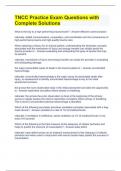
TNCC Practice Exam Questions with
Complete Solutions
What is the key to a high performing trauma team? - Answer-effective communication
rationale: skilled communication, cooperation, and coordination are the cornerstones of
high-performance teams and high-quality trauma care.
When obtaining a history for an injured patient, understanding the kinematic concepts
associated with the mechanism of injury and energy transfer can initially assist the
trauma provider in: - Answer-evaluating and anticipating the types of injuries that may
be present.
rationale: mechanism of injury and energy transfer can assist the provider in evaluating
and anticipating damage.
the major preventable cause of death in the trauma patient is: - Answer-uncontrolled
haemorrhage.
rationale: uncontrolled haemorrhage is the major cause of preventable death after
injury, so assessment to identify uncontrolled haemorrhage is key to the initial
assessment process.
the across-the-room observation step in the initial assessment provides the opportunity
to - Answer-reprioritize circulation before airway or breathing.
rationale: the across-the-room observation is done at the beginning of the primary
survey to rapidly assess the need to reprioritize circulation before airway or breathing.
This is done if uncontrolled external haemorrhage is identified.
Which of the following accurately describes ventilation principles associated with a bag-
mask device? - Answer-ventilate at a rate of 10-12 breaths/minute
rationale: if ventilation is ineffective, assist ventilation at 10-12 breaths/minute or one
every 5-6 seconds.
Which of the following is the best measure of the adequacy of cellular perfusion and
helps to predict the outcome of resuscitation? - Answer-base deficit
rationale: base deficit serves as an endpoint measurement of the adequacy of cellular
perfusion and when used in conjunction with serum lactate helps predict the success of
resuscitation.
, What is the safe pharmacological alternative to opioids for rib fracture pain management
in the anticoagulated patient? - Answer-intercostal nerve blocks
rationale: continuous intercostal nerve blocks use long-acting anaesthetics and can
provide safe and effective pain management for the anticoagulated patient.
In a patient with severe traumatic brain injury, hypocapnia causes: - Answer-cerebral
vasoconstriction.
rationale: hypocapnia, or low levels of carbon dioxide, will cause vasoconstriction,
especially in the cerebra; vasculature.
A patient with a knife injury to the neck has an intact airway and is hemodynamically
stable. He complains of difficulty swallowing and speaking. Further assessment is
indicated next for which of the following? - Answer-damage to spinal cord
rationale: penetrating neck trauma may include concurrent injuries to the spinal cord,
airway, or vascular neck structures. With an intact airway and hemodynamic stability,
the other common concurrent injury is to the spinal cord.
What is the appropriate technique for palpating the pelvis for stability? - Answer-apply
gentle pressure over the iliac downward and medially
rationale: to assess for pelvic instability, gentle pressure is applied over the iliac crests
downward and medially.
a patient with a spinal cord injury at C5 is being cared for in the emergency department
while awaiting transport to a trauma centre. which of the following represents the
highest priority for ongoing assessment and management? - Answer-maintain adequate
respiratory status
rationale: spinal cord injuries at C3 to C5 can cause the loss of phrenic nerve function,
resulting in a paralysed diaphragm and inability to breathe.
Based on proper bleeding control techniques, what is the first step to stop the bleeding
of a penetrating injury to the lower extremity? - Answer-initiate direct pressure
rationale: the first step in controlling any bleeding is direct pressure. if that is not
adequate, the application of a tourniquet may be needed.
treatment for frostbite includes: - Answer-administer tissue plasminogen activator.
rationale: with frostbite, thrombus formation is a risk. tissue plasminogen or nonsteroidal
anti-inflammatory medication can be administered. The tissue plasminogen activator
has been effective in maintaining perfusion and decreasing the need for amputation
when administered within 24 hours of rewarming.
Complete Solutions
What is the key to a high performing trauma team? - Answer-effective communication
rationale: skilled communication, cooperation, and coordination are the cornerstones of
high-performance teams and high-quality trauma care.
When obtaining a history for an injured patient, understanding the kinematic concepts
associated with the mechanism of injury and energy transfer can initially assist the
trauma provider in: - Answer-evaluating and anticipating the types of injuries that may
be present.
rationale: mechanism of injury and energy transfer can assist the provider in evaluating
and anticipating damage.
the major preventable cause of death in the trauma patient is: - Answer-uncontrolled
haemorrhage.
rationale: uncontrolled haemorrhage is the major cause of preventable death after
injury, so assessment to identify uncontrolled haemorrhage is key to the initial
assessment process.
the across-the-room observation step in the initial assessment provides the opportunity
to - Answer-reprioritize circulation before airway or breathing.
rationale: the across-the-room observation is done at the beginning of the primary
survey to rapidly assess the need to reprioritize circulation before airway or breathing.
This is done if uncontrolled external haemorrhage is identified.
Which of the following accurately describes ventilation principles associated with a bag-
mask device? - Answer-ventilate at a rate of 10-12 breaths/minute
rationale: if ventilation is ineffective, assist ventilation at 10-12 breaths/minute or one
every 5-6 seconds.
Which of the following is the best measure of the adequacy of cellular perfusion and
helps to predict the outcome of resuscitation? - Answer-base deficit
rationale: base deficit serves as an endpoint measurement of the adequacy of cellular
perfusion and when used in conjunction with serum lactate helps predict the success of
resuscitation.
, What is the safe pharmacological alternative to opioids for rib fracture pain management
in the anticoagulated patient? - Answer-intercostal nerve blocks
rationale: continuous intercostal nerve blocks use long-acting anaesthetics and can
provide safe and effective pain management for the anticoagulated patient.
In a patient with severe traumatic brain injury, hypocapnia causes: - Answer-cerebral
vasoconstriction.
rationale: hypocapnia, or low levels of carbon dioxide, will cause vasoconstriction,
especially in the cerebra; vasculature.
A patient with a knife injury to the neck has an intact airway and is hemodynamically
stable. He complains of difficulty swallowing and speaking. Further assessment is
indicated next for which of the following? - Answer-damage to spinal cord
rationale: penetrating neck trauma may include concurrent injuries to the spinal cord,
airway, or vascular neck structures. With an intact airway and hemodynamic stability,
the other common concurrent injury is to the spinal cord.
What is the appropriate technique for palpating the pelvis for stability? - Answer-apply
gentle pressure over the iliac downward and medially
rationale: to assess for pelvic instability, gentle pressure is applied over the iliac crests
downward and medially.
a patient with a spinal cord injury at C5 is being cared for in the emergency department
while awaiting transport to a trauma centre. which of the following represents the
highest priority for ongoing assessment and management? - Answer-maintain adequate
respiratory status
rationale: spinal cord injuries at C3 to C5 can cause the loss of phrenic nerve function,
resulting in a paralysed diaphragm and inability to breathe.
Based on proper bleeding control techniques, what is the first step to stop the bleeding
of a penetrating injury to the lower extremity? - Answer-initiate direct pressure
rationale: the first step in controlling any bleeding is direct pressure. if that is not
adequate, the application of a tourniquet may be needed.
treatment for frostbite includes: - Answer-administer tissue plasminogen activator.
rationale: with frostbite, thrombus formation is a risk. tissue plasminogen or nonsteroidal
anti-inflammatory medication can be administered. The tissue plasminogen activator
has been effective in maintaining perfusion and decreasing the need for amputation
when administered within 24 hours of rewarming.