Lecture 9 – Yohji Yamamoto
His work is kinda based on existentialist philosophy – emphasizes the role of the individual
human being, the most important thing about clothing is the way human beings behave –
huamn beings should behave the way they want to (through cloth as well)
→ intellectual designer
- His work is a protest against elitism
- He wants freedom and stop to restrict people
- populist culture and
radical design
thinking
- 1st collection he
showed in Paris
- This cocoon-like
shape is a very new
silhouette/garment
back in that time (no
straight lines)
- no culture/religion
involved, these
designs belongs to
anyone -
transcultural
- things shoudln’t be
labelled, they shuld just be free to just be
- Grew up in Tokyo when mass consumption, mass culture was booming
- Constant need for innovation, new things
- So many different influencers that it became a culture on its own
- His cloth were seen as a rebellion again this age of excess (in his early work)
- Lives his life by the way he sees life
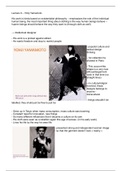
- presented strong and independent woman image
- so that the garment doesn’t look « trashy »
, - fierce look
- he sees that women
have been restricted by
the use of fashionable
- he feels fashion should
help them suffer less
- he distinguished two
types of women : status
driven,wealthy women
who he thinks are the
opposite of women, and
on the other hand,
independent women who
he thinks should be
helped through fashion
- turns her into a more
androgynous image
- created label Y 1977 presented his first collection – considered his most low budget line
HIS INSPIRATION
- determines the way his garments look
work of photographer August Sanders – known for revealing the dignity of the poor
- softened structure, aged → beautifying the poorness of the poor
- Yamamoto recognised that and took it for his inspiration
- these garments became part of the person wearing them in a way
that nothing else could → storytelling in a subtle way
- finds the ideal look in bohemians, traveler → ppl who carry their
lives, secrets along with them → carried out through the way they
look
- you cannot imitate that through clothing bc it’s so personal but
Yamamoto attempts to do it
- aesthetics of poverty
- the fact that the world of fashion is so attached to innovation
makes him want to capture history instead
His work is kinda based on existentialist philosophy – emphasizes the role of the individual
human being, the most important thing about clothing is the way human beings behave –
huamn beings should behave the way they want to (through cloth as well)
→ intellectual designer
- His work is a protest against elitism
- He wants freedom and stop to restrict people
- populist culture and
radical design
thinking
- 1st collection he
showed in Paris
- This cocoon-like
shape is a very new
silhouette/garment
back in that time (no
straight lines)
- no culture/religion
involved, these
designs belongs to
anyone -
transcultural
- things shoudln’t be
labelled, they shuld just be free to just be
- Grew up in Tokyo when mass consumption, mass culture was booming
- Constant need for innovation, new things
- So many different influencers that it became a culture on its own
- His cloth were seen as a rebellion again this age of excess (in his early work)
- Lives his life by the way he sees life
- presented strong and independent woman image
- so that the garment doesn’t look « trashy »
, - fierce look
- he sees that women
have been restricted by
the use of fashionable
- he feels fashion should
help them suffer less
- he distinguished two
types of women : status
driven,wealthy women
who he thinks are the
opposite of women, and
on the other hand,
independent women who
he thinks should be
helped through fashion
- turns her into a more
androgynous image
- created label Y 1977 presented his first collection – considered his most low budget line
HIS INSPIRATION
- determines the way his garments look
work of photographer August Sanders – known for revealing the dignity of the poor
- softened structure, aged → beautifying the poorness of the poor
- Yamamoto recognised that and took it for his inspiration
- these garments became part of the person wearing them in a way
that nothing else could → storytelling in a subtle way
- finds the ideal look in bohemians, traveler → ppl who carry their
lives, secrets along with them → carried out through the way they
look
- you cannot imitate that through clothing bc it’s so personal but
Yamamoto attempts to do it
- aesthetics of poverty
- the fact that the world of fashion is so attached to innovation
makes him want to capture history instead