

Humanistic-existential approaches 1
Lecture part 1 – humanism and Carl Rogers
Humanism and existentialism
‘third force’ in psychology
Humanism – natural potential that we can actualise. Problems: not being ‘true self’
Phenomenology – ‘here and now’ freedom, responsibility. Trust to make
constructive choices. Awareness.
Existentialism – human limitations, realities. problems: failing to create meaning in
life
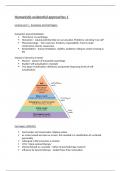
Maslow’s hierarchy of needs
Maslow – pioneer of humanistic psychology
Studied ‘self-actualisation’ of people
Two types of motivation: deficiency and growth (improving levels of self-
actualisation)
Carl rogers (1902-87)
hard worker and conservative religious values
as a teen teased and seen as a loner, this resulted in a classification of a schizoid
personality
initial goal in life to become a minister
1951: ‘client-centred therapy’
Viewed himself as a scientist – father of psychotherapy research
Influence far beyond therapy – Nobel Peace Prize nomination
, Natalie rogers – developed ideas of person centred therapy into much more
expressive art therapy
Views on human nature
Freud – pessimistic view, sexual drives lead to aggression, selfishness and incest
Rogers – humans basically good, actualising tendency leads to a productive life
Actualising tendency
Single basic motivating drive
‘directional tendency towards wholeness, toward actualisation of potentialities’
(rogers, 1977p.240)
People move towards self-regulation of own enhancement and away from influence
of external forces
Cited support for actualising tendency in both naturalistic and empirical
environments
Organismic valuing process
Central to true of unique self
‘weighing’ of experiences and placing value based on ability to satisfy organism
Based on the individual’s phenomenal field
o Subjective experience/frame of reference
Experience of awareness
We are experts on ourselves
Awareness : representation of experience. May not accurately be symbolised in
awareness due to unimportance or defensive denials or distortions
Non conscious organismic functioning (tiny peak of awareness)– e.g. unimportance,
due to processes such as automatic functioning for example sitting on a chair
Self and self concept
Self -real, underlying organismic self
Self concept – perceptions of self
“I, me, my”
Initially incorporations of perceptual experiences, later incorporate experiences such
as socialisation into their self-concepts instead
Conditions of worth
Need for positive regard
This can be conditional and unconditional
o Valued for who you are, no matter what you do – unconditional vs
o Valued for doing what others want you to do - conditional
Rely on conditional regard = introject conditions of worth
o Secondary valuing processes (primary valuing process – focused on positive
regard to achieve self actualisation, secondary – developing conditions of
worth) . the individual is also going through false awareness
Lecture part 1 – humanism and Carl Rogers
Humanism and existentialism
‘third force’ in psychology
Humanism – natural potential that we can actualise. Problems: not being ‘true self’
Phenomenology – ‘here and now’ freedom, responsibility. Trust to make
constructive choices. Awareness.
Existentialism – human limitations, realities. problems: failing to create meaning in
life
Maslow’s hierarchy of needs
Maslow – pioneer of humanistic psychology
Studied ‘self-actualisation’ of people
Two types of motivation: deficiency and growth (improving levels of self-
actualisation)
Carl rogers (1902-87)
hard worker and conservative religious values
as a teen teased and seen as a loner, this resulted in a classification of a schizoid
personality
initial goal in life to become a minister
1951: ‘client-centred therapy’
Viewed himself as a scientist – father of psychotherapy research
Influence far beyond therapy – Nobel Peace Prize nomination
, Natalie rogers – developed ideas of person centred therapy into much more
expressive art therapy
Views on human nature
Freud – pessimistic view, sexual drives lead to aggression, selfishness and incest
Rogers – humans basically good, actualising tendency leads to a productive life
Actualising tendency
Single basic motivating drive
‘directional tendency towards wholeness, toward actualisation of potentialities’
(rogers, 1977p.240)
People move towards self-regulation of own enhancement and away from influence
of external forces
Cited support for actualising tendency in both naturalistic and empirical
environments
Organismic valuing process
Central to true of unique self
‘weighing’ of experiences and placing value based on ability to satisfy organism
Based on the individual’s phenomenal field
o Subjective experience/frame of reference
Experience of awareness
We are experts on ourselves
Awareness : representation of experience. May not accurately be symbolised in
awareness due to unimportance or defensive denials or distortions
Non conscious organismic functioning (tiny peak of awareness)– e.g. unimportance,
due to processes such as automatic functioning for example sitting on a chair
Self and self concept
Self -real, underlying organismic self
Self concept – perceptions of self
“I, me, my”
Initially incorporations of perceptual experiences, later incorporate experiences such
as socialisation into their self-concepts instead
Conditions of worth
Need for positive regard
This can be conditional and unconditional
o Valued for who you are, no matter what you do – unconditional vs
o Valued for doing what others want you to do - conditional
Rely on conditional regard = introject conditions of worth
o Secondary valuing processes (primary valuing process – focused on positive
regard to achieve self actualisation, secondary – developing conditions of
worth) . the individual is also going through false awareness


