AFST 201 Final—Kefentse Latest Version Graded A
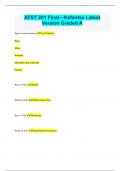
AFST 201 Final—Kefentse Latest Version Graded A Egypt social structure top to bottom: King Elites Warriors Merchants and craftsmen Farmers West of Nile Sahara North of Nile Mediterranean Sea East of Nile Mountains South of Nile Natural barriers (caracts) Trade from Egypt to Mesopotamia Developed wealthy elite class, econ and political systems King Menes United upper and lower Egypt Ma'at 42 principles "I have not" Ma'at Goddess of truth and justice. The feather Old Kingdom of Egypt Era of pyramid building King Djoser Step Pyramid (1st) built for him by Imhotep King Seneferu Seneferu's Bent pyramid Seneferu's Red pyramid King Khufu The Great Pyramids Ghana location (5th-13th CE) W Africa Ghana Empire Founded by the Sonike people Gold Abu Ubayd al-Bakri Detailed descriptions of Ghana at its height Mali Empire location (13th-15th CE) W Africa Mali Empire rise Malikine people opposed the Sonike rule Sundiata of Keita clan Led Mali "The Lion King" Organized the resistance against Sonike Timbuktu W Africa trading city that became a center of wealth and learning Mansa Musa King of Mali —made a famous pilgrimage to Mecca Mali's Decline Songhai emerged Songhai Empire founded by Sunni Ali —Islamic As Kia Muhammad Mali Empire at its height Songhai decline Civil war Middle passage A voyage that brought enslaved Africans across the Atlantic Ocean to North America and the West Indies Portugal in Africa Portugal was the first to explore Africa. —wanted to trade w/o passing Muslims Portuguese Expansion Headed south in search of African gold —found slavery Bartolommeo Dias Who reached the tip of Africa Vast de Gama Rounded Cape and came in contact w SW India Treaty of Tordesillas Divided the New World between Spain and Portugal Spain new world West Portugal new world east Spain sent a priest to the indies in order to... Mentally control and push religion amongst the natives Bartholmo said to use Africans instead of Indians bc Africans were... Soulless beings Slavery A system of enforced servitude in which some people are owned by other people Atlantic Slave trade the buying, transporting, and selling of Africans for work in the Americas March from Africa interior —slaves trades for guns —resistance = death —died from hunger, exposure, and exhaustion Point of No Return Portuguese warehouse here Africans were kept West Indies Where slaves were "seasoned" Jamestown, VA Established in 1607, it became the first permanent English settlement New-Paleo Indians Walked from Russia to Alaska and tricked down Colonial society Wealthy landowners and merchants stood at the top, independent farmers were next, followed by craftsmen. At the bottom were unskilled laborers and slaves. Bacon's Rebellion Nathaniel Bacon led —poor farmers were FED up —no more indentured servitude —drove wedge between blacks and poor whites Slave codes laws to control slaves 1700s French and Indian War fought in the colonies between the English and the French for possession of the Ohio Valley area —The English won Seven Years War worldwide struggle between France and Great Britain for power and control of land —began by George Washington telling French to get tf via Indian What started the French and Indian War? British settlers pushed west into French and Native American lands killing French men Results of French and Indian War France lost Canada and the 13 colonies were asked to pay for the war by being taxed Sugar (64) and Stamp Act (65) tax foreign molasses and printed material Colonists and taxation Began questioning their representation in Parliament —"virtually" The Townshend Act A tax that the British Parliament placed on leads, glass, paint and tea Boston Tea Party protest against increased tea prices in which colonists dumped british tea into boston harbor Intolerable Acts in response to Boston Tea Party, 4 acts passed in 1774, Port of Boston closed, reduced power of assemblies in colonies, permitted royal officers to be tried elsewhere, provided for quartering of troop's in barns and empty houses American Revolution This political revolution began with the Declaration of Independence in 1776 where American colonists sought to balance the power between government and the people and protect the rights of citizens in a democracy. Black Laws laws limiting the activity of free black citizens in non slave-holding states Disfranchisement Denial of the right to vote The Black Family Led by women Extended families Democratic-Republican Party Wanted to expand west (whites) Democratic Party Wanted western slavery Whig party No slavery Haitian Revolution A major influece of the Latin American revolutions because of its successfulness; the only successful slave revolt in history San Domingue Haiti Toussaint L'Ouverture Leader of the Haitian Revolution. He freed the slaves and gained effective independence for Haiti despite military interventions by the British and French. Slave and voodoo priest Bookman Napoleon and Haiti Haiti revolted against the French in 1791 and gained their independence in 1804, because of this Napoleon wanted to focus on conquering Continental Europe and sold Jefferson the Louisiana Purchase Haiti First Black Republic AASS American Anti-Slavery Society American Anti-Slavery Society —William Lloyd Garrison —advocated the immediate abolition of slavery Blacks in anti-slavery societies Rarely held positions Dread Scott case Black slave brought between Missouri, a slave state, and Illinois a free state, claimed to be free because he was living in the free state, however white property rights overruled black citizenship and therefore his rights were not acknowledged. Fugitive slave law provided for the return of escaped slaves to their owners —Law was tougher and was aimed at eliminating the underground railroad. Underground Railroad a system of secret routes used by escaping slaves to reach freedom in the North or in Canada Lincoln and Slavery Didn't care if slavery expanded or not Lincoln and Secession Suspended the writ of babeas corpus Emancipation Proclamation Proclamation issued by Lincoln, freeing all slaves in areas still at war with the Union. Free blacks in civil war Not allowed to fight Manual laborers Black contentment's in civil war Segregated regiments —less pay —no commissioned officer positions —harsh punishment —
Written for
- Institution
- AFST 201
- Course
- AFST 201
Document information
- Uploaded on
- January 17, 2024
- Number of pages
- 12
- Written in
- 2023/2024
- Type
- Exam (elaborations)
- Contains
- Questions & answers
Subjects
-
afst 201 finalkefentse latest version graded a

Also available in package deal