Principles of Management IIB (Entrepreneurship) by ProfessorBurgerQueen
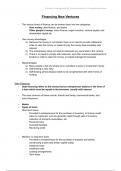
Financing New Ventures
- The various forms of finance can be broken down into two categories:
- Own money: debt finance, and banks
- Other people’s money: micro finance, angel investors, venture capital, and
shareholder capital etc.
- Own money advantages:
a) Because the money is not loaned, there is no need to provide collateral in
order to raise the money or indeed to pay the money back inevitably with
interest;
b) The entrepreneur does not need to relinquish any ownership in the venture;
c) There is no need to comply with extensive, and often onerous requirements of
funders in order to raise the money, or indeed manage the business
- Disadvantages
a) Many people in SA are simply not in a position to save or invest their money
b) Self-funding is very risky
c) Self-funding almost always needs to be complimented with other forms of
funding
Debt Financing
- Debt financing refers to the money that an entrepreneur obtains in the form of
a loan which must be repaid to the borrower, usually with interest
- The most common of these include; friends and family, commercial banks, and
micro-financiers
- Banks
- Types of loans
- Short-term loans
- Provided to entrepreneurs for the purchase of inventory, to finance credit
sales to customers, and are generally rapid through sale of inventory,
collection of accounts receivables, etc.
- Personal loans
- Overdraft facilities
- Revolving credit
- Medium- to long-term loans
- Provided to entrepreneurs for the purchase of property and assets,
constructing a plant and similar capital outlay.
- Instalment loan
- Instalment sale
- Leasing arrangements
- Term loans
Financing New Ventures
- The various forms of finance can be broken down into two categories:
- Own money: debt finance, and banks
- Other people’s money: micro finance, angel investors, venture capital, and
shareholder capital etc.
- Own money advantages:
a) Because the money is not loaned, there is no need to provide collateral in
order to raise the money or indeed to pay the money back inevitably with
interest;
b) The entrepreneur does not need to relinquish any ownership in the venture;
c) There is no need to comply with extensive, and often onerous requirements of
funders in order to raise the money, or indeed manage the business
- Disadvantages
a) Many people in SA are simply not in a position to save or invest their money
b) Self-funding is very risky
c) Self-funding almost always needs to be complimented with other forms of
funding
Debt Financing
- Debt financing refers to the money that an entrepreneur obtains in the form of
a loan which must be repaid to the borrower, usually with interest
- The most common of these include; friends and family, commercial banks, and
micro-financiers
- Banks
- Types of loans
- Short-term loans
- Provided to entrepreneurs for the purchase of inventory, to finance credit
sales to customers, and are generally rapid through sale of inventory,
collection of accounts receivables, etc.
- Personal loans
- Overdraft facilities
- Revolving credit
- Medium- to long-term loans
- Provided to entrepreneurs for the purchase of property and assets,
constructing a plant and similar capital outlay.
- Instalment loan
- Instalment sale
- Leasing arrangements
- Term loans