PCCN Blue Practice Exam 47 Questions with Verified Answers,100% CORRECT
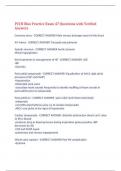
PCCN Blue Practice Exam 47 Questions with Verified Answers Coronary sinus - CORRECT ANSWER Main venous drainage vessel of the heart AV Valves - CORRECT ANSWER Tricuspid and pulmonic Systolic murmur - CORRECT ANSWER Aortic stenosis Mitral regurgitation Key treatments in management of HF - CORRECT ANSWER -ACE -BB -Diuertics Pericardial tamponade - CORRECT ANSWER -Equalization of left & right atrial pressures (CVP and PAOP) -Hypotension -Distended neck veins -auscultate heart sounds frequently to identify muffling of heart sounds in pericarditis prior to tamponade Pericarditis tx - CORRECT ANSWER -pain relief (anti-infam/sterioidal( -antipyretic -cont EEG (dysrhythmia early s/s of cardiac tamponade) -ABG/ cont pulse ox for signs of hypoxemia Cardiac tamponade - CORRECT ANSWER -diastolic dysfunction (heart can't relax to fill w blood) -produces drop in blood pressure during inspiration (pulus paradox, SBP decreases by 20) -CVP and PAOP equal -pulmonary and venous engorgement Mitral valve rupture - CORRECT ANSWER Post MI complication -dyspnea -orthopnea -paroxsmal nocturnal dyspnea -elevated PAOP -pulm hyperTN -decreased CO -crackles -holosystolic murmur at apex -s3 -s/s of R HF Mitral stenosis - CORRECT ANSWER -most commonly due to rheumatic fever -dyspnea on exertion -progressive fatigue -cough -hemoptysis -R HF -elevated PAOP / RV pressures -afib Aortic insufficiency - CORRECT ANSWER -fatigue -dyspnea -paroxysmal nocturnal dyspnea -orthopnea -angina -widened pulse presssure -s3 -systolic murmur aortic area & era's point -sinus tach -elevated PAOP Aortic stenosis - CORRECT ANSWER (obstruction of blood from LV to systemic circulation during systole) =syncope, fatigue, palpitations, angina Chamber w deoxygenated blood - CORRECT ANSWER R ventricle SA node - CORRECT ANSWER Right atrium V fib tx - CORRECT ANSWER Defibrillation 200-300J monophonic or 120-200 biphasic Anterior MI leads - CORRECT ANSWER V1-4 Inferior MI leads - CORRECT ANSWER II, III, avF Lateral MI leads - CORRECT ANSWER I, avL, v5, v6 Anterior MI - CORRECT ANSWER -second and third degree block Inferior MI - CORRECT ANSWER -first and second type I block stable angina tx - CORRECT ANSWER -nitrates and bb AV node rate - CORRECT ANSWER 40-60 SA node rate - CORRECT ANSWER 60-100 Passage of electrical impulse through AV node - CORRECT ANSWER PR interval Junctional rhythm - CORRECT ANSWER - MI diagnostic isoenzyme - CORRECT ANSWER troponin I (cTnI) unstable angina tx - CORRECT ANSWER -bb MI tx - CORRECT ANSWER -cath lab within 90 min or thrombolytic -risk of bleeding (reduce punctures, bags, fall precautions, avoidance of automated bp cuffs) -signs of bleeding: hypotn, tachycardia, organ changes aka LOC) -bradycardia is common with admin r/t repercussion , vtach also common stent placement complication - CORRECT ANSWER -reocculsion due to endothelial growth = use DES -reocclusion due to PLT act/agg = antiPLT (clopidogrel and prasugrel + lifelong ASA) Pulsus paradox - CORRECT ANSWER SBP heard during exhalation but not during inhalation (>10mmHg) -symptom of cardiac tamponade -occurs w pericardial effusion, complication of trauma, pericarditis, cardiac surgery, or HF -sudden increase in pericardial fluid compresses heart increasing E DBP in R&LV, decreased venous return, decreased ventricular filling -becks triads: ( increased central venous pressure w distended neck veins, muffled heart sounds, hypotn) -tx: pericardiocentesis, surgical repair to control bleeding/relieve cardiac compression ortho hyptoTN - CORRECT ANSWER -decrease by 25/10 from lying to sitting -hypovolemia halosystolic/pansystolic murmur - CORRECT ANSWER s1-s2 mitral/tricuspid regurg s3 - CORRECT ANSWER HF L VF (pt lying on L side) s4 - CORRECT ANSWER ventricular hypertrophy (from CAD, HTP, aortic valve stenosis) heard before s1 opening snap - CORRECT ANSWER high-pitched, after s2 w stenosis of mitral valve from rheumatic heart disease ejection click - CORRECT ANSWER brief high-pitched after s1 = stenosis of aortic valve friction rub - CORRECT ANSWER harsh, grating soul during systole/diastole in pericarditis s1 - CORRECT ANSWER closure of mitral/tricuspid valves ; heard at apex/LV s2 - CORRECT ANSWER closure of aortic/pulmonic valves; heard at base of heart HF tx med to NOT use - CORRECT ANSWER Ca+ chl blockers (nicardipine) -do not get ARB (losartan) with ACE inhibitors HF first med to use - CORRECT ANSWER ACE inhibitors -can cause cough, hyperK, angioedema --> give ARB instead -use before giving hydrazine nesiritide - CORRECT ANSWER BNP - promotes diuresis ; can cause hypoTN GFR low / diruesis - CORRECT ANSWER thiazide diuretics ineffective ; hypokalemia ; hydrochlorothiaziade, esidrix ; NO in kidney pts aldosterone blckers - CORRECT ANSWER spironolactone, na+/h20 loss = k+ high = give k+ sparing agent loop diuretics - CORRECT ANSWER furosemide - increases na+ excretion ; SE: hypoTN and hypoK+ inotropic agent - CORRECT ANSWER -increase myocardial contraction = increase CO -digoxin decreases HR & slows conduction through AV node; improves QOL but not outcome -dobutamine increases sinus node automaticity and AV conduction, increases myocardial o2 demand -amrinone (Inocor) and milrinone (Primacor) - NO effect on HR or myocardial o2 demands beta blockers for HF - CORRECT ANSWER -s/s worsening at start of tx =NYHA class II-IV -Stage B & C, D if tolerated -carvedilol aBB vasodilator is ONLY FDA approved BB decreases HR, PAOP increases CO/CI/EF/QOL survival benefits for HF pts w metoprolol bucindolol, bisoprolol, and nebivolol but not fda approved common vessel used as graft in CABG - CORRECT ANSWER internal mammary artery
Written for
- Institution
- PCCN Blue Practice
- Course
- PCCN Blue Practice
Document information
- Uploaded on
- January 16, 2024
- Number of pages
- 6
- Written in
- 2023/2024
- Type
- Exam (elaborations)
- Contains
- Questions & answers
Subjects
-
pccn blue practice exam 47 questions with answers

Also available in package deal