INTERNATIONAL CORPORATE GOVERNANCE
INTRODUCTION
LECTURE 1
DO THE READING AND DETERMINE WHAT THE AIM OF THE READER
ACTUALLY ENTAILS!
FINISH READINGS BEFORE THE NEXT LECTURE!
,• In lecture 7 state control is discussed
• Who is allowed to invest in companies etc.
• In lecture 8 that when everything is tied together
• A major recap.
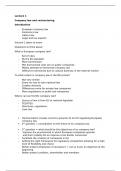
Introduction to corporate governance
• This course discusses the legal and external aspect of CG
• The main focus is on publicly listed companies
• These firms have shared traded in stock exchange
• They have a lot of shareholders sometimes thousands and operations in many countries
• However, there are issues that come with this
• This is not same as family business corporate governance
What is corporate governance?
• The OECD principles define corporate governance as:
• A set of relationships between a firm’s management, board, shareholders and stakeholders
• It provides the structure through which the objectives of the company are set
• And the means of attaining those objectives
• And monitoring performance are determined
Another definition could be…
,Listed company
• Firms that have shareholders which trade on the stock exchange
• There is the requirement of separation of powers
• You cannot have managing shareholders; too much problems associated with
• There is the necessity of transparency
• It is also required a certain level of control and monitoring framework
• Although there must be a right balance between monitoring and trust
Key elements of corporate governance
• Transparency
• Monitoring
• Firing and its conditions
• Duty of disclosure to shareholders on decisions taken by the board and management
• How do we keep things under control?
• Principle of autonomy
• Aim is to keep values of shares high
• However different jurisdictions and different companies have distinctive approaches
• Nevertheless, if you want to change, you need board approval!
• What is the corporate governance framework that you want for the companies?
• How to allocate powers
• Between managers and shareholders specifically
, Definitions of terms
Managers and board members
• A board of directors is an executive committee that jointly supervises the activities of an
organization,
• which can be either a for-profit or a nonprofit organization such as a business, nonprofit
organization, or a government agency.
• Manager and the board both run the company as they see fit, shareholders do not have
influence in this area
Shareholders
• A shareholder is any person, company, or institution that owns shares in a company's stock.
• A company shareholder can hold as little as one share.
• Shareholders are subject to capital gains (or losses) and/or dividend payments as residual
claimants on a firm's profits.
• They have the right to vote on company’s decisions (of significance)
• They appoint the board and management to run the company on their behalf
Stakeholders
• A stakeholder is a party that has an interest in a company and can either affect or be affected
by the business.
• The primary stakeholders in a typical corporation are its investors, employees, customers,
creditors, banks and suppliers.
• However, with the increasing attention on corporate social responsibility, the concept has
been extended to include communities, governments, and trade associations.
• The society in which we operate
• Big question is how do we regulate the relationship between stakeholders and the company?
• There is a fundamental difference between stakeholder and shareholder
• Different approaches
• However, in practice this is not the case
INTRODUCTION
LECTURE 1
DO THE READING AND DETERMINE WHAT THE AIM OF THE READER
ACTUALLY ENTAILS!
FINISH READINGS BEFORE THE NEXT LECTURE!
,• In lecture 7 state control is discussed
• Who is allowed to invest in companies etc.
• In lecture 8 that when everything is tied together
• A major recap.
Introduction to corporate governance
• This course discusses the legal and external aspect of CG
• The main focus is on publicly listed companies
• These firms have shared traded in stock exchange
• They have a lot of shareholders sometimes thousands and operations in many countries
• However, there are issues that come with this
• This is not same as family business corporate governance
What is corporate governance?
• The OECD principles define corporate governance as:
• A set of relationships between a firm’s management, board, shareholders and stakeholders
• It provides the structure through which the objectives of the company are set
• And the means of attaining those objectives
• And monitoring performance are determined
Another definition could be…
,Listed company
• Firms that have shareholders which trade on the stock exchange
• There is the requirement of separation of powers
• You cannot have managing shareholders; too much problems associated with
• There is the necessity of transparency
• It is also required a certain level of control and monitoring framework
• Although there must be a right balance between monitoring and trust
Key elements of corporate governance
• Transparency
• Monitoring
• Firing and its conditions
• Duty of disclosure to shareholders on decisions taken by the board and management
• How do we keep things under control?
• Principle of autonomy
• Aim is to keep values of shares high
• However different jurisdictions and different companies have distinctive approaches
• Nevertheless, if you want to change, you need board approval!
• What is the corporate governance framework that you want for the companies?
• How to allocate powers
• Between managers and shareholders specifically
, Definitions of terms
Managers and board members
• A board of directors is an executive committee that jointly supervises the activities of an
organization,
• which can be either a for-profit or a nonprofit organization such as a business, nonprofit
organization, or a government agency.
• Manager and the board both run the company as they see fit, shareholders do not have
influence in this area
Shareholders
• A shareholder is any person, company, or institution that owns shares in a company's stock.
• A company shareholder can hold as little as one share.
• Shareholders are subject to capital gains (or losses) and/or dividend payments as residual
claimants on a firm's profits.
• They have the right to vote on company’s decisions (of significance)
• They appoint the board and management to run the company on their behalf
Stakeholders
• A stakeholder is a party that has an interest in a company and can either affect or be affected
by the business.
• The primary stakeholders in a typical corporation are its investors, employees, customers,
creditors, banks and suppliers.
• However, with the increasing attention on corporate social responsibility, the concept has
been extended to include communities, governments, and trade associations.
• The society in which we operate
• Big question is how do we regulate the relationship between stakeholders and the company?
• There is a fundamental difference between stakeholder and shareholder
• Different approaches
• However, in practice this is not the case