
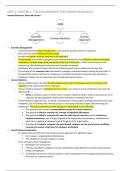
UNIT 1 CHAPTER 1: THE ENVIRONMENT FOR HUMAN RESOURCES
Human Resources: Past and Present
HRM
Scientific Human
Human Relations
Management Approach
→ Scientific Management
- Concerns itself with output management: producing the greatest amount of products
- Has a lot to do with maximizing financial gain
- In order to receive incentive, work has to be produced.
- The technique of scientific management generally considered the most effective means of managing
employees- constant supervision and threat of the loss of their jobs – if their productivity did not
measure up, their employment deserved to be quickly terminated.
- Employees who produced output above the standard would receive additional incentive pay.
- The concept of the economic man embraced by managers and administrators during the early part of
the twentieth century, held that an employee is motivated primarily by economic gain and that an
employee’s output can be maximized only through financial incentives.
→ Human Relations
- Human relations has to do with the physiological well-being of employees and has nothing to with
income but the social needs of the employees.
- Human relations always for employees to form unions. As a result of unions employees now have the
right to strike
Strike: a collective action in which union members refuse to work in order to put pressure on an
employer during negotiations until certain demands or conditions are met.
- Human Relations approach was, no doubt, instrumental in improving the working environment of many
employees, but it achieved only minimal success in increasing employee output and enhancing job
satisfaction. The poor performance of the approach is attributable to the following:
The approach was based on oversimplified concept of human behaviour
The approach failed to consider the concept of individual differences.
The approach failed to recognize the need for both the job structure and for controls on
employee behaviour, and it largely neglected the importance of procedures, standards and
work rules in guiding employees toward the goals of the organisation.
The approach failed to recognize the good human relations are but one of many conditions
necessary to sustain a high level of employee motivation.
→ Human Resource Approach
- An organisation benefits from the human resource approach in 2 significant ways:
An increase in organisational effectiveness
The satisfaction of each employee’s needs.
- The 4 principles of the HR approach
Employees are investments
Policies, procedures, programs must be created that satisfy both the economic and emotional
needs of employees.
A working environment must be created in which employees are encouraged to develop and use
their skills to maximum extent.
, HR programmes and practices must be implemented with the goal of balancing the needs and
meeting the goals of the organisation and employee.
Strategic HRM
→ Definition of Strategic Human Resource Management (SHRM)
- A focus on the integration and alignment of all HR policies with one another and with the overall strategy
and direction of the organisation.
- Eg. Keeping Employee records is part of Strategic HR
→ The differences between SHRM and traditional HRM
Human Resources: Past and Present
HRM
Scientific Human
Human Relations
Management Approach
→ Scientific Management
- Concerns itself with output management: producing the greatest amount of products
- Has a lot to do with maximizing financial gain
- In order to receive incentive, work has to be produced.
- The technique of scientific management generally considered the most effective means of managing
employees- constant supervision and threat of the loss of their jobs – if their productivity did not
measure up, their employment deserved to be quickly terminated.
- Employees who produced output above the standard would receive additional incentive pay.
- The concept of the economic man embraced by managers and administrators during the early part of
the twentieth century, held that an employee is motivated primarily by economic gain and that an
employee’s output can be maximized only through financial incentives.
→ Human Relations
- Human relations has to do with the physiological well-being of employees and has nothing to with
income but the social needs of the employees.
- Human relations always for employees to form unions. As a result of unions employees now have the
right to strike
Strike: a collective action in which union members refuse to work in order to put pressure on an
employer during negotiations until certain demands or conditions are met.
- Human Relations approach was, no doubt, instrumental in improving the working environment of many
employees, but it achieved only minimal success in increasing employee output and enhancing job
satisfaction. The poor performance of the approach is attributable to the following:
The approach was based on oversimplified concept of human behaviour
The approach failed to consider the concept of individual differences.
The approach failed to recognize the need for both the job structure and for controls on
employee behaviour, and it largely neglected the importance of procedures, standards and
work rules in guiding employees toward the goals of the organisation.
The approach failed to recognize the good human relations are but one of many conditions
necessary to sustain a high level of employee motivation.
→ Human Resource Approach
- An organisation benefits from the human resource approach in 2 significant ways:
An increase in organisational effectiveness
The satisfaction of each employee’s needs.
- The 4 principles of the HR approach
Employees are investments
Policies, procedures, programs must be created that satisfy both the economic and emotional
needs of employees.
A working environment must be created in which employees are encouraged to develop and use
their skills to maximum extent.
, HR programmes and practices must be implemented with the goal of balancing the needs and
meeting the goals of the organisation and employee.
Strategic HRM
→ Definition of Strategic Human Resource Management (SHRM)
- A focus on the integration and alignment of all HR policies with one another and with the overall strategy
and direction of the organisation.
- Eg. Keeping Employee records is part of Strategic HR
→ The differences between SHRM and traditional HRM


