Learning
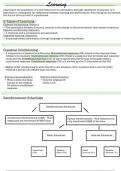
Learning is the acquisition of a new behaviour or information through experience of practice. It is
important to distinguish the differences between learning and performance. Something can be learned,
but it's not obvious until it is performed.
3 Types of Learning
Classical conditioning (Pavlov):
• The association between 2 stimuli (stimuli is the change in the environment that causes a reaction)
Operant conditioning (Skinner):
• A response and a consequence are associated.
Cognitive learning (Bandura):
• Acquiring mental information through language or observing others.
Classical Conditioning
• 4 components of classical conditioning: Unconditioned response (UR) which is the response thats
re exive/involuntary. Unconditioned stimulus (US) which is a stimulus that precedes and naturally
elicits the UR. Conditioned Stimulus (CS) is any S paired with the US that eventually elicits a
conditioned response. Conditioned response (CR) a R elicited by the CS (the same as the UR)
• Higher order conditioning is when the CS in one situation (CS1) is paired with a new CS (CS2)
creating a second CR (weaker than the rst)
Stimulus Generalization: Stimulus Discrimination:
• When a stimulus thats • Only the original CS
similar to the original elicits a CR
CS elicits a conditioned
response
Reinforcement Schedules
Reinforcement Schedules
Continuous reinforcement (CRF) - Your Partial reinforcement - Your behaviour is
responses are reinforced EVERY time only reinforced SOME of the time
Ratio Schedules Interval Schedules
Fixed Ratio Variable Fixed Variable
(FR) Ratio (VR) Interval (FI) Interval (Vi)
Learning is the acquisition of a new behaviour or information through experience of practice. It is
important to distinguish the differences between learning and performance. Something can be learned,
but it's not obvious until it is performed.
3 Types of Learning
Classical conditioning (Pavlov):
• The association between 2 stimuli (stimuli is the change in the environment that causes a reaction)
Operant conditioning (Skinner):
• A response and a consequence are associated.
Cognitive learning (Bandura):
• Acquiring mental information through language or observing others.
Classical Conditioning
• 4 components of classical conditioning: Unconditioned response (UR) which is the response thats
re exive/involuntary. Unconditioned stimulus (US) which is a stimulus that precedes and naturally
elicits the UR. Conditioned Stimulus (CS) is any S paired with the US that eventually elicits a
conditioned response. Conditioned response (CR) a R elicited by the CS (the same as the UR)
• Higher order conditioning is when the CS in one situation (CS1) is paired with a new CS (CS2)
creating a second CR (weaker than the rst)
Stimulus Generalization: Stimulus Discrimination:
• When a stimulus thats • Only the original CS
similar to the original elicits a CR
CS elicits a conditioned
response
Reinforcement Schedules
Reinforcement Schedules
Continuous reinforcement (CRF) - Your Partial reinforcement - Your behaviour is
responses are reinforced EVERY time only reinforced SOME of the time
Ratio Schedules Interval Schedules
Fixed Ratio Variable Fixed Variable
(FR) Ratio (VR) Interval (FI) Interval (Vi)