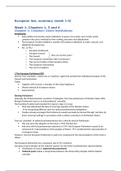
European law, summary (week 1-4)
Week 1: Chapters 1, 5 and 6
Chapter 1: Creation: Union Institutions
Introduction
Each politcal community needs insttutons to govern its society; each society needs
common rules and a method for their making, executon and adjudicatonn
The European Treates establish a number of European insttutons to make, execute, and
adjudicate European lawn
Artn 13 TEU:
o European Parliament
o European Council
o The Council They are not the same!
o The European Commission (the Commission)
o The Court of Justce of the European Union
o The European Central Bank
o The Court of Auditors
1.The European Parliament (EP)
Not the ‘frstt’ insttutonn Used to be an ‘auxiliaryt’ organ that assisted the insttutonal duopoly of the
Council and Commissionn
Today:
Together with Council: a chamber of the Union legislature
Directly elected by European citiens
Supranatonal
Electing Parliament
Originally the Parliamentarians consisted of delegates from the parliaments of Member States (MS)n
Brought Parliament close to an (internatonal) ‘assemblyt’n
The founding Treates had breached the classis IL logic in 2 ways:
They had abandoned the idea of sovereign equality of the Member States
by recogniiing diferent siies for natonal parliamentary delegatons
Treates already envisaged that Parliament would eventually be formed through ‘electons by
direct universal sufrage in accordance with a uniform procedure of all Member Statest’
From an ‘assemblyt’ of natonal parliamentarians into a directly elected Parliament:
This was since the adopton of the Uniont’s 1976 ‘Electon Actt’
And since the frst parliamentary electons in 1979, the European Parliament ceased to be
composed of ‘representatves of the peoples of Statest’ it consttuted the representatve of
a European Unionn
However, now the European Parliament is said to be composed of the representatves of the Uniont’s
citienn
The European Parliament has a maximum siie of 751 membersn
European Council decides on the natonal ‘quotast’ for the Uniont’s parliamentary representatvesn
Distributon of seats is degressively proportional
National quota makes a compromise between the democratc principle and the federal
principle
, o Democratc: each citien in Union has equal votng power
o Federal: insists on the politcal existence of States
Result of compromise was the rejecton of a purely proportonal distributon in favor of a
degressively proportonal system
Which means that not every citien has the same votng power!
Degressive element means that a Luxembourg citien has 10x more votng power than a
German citien
Members are elected for 5 years
The specifes of the electon procedure are lef to the Member States, but should be in
accordance with principles common to all MSt’s
Citiens of the EU residing in another MS, have the same rights as natonals of that State
Electons on the basis of proportonal representaton, they do not follow a uniform electoral
procedure in all Member States
o But Treates insist on one common rule constitutional rule: all members shall
have the right to vote and to stand as a candidate in electons
Parliamentary powers
At frst, the Parliament was only given supervisory powers, as a passive onlooker on the
decision-making process, later it became advisoryn
Later the Parliament ‘advisory and supervisory powerst’ active power
o Parliament had to be consulted on Commission proposals before their adopton
by the Council
Now 4 types of powers:
in Legislatve powers
o Propose new legislaton (making the formal bill is done by the Commission)
o The legislatve involvement of Parliament starts afer the Commission has
submitted a proposal to the European legislature
o Treates now distnguish between ‘ordinaryt’ legislatve procedure and ‘specialt’
legislatve procedure
Ordinary: the joint adopton by the EP and the Council
Special: cover various degrees of parliamentary partcipaton
Consent procedure: Parliament must give its consent before the
Council can adopt European legislaton, but they cannot amend
which leads to a take-or-leave positon
Consultation procedure: Parliament is not enttled to give its
consent, it only needs to be consulted
iin Budgetary powers
o Not focused on the income side, but on the expenditure side
o EPt’s involvement in the Union budget started with the 1970 and 1975 Budget
Treates
o Budget Treates distnguish:
Compulsory expenditure: fnancial commitments from the applicaton of
EU law
Non-compulsory expenditure: expenditure that would not result from
compulsory fnancial commitments fowing from the applicaton of EU
law
Later this distncton was abandoned and Parliament became
equal with the Council in establishing the budget
iiin Supervisory powers
o The power to debate, queston and investgate
Week 1: Chapters 1, 5 and 6
Chapter 1: Creation: Union Institutions
Introduction
Each politcal community needs insttutons to govern its society; each society needs
common rules and a method for their making, executon and adjudicatonn
The European Treates establish a number of European insttutons to make, execute, and
adjudicate European lawn
Artn 13 TEU:
o European Parliament
o European Council
o The Council They are not the same!
o The European Commission (the Commission)
o The Court of Justce of the European Union
o The European Central Bank
o The Court of Auditors
1.The European Parliament (EP)
Not the ‘frstt’ insttutonn Used to be an ‘auxiliaryt’ organ that assisted the insttutonal duopoly of the
Council and Commissionn
Today:
Together with Council: a chamber of the Union legislature
Directly elected by European citiens
Supranatonal
Electing Parliament
Originally the Parliamentarians consisted of delegates from the parliaments of Member States (MS)n
Brought Parliament close to an (internatonal) ‘assemblyt’n
The founding Treates had breached the classis IL logic in 2 ways:
They had abandoned the idea of sovereign equality of the Member States
by recogniiing diferent siies for natonal parliamentary delegatons
Treates already envisaged that Parliament would eventually be formed through ‘electons by
direct universal sufrage in accordance with a uniform procedure of all Member Statest’
From an ‘assemblyt’ of natonal parliamentarians into a directly elected Parliament:
This was since the adopton of the Uniont’s 1976 ‘Electon Actt’
And since the frst parliamentary electons in 1979, the European Parliament ceased to be
composed of ‘representatves of the peoples of Statest’ it consttuted the representatve of
a European Unionn
However, now the European Parliament is said to be composed of the representatves of the Uniont’s
citienn
The European Parliament has a maximum siie of 751 membersn
European Council decides on the natonal ‘quotast’ for the Uniont’s parliamentary representatvesn
Distributon of seats is degressively proportional
National quota makes a compromise between the democratc principle and the federal
principle
, o Democratc: each citien in Union has equal votng power
o Federal: insists on the politcal existence of States
Result of compromise was the rejecton of a purely proportonal distributon in favor of a
degressively proportonal system
Which means that not every citien has the same votng power!
Degressive element means that a Luxembourg citien has 10x more votng power than a
German citien
Members are elected for 5 years
The specifes of the electon procedure are lef to the Member States, but should be in
accordance with principles common to all MSt’s
Citiens of the EU residing in another MS, have the same rights as natonals of that State
Electons on the basis of proportonal representaton, they do not follow a uniform electoral
procedure in all Member States
o But Treates insist on one common rule constitutional rule: all members shall
have the right to vote and to stand as a candidate in electons
Parliamentary powers
At frst, the Parliament was only given supervisory powers, as a passive onlooker on the
decision-making process, later it became advisoryn
Later the Parliament ‘advisory and supervisory powerst’ active power
o Parliament had to be consulted on Commission proposals before their adopton
by the Council
Now 4 types of powers:
in Legislatve powers
o Propose new legislaton (making the formal bill is done by the Commission)
o The legislatve involvement of Parliament starts afer the Commission has
submitted a proposal to the European legislature
o Treates now distnguish between ‘ordinaryt’ legislatve procedure and ‘specialt’
legislatve procedure
Ordinary: the joint adopton by the EP and the Council
Special: cover various degrees of parliamentary partcipaton
Consent procedure: Parliament must give its consent before the
Council can adopt European legislaton, but they cannot amend
which leads to a take-or-leave positon
Consultation procedure: Parliament is not enttled to give its
consent, it only needs to be consulted
iin Budgetary powers
o Not focused on the income side, but on the expenditure side
o EPt’s involvement in the Union budget started with the 1970 and 1975 Budget
Treates
o Budget Treates distnguish:
Compulsory expenditure: fnancial commitments from the applicaton of
EU law
Non-compulsory expenditure: expenditure that would not result from
compulsory fnancial commitments fowing from the applicaton of EU
law
Later this distncton was abandoned and Parliament became
equal with the Council in establishing the budget
iiin Supervisory powers
o The power to debate, queston and investgate