

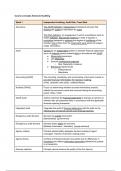
Course concepts Advanced Auditing
Week 1 Independent Auditing, Audit Risk, Fraud Risk
Assurance The AICPA definition: Independent professional services that
improve the quality of information for users
The IFAC definition: An engagement in which a practitioner aims to
obtain sufficient, appropriate evidence in order to express a
conclusion designed to enhance the degree of confidence of the
intended users Other than the responsible party about the subject
matter information.”
Audit Opinion by an independent auditor on whether financial statements
are in all material aspects present fairly in accordance with GAAP
● Reasonable assurance
● Use Materiality
● Exercise professional judgment
○ Risk, Materiality, Evidence
● Behavioral requirements
○ Independence
○ Skepticism
Accounting [GAAP] The recording, classifying, and summarizing of economic events to
provide financial information for decision making.
(IFRS, USGAAP, DAS (ESG: CSRD/EFRAG))
Auditors [GAAS] Focus on determining whether recorded information properly
reflects the economic events that occurred during the accounting
period. (ISAs, COS)
GAAS Audit Auditor examines the financial statements to express an opinion on
whether they are presented fairly in accordance with the applicable
financial reporting framework
Integrated Audit Integrates the audit of financial statements with the audit on the
effectiveness of internal controls over financial reporting
Exogenous audit demand Demand by outside intervention
[Stewardship] (government)
Endogenous audit demand Demand arises within the economy
[Reliable Information / Valuation] (supply-demand)
Agency relation Principle (shareholder) delegates decision-making to agent
(manager). Transfer of decision-making power
Agency theory Conflicts of interests between two parties due to differences in
incentives and reflects information asymmetry between two parties
to a transaction
Adverse selection Principle cannot observe the quality of the firm (lemon)
, Moral Hazard Agent actions not observed yet incentivized (work hard / shirk)
Independence of Mind State of mind that permits the expression of a conclusion without
being affected by influences that compromise judgment, allowing to
act with integrity, and exercise objectivity and professional
skepticism.
Independence of The avoidance of facts and circumstances that are so significant
Appearance that a reasonable and informed third party, having knowledge of all
relevant information would reasonably conclude that a
firm’s/auditor’s integrity, objectivity, or professional skepticism has
been compromised.
Risk A threat to an organization that reduces the likelihood that the
organization will achieve one or more of its objectives.
Risk Assessment ● Identification
● Measurement
● Prioritization
Risk Management ● Control it
● Share or Transfer it
● Diversity or Avoid it
Risk Monitoring ● Process Level
● Activity Level
● Entity Level
Business Risk Threat to an organization not meeting objectives
Audit Risk RMM. The auditor expresses an inappropriate audit opinion when
financial statements are materially misstated. Type-2 error 5%
Audit Risk Model AR = f (RMM, DR)
Risk of Material Risk that financial statements are misstated prior to the audit.
Misstatements (RMM) (consists of inherent risk (IR) and internal control risk (CR))
Detection Risk (DR) Risk that the auditor will not detect a material misstatement.
Reasons: the auditor…
● Samples (sampling risk)
● Selects ineffective audit procedures
● Applies procedures ineffectively
● Evaluates the results of procedures incorrect
Engagement Risk Litigation, Regulatory penalties, Reputation Loss, Lack of
Profitability
Audit Business Risk Risk of loss to an auditor’s practice due to client relationships (aka
engagement risk)
Intentional misstatements An intentional act by one or more individuals among management,
those charged with governance, employees, or third parties,
Week 1 Independent Auditing, Audit Risk, Fraud Risk
Assurance The AICPA definition: Independent professional services that
improve the quality of information for users
The IFAC definition: An engagement in which a practitioner aims to
obtain sufficient, appropriate evidence in order to express a
conclusion designed to enhance the degree of confidence of the
intended users Other than the responsible party about the subject
matter information.”
Audit Opinion by an independent auditor on whether financial statements
are in all material aspects present fairly in accordance with GAAP
● Reasonable assurance
● Use Materiality
● Exercise professional judgment
○ Risk, Materiality, Evidence
● Behavioral requirements
○ Independence
○ Skepticism
Accounting [GAAP] The recording, classifying, and summarizing of economic events to
provide financial information for decision making.
(IFRS, USGAAP, DAS (ESG: CSRD/EFRAG))
Auditors [GAAS] Focus on determining whether recorded information properly
reflects the economic events that occurred during the accounting
period. (ISAs, COS)
GAAS Audit Auditor examines the financial statements to express an opinion on
whether they are presented fairly in accordance with the applicable
financial reporting framework
Integrated Audit Integrates the audit of financial statements with the audit on the
effectiveness of internal controls over financial reporting
Exogenous audit demand Demand by outside intervention
[Stewardship] (government)
Endogenous audit demand Demand arises within the economy
[Reliable Information / Valuation] (supply-demand)
Agency relation Principle (shareholder) delegates decision-making to agent
(manager). Transfer of decision-making power
Agency theory Conflicts of interests between two parties due to differences in
incentives and reflects information asymmetry between two parties
to a transaction
Adverse selection Principle cannot observe the quality of the firm (lemon)
, Moral Hazard Agent actions not observed yet incentivized (work hard / shirk)
Independence of Mind State of mind that permits the expression of a conclusion without
being affected by influences that compromise judgment, allowing to
act with integrity, and exercise objectivity and professional
skepticism.
Independence of The avoidance of facts and circumstances that are so significant
Appearance that a reasonable and informed third party, having knowledge of all
relevant information would reasonably conclude that a
firm’s/auditor’s integrity, objectivity, or professional skepticism has
been compromised.
Risk A threat to an organization that reduces the likelihood that the
organization will achieve one or more of its objectives.
Risk Assessment ● Identification
● Measurement
● Prioritization
Risk Management ● Control it
● Share or Transfer it
● Diversity or Avoid it
Risk Monitoring ● Process Level
● Activity Level
● Entity Level
Business Risk Threat to an organization not meeting objectives
Audit Risk RMM. The auditor expresses an inappropriate audit opinion when
financial statements are materially misstated. Type-2 error 5%
Audit Risk Model AR = f (RMM, DR)
Risk of Material Risk that financial statements are misstated prior to the audit.
Misstatements (RMM) (consists of inherent risk (IR) and internal control risk (CR))
Detection Risk (DR) Risk that the auditor will not detect a material misstatement.
Reasons: the auditor…
● Samples (sampling risk)
● Selects ineffective audit procedures
● Applies procedures ineffectively
● Evaluates the results of procedures incorrect
Engagement Risk Litigation, Regulatory penalties, Reputation Loss, Lack of
Profitability
Audit Business Risk Risk of loss to an auditor’s practice due to client relationships (aka
engagement risk)
Intentional misstatements An intentional act by one or more individuals among management,
those charged with governance, employees, or third parties,


