🧠
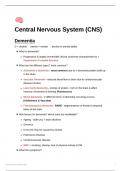
Central Nervous System (CNS)
Dementia
D = decline mentia = mental - decline in mental ability
What is dementia?
Progressive & largely irreversible clinical syndrome characterised by =
impairment of mental function
What are the different types? most common?
Alzheimer’s Dementia - most common due to = dementia protein build up
in the brain
Vascular Dementia - reduced blood flow to brain due to cerebrovascular
disease (stroke)
Lewy body Dementia - clumps of protein - form in the brain & affect
memory, movement & thinking (Parkinson's)
Mixed Dementia - 2 different forms of dementia occurring at once
(Alzheimers & Vascular)
Frontotemporal dementia - RARE - degenerations of frontal & temporal
lobes of the brain
Risk factors for dementia? which ones are modifiable?
Ageing - older you = brain declines
Genetics
CVD (VD may be caused by stroke)
Parkinsons Disease
Cerebrovascular disease
MRF = smoking, obesity, lack of physical activity & DM
What the symptoms?
Central Nervous System (CNS) 1
, Cognitive dysfunction - memory loss, concentration, communication,
reasoning & problem solving
Behaviour symptoms - aggression, distress, agitation, psychosis
Difficulties with activities of daily living - washing, dressing etc
Aims of treatment?
Promote independence
Maintain function
Manage symptoms of dementia
Non-drug treatment = provide structured group cognitive stimulation
programme to patients with all types of dementia (cognitive symptoms)
Mainly due to?
Low ACh (cause decline in mental capacity)
Blood proteins = Lewy bodies = reduce capacity of brain
Low blood to the brain due to VD
Relationship of antipsychotics with elderly pts with dementia? (MHRA)
MHRA = increased risk of stroke & death when AP = used in elderly pts with
dementia
Balance risk to benefits & assess any previous history of stroke/TIA & risk
factors for cerebrovascular disease (HTN, diabetes, smoking, AF)
AP = used at lowest effective dose (self-harm or agitation) & shortest time
possible - regular review every 6 weeks
Antipsychotics use in dementia? (MHRA)
Only offered to dementia patients = risk of harming themselves or others
Experiencing hallucinations, agitation or delusions causing severe
distress
Antipsychotics in patients with levy bodies or Parkinsons disease?
AVOID - Can worsen motor symptoms
Extra care with antimuscarinic/anticholinergic drugs?
They may worsen symptoms of dementia by breaking down or reducing
ACh
Central Nervous System (CNS) 2
, Drug treatment for frontotemporal dementia?
No cure
Treatment
Mild-moderate Alzheimers disease? dose?
ACh = 1st line - DRG
Donepezil
Initially 5mg OD = 1 month
Increased if necessary to 10mg daily
Given at bed time
Galantamine
4mg BD = 4 weeks
Increased to 8mg BD = 4 weeks
Maintenance = 8-12mg BD
Rivastigmine
1.5mg BD
Increased in steps of 1.5mg BD at intervals of atleast 2 weeks
Dose increased according to response & tolerance
Usual dose = 3-6mg BD
Moderate-severe Alzheimers disease? or if above CI or severe?
Can be used as an alternative or add on treatment - if severe go straight to
memantine
Memantine - add to ACh
Initially 5mg OD
Increased in steps of 5mg every week
Usual maintenance of 20mg daily
Max daily dose = 20mg
Central Nervous System (CNS) 3
, (NA) Mild-severe dementia with Levy bodies?
1st line = Donepezil OR rivastigmine (D = 5mg OD = 1 month - 10mg if
necessary at bed time)
Galantamine only used = both are not tolerated
ALL = unlicensed treatment in non-alzheimers dementia
Vascular dementia? what is required?
ACh or Memantine
Only use on pts with suspected co-morbidities
E.g = Alzheimer’s, Parkinson’s dementia or Lewy body dementia
Frontotemporal dementia?
ACh inhibitor & memantine = NOT recommended
Antidepressants & antipsychotics = can help reduce symptoms
Discontinuing ACh inhibitors?
Pts with moderate Alzheimer’s disease - discontinuing can cause =
substantial worsening in cognitive function
Anticholinergic drugs in dementia? what can they cause?
May increase cognitive impairment - their use should be = minimised
Antidepressants (amitriptyline or paroxetine)
Antihistamines (chlorphenamine or promethazine)
Antipsychotics (quetiapine or olanzapine)
Urinary antispasmodics (solifenacin or tolterodine)
Key Points Anti-Epileptic Drugs
Monotherapy preferred
Start slow & increase dose slowly
Don’t withdraw abruptly - do it slow 2-6 months
Stick to the same brand for CP3 drugs (carbamazepine, phenobarbital,
primidone & phenytoin)
Central Nervous System (CNS) 4
, All cause suicidal thoughts
All teratogenic - thus may have high dose folic acid used in pregnancy
Epilepsy
Treatment aims?
Prevent occurrence of seizures
How are doses adjusted? dosage frequency?
Adjust doses if necessary - start small dose & gradually increase until
seizure controlled
Keep dosage frequency as low as possible to encourage pt adherence
Choice of AE drug depends on what?
Several factors including:
Co-morbidity
Concomitant medication
Age
Sex (SV & PPP)
Epilepsy syndrome type
Which AE drugs have a long half life & can be given OD? (Memory trick)
LP3 (LONG PERIOD 3) (can be given OD at bedtime)
Lamotrigine
Perampanel
Phenobarbital
Phenytoin
How is monotherapy initiated? how to switch to another AE?
Monotherapy with 1st line AE
If this fails = monotherapy = 2nd drug
Cautiously change from on AE to another
Central Nervous System (CNS) 5
, Slowly withdraw first drug only when new regimen established (pt will
be on 1 drug; then 2 - then initial drug will be withdrawn slowly)
Avoid abrupt withdrawal = cause rebound seizures
What is the risk with combination therapy?
2 or more AE = may be necessary
Increases chances of side effects & interactions
What if combination therapy fails?
Revert to the regimen (mono or combo) that provided best balance between
tolerability & efficacy
Prescribe a single AE where possible
MHRA/CHM ADVICE? (switching)
Potential harm between switching patients stabilised on brands for epilepsy
to generic products
What AE drugs need to be maintained on a specific brand?
Only for epilepsy
Category 1 drugs - as they vary in bioavailability
Category 1 drugs? (memory trick)
CPR3 (also cause hypersensitivity syndrome)
Carbamazepine (tegretol, carbagen) (retard & IR)
Phenytoin (epanutin)
Phenobarbital
Primidone
Category 2 drugs? (memory trick)
Need for continuity depends on clinical judgement from prescriber/consultant &
consultation with patient/carer
L.C.C.T.V
Lamotrigine
Clobazam
Clonazepam
Central Nervous System (CNS) 6
Central Nervous System (CNS)
Dementia
D = decline mentia = mental - decline in mental ability
What is dementia?
Progressive & largely irreversible clinical syndrome characterised by =
impairment of mental function
What are the different types? most common?
Alzheimer’s Dementia - most common due to = dementia protein build up
in the brain
Vascular Dementia - reduced blood flow to brain due to cerebrovascular
disease (stroke)
Lewy body Dementia - clumps of protein - form in the brain & affect
memory, movement & thinking (Parkinson's)
Mixed Dementia - 2 different forms of dementia occurring at once
(Alzheimers & Vascular)
Frontotemporal dementia - RARE - degenerations of frontal & temporal
lobes of the brain
Risk factors for dementia? which ones are modifiable?
Ageing - older you = brain declines
Genetics
CVD (VD may be caused by stroke)
Parkinsons Disease
Cerebrovascular disease
MRF = smoking, obesity, lack of physical activity & DM
What the symptoms?
Central Nervous System (CNS) 1
, Cognitive dysfunction - memory loss, concentration, communication,
reasoning & problem solving
Behaviour symptoms - aggression, distress, agitation, psychosis
Difficulties with activities of daily living - washing, dressing etc
Aims of treatment?
Promote independence
Maintain function
Manage symptoms of dementia
Non-drug treatment = provide structured group cognitive stimulation
programme to patients with all types of dementia (cognitive symptoms)
Mainly due to?
Low ACh (cause decline in mental capacity)
Blood proteins = Lewy bodies = reduce capacity of brain
Low blood to the brain due to VD
Relationship of antipsychotics with elderly pts with dementia? (MHRA)
MHRA = increased risk of stroke & death when AP = used in elderly pts with
dementia
Balance risk to benefits & assess any previous history of stroke/TIA & risk
factors for cerebrovascular disease (HTN, diabetes, smoking, AF)
AP = used at lowest effective dose (self-harm or agitation) & shortest time
possible - regular review every 6 weeks
Antipsychotics use in dementia? (MHRA)
Only offered to dementia patients = risk of harming themselves or others
Experiencing hallucinations, agitation or delusions causing severe
distress
Antipsychotics in patients with levy bodies or Parkinsons disease?
AVOID - Can worsen motor symptoms
Extra care with antimuscarinic/anticholinergic drugs?
They may worsen symptoms of dementia by breaking down or reducing
ACh
Central Nervous System (CNS) 2
, Drug treatment for frontotemporal dementia?
No cure
Treatment
Mild-moderate Alzheimers disease? dose?
ACh = 1st line - DRG
Donepezil
Initially 5mg OD = 1 month
Increased if necessary to 10mg daily
Given at bed time
Galantamine
4mg BD = 4 weeks
Increased to 8mg BD = 4 weeks
Maintenance = 8-12mg BD
Rivastigmine
1.5mg BD
Increased in steps of 1.5mg BD at intervals of atleast 2 weeks
Dose increased according to response & tolerance
Usual dose = 3-6mg BD
Moderate-severe Alzheimers disease? or if above CI or severe?
Can be used as an alternative or add on treatment - if severe go straight to
memantine
Memantine - add to ACh
Initially 5mg OD
Increased in steps of 5mg every week
Usual maintenance of 20mg daily
Max daily dose = 20mg
Central Nervous System (CNS) 3
, (NA) Mild-severe dementia with Levy bodies?
1st line = Donepezil OR rivastigmine (D = 5mg OD = 1 month - 10mg if
necessary at bed time)
Galantamine only used = both are not tolerated
ALL = unlicensed treatment in non-alzheimers dementia
Vascular dementia? what is required?
ACh or Memantine
Only use on pts with suspected co-morbidities
E.g = Alzheimer’s, Parkinson’s dementia or Lewy body dementia
Frontotemporal dementia?
ACh inhibitor & memantine = NOT recommended
Antidepressants & antipsychotics = can help reduce symptoms
Discontinuing ACh inhibitors?
Pts with moderate Alzheimer’s disease - discontinuing can cause =
substantial worsening in cognitive function
Anticholinergic drugs in dementia? what can they cause?
May increase cognitive impairment - their use should be = minimised
Antidepressants (amitriptyline or paroxetine)
Antihistamines (chlorphenamine or promethazine)
Antipsychotics (quetiapine or olanzapine)
Urinary antispasmodics (solifenacin or tolterodine)
Key Points Anti-Epileptic Drugs
Monotherapy preferred
Start slow & increase dose slowly
Don’t withdraw abruptly - do it slow 2-6 months
Stick to the same brand for CP3 drugs (carbamazepine, phenobarbital,
primidone & phenytoin)
Central Nervous System (CNS) 4
, All cause suicidal thoughts
All teratogenic - thus may have high dose folic acid used in pregnancy
Epilepsy
Treatment aims?
Prevent occurrence of seizures
How are doses adjusted? dosage frequency?
Adjust doses if necessary - start small dose & gradually increase until
seizure controlled
Keep dosage frequency as low as possible to encourage pt adherence
Choice of AE drug depends on what?
Several factors including:
Co-morbidity
Concomitant medication
Age
Sex (SV & PPP)
Epilepsy syndrome type
Which AE drugs have a long half life & can be given OD? (Memory trick)
LP3 (LONG PERIOD 3) (can be given OD at bedtime)
Lamotrigine
Perampanel
Phenobarbital
Phenytoin
How is monotherapy initiated? how to switch to another AE?
Monotherapy with 1st line AE
If this fails = monotherapy = 2nd drug
Cautiously change from on AE to another
Central Nervous System (CNS) 5
, Slowly withdraw first drug only when new regimen established (pt will
be on 1 drug; then 2 - then initial drug will be withdrawn slowly)
Avoid abrupt withdrawal = cause rebound seizures
What is the risk with combination therapy?
2 or more AE = may be necessary
Increases chances of side effects & interactions
What if combination therapy fails?
Revert to the regimen (mono or combo) that provided best balance between
tolerability & efficacy
Prescribe a single AE where possible
MHRA/CHM ADVICE? (switching)
Potential harm between switching patients stabilised on brands for epilepsy
to generic products
What AE drugs need to be maintained on a specific brand?
Only for epilepsy
Category 1 drugs - as they vary in bioavailability
Category 1 drugs? (memory trick)
CPR3 (also cause hypersensitivity syndrome)
Carbamazepine (tegretol, carbagen) (retard & IR)
Phenytoin (epanutin)
Phenobarbital
Primidone
Category 2 drugs? (memory trick)
Need for continuity depends on clinical judgement from prescriber/consultant &
consultation with patient/carer
L.C.C.T.V
Lamotrigine
Clobazam
Clonazepam
Central Nervous System (CNS) 6