Lecture 1
Borrowing
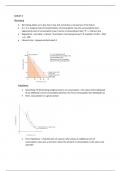
• Borrowing allows us to buy more now, but constrains us to buy less in the future
• (1 + r) is marginal rate of transformation of consumption now into consumption later,
opportunity cost of consumption now in terms of consumption later → r = interest rate
• Repayment = principal + interest → principal = borrowing amount → example: 91+91r = 91(1
+ r) = 100
• Interest rate = (repayment/principal)-1
Impatience
• Smoothing → diminishing marginal returns to consumption = the value of the individual
of an additional unit of consumption declines, the more consumption the individual has
• Here: consumption in a given period
• Pure impatience = characteristic of a person who values an additional unit of
consumption now over a unit later, when the amount of consumption is the same now
and later
,Person’s discount rate
• A person’s discount rate = p = is a measure of a person’s impatience: how much she
values an extra unit of consumption now over an extra unit of consumption later
• This is the slope of her indifference curve between consumption now and consumption
later, minus one
• Slope of the indifference curve (MRS) = slope of the feasible frontier (MRT)
• MRS = 1 + p
• MRT = 1 + r
• p=r
Guided preperation assignment 1
Economic fluctautions and unemployment
• Fluctuations in total output of a nation (GDP) affect unemployment & unemployment is
serious hardship
• Economists measure the size of economy using the national accounts: these measure
economic fluctuations & growth
• Households respond to shocks by saving, borrowing, and sharing to smooth their
consumption of goods and services
• Due to limits on people’s ability to borrow, these strategies are not sufficient to eliminate
shocks to their consumption
, • Investment spending by firms & households (on new housing) fluctuates more than
consumption
The labour market
• Unemployed people are people who:
o were without work during a reference period (usually four weeks), which means
they were not in paid employment or self-employment
o were available for work
o were seeking work, which means they had taken specific steps in that period to
seek paid employment or self-employment
• Participation rate = labour force / population of working age
• Unemployment rate = unemployed / labour force
• Employment rate = employed / population of working age
Growth and fluctuations
• Definition of recession:
o National Bureau of Economic Research (NBER): output is declining. Recession is
over once the economy begins to growth again
o Alternative: output is below normal level. Not over until back to normal level
Measuring the aggregate economy
• Economists use aggregate statistics to describe economy as a whole
• Aggregate output (GDP): output of all produces in a country, not just from some region, firm,
or sector
• National accounts: the system used for measuring overall output and expenditure in a
country.
o Statistics published by national statistical offices that use information about
individual behavior to construct a quantitative picture of the economy as a whole.
• The approach to estimate GDP
o Spending approach: Total spent by households, firms, the government & residents of
other countries on the home economy’s products.
o Production approach: Total produced by the industries that operate in the home
economy, measured by value added
➔ Value added: the cost of goods & services used as inputs to production is
subtracted from the value of output. These inputs are measured in the value
added of other industries, prevents double-counting.
o Income approach: The sum of all the incomes received, comprising wages, profits,
the incomes of the self- employed, and taxes received by the government
Borrowing
• Borrowing allows us to buy more now, but constrains us to buy less in the future
• (1 + r) is marginal rate of transformation of consumption now into consumption later,
opportunity cost of consumption now in terms of consumption later → r = interest rate
• Repayment = principal + interest → principal = borrowing amount → example: 91+91r = 91(1
+ r) = 100
• Interest rate = (repayment/principal)-1
Impatience
• Smoothing → diminishing marginal returns to consumption = the value of the individual
of an additional unit of consumption declines, the more consumption the individual has
• Here: consumption in a given period
• Pure impatience = characteristic of a person who values an additional unit of
consumption now over a unit later, when the amount of consumption is the same now
and later
,Person’s discount rate
• A person’s discount rate = p = is a measure of a person’s impatience: how much she
values an extra unit of consumption now over an extra unit of consumption later
• This is the slope of her indifference curve between consumption now and consumption
later, minus one
• Slope of the indifference curve (MRS) = slope of the feasible frontier (MRT)
• MRS = 1 + p
• MRT = 1 + r
• p=r
Guided preperation assignment 1
Economic fluctautions and unemployment
• Fluctuations in total output of a nation (GDP) affect unemployment & unemployment is
serious hardship
• Economists measure the size of economy using the national accounts: these measure
economic fluctuations & growth
• Households respond to shocks by saving, borrowing, and sharing to smooth their
consumption of goods and services
• Due to limits on people’s ability to borrow, these strategies are not sufficient to eliminate
shocks to their consumption
, • Investment spending by firms & households (on new housing) fluctuates more than
consumption
The labour market
• Unemployed people are people who:
o were without work during a reference period (usually four weeks), which means
they were not in paid employment or self-employment
o were available for work
o were seeking work, which means they had taken specific steps in that period to
seek paid employment or self-employment
• Participation rate = labour force / population of working age
• Unemployment rate = unemployed / labour force
• Employment rate = employed / population of working age
Growth and fluctuations
• Definition of recession:
o National Bureau of Economic Research (NBER): output is declining. Recession is
over once the economy begins to growth again
o Alternative: output is below normal level. Not over until back to normal level
Measuring the aggregate economy
• Economists use aggregate statistics to describe economy as a whole
• Aggregate output (GDP): output of all produces in a country, not just from some region, firm,
or sector
• National accounts: the system used for measuring overall output and expenditure in a
country.
o Statistics published by national statistical offices that use information about
individual behavior to construct a quantitative picture of the economy as a whole.
• The approach to estimate GDP
o Spending approach: Total spent by households, firms, the government & residents of
other countries on the home economy’s products.
o Production approach: Total produced by the industries that operate in the home
economy, measured by value added
➔ Value added: the cost of goods & services used as inputs to production is
subtracted from the value of output. These inputs are measured in the value
added of other industries, prevents double-counting.
o Income approach: The sum of all the incomes received, comprising wages, profits,
the incomes of the self- employed, and taxes received by the government