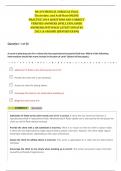
Major Field Test Sample Questions for Associate's Business practice exam with 100% correct answers
(D) $328,000 1. If a company sold merchandise for a $230,000 cash down payment and $310,000 on account and if the cost of the merchandise sold is $212,000, what is the amount of gross profit? (A) $18,000 (B) $98,000 (C) $310,000 (D) $328,000 (C) $618,000 2. A company issued a $600,000, 12 percent, 90-day note payable to acquire an office building. What is the maturity value of the note? (A) $72,000 (B) $600,000 (C) $618,000 (D) $672,000 Brainpower Read More Previous Play Next Rewind 10 seconds Move forward 10 seconds Unmute 0:00 / 0:00 Full screen (A) $116,000 3. A company had sales of $920,000 and fixed costs were $160,000. What was the income from operations if the contribution margin ratio was 30 percent? (A) $116,000 (B) $276,000 (C) $484,000 (D) $644,000 (D) 19,500 4. The unit selling price of a manufactured product is $100, and the unit variable costs are $60. If fixed costs are $780,000, what is the break-even number of sales units? (A) 4,875 (B) 7,800 (C) 13,000 (D) 19,500 (A) $500 overapplied 5. A manufacturer estimates its factory overhead costs to be $30,000 and machine hours to be 4,000 for the year. If the actual hours worked on production total 3,800 and the actual factory overhead costs are $28,000, what is the amount of the over- or underapplied factory overhead? (A) $500 overapplied (B) $500 underapplied (C) $2,000 overapplied (D) $2,000 underapplied (D) Taylor's scientific management 6. Money is the key motivator in (A) Herzberg's motivation-hygiene theory (B) Maslow's hierarchy of needs (C) McGregor's Theory X and Theory Y (D) Taylor's scientific management (B) strengths, weaknesses, opportunities, and threats 7. A SWOT analysis examines a company's (A) strategies, weaknesses, opportunities, and threats (B) strengths, weaknesses, opportunities, and threats (C) strategies, weaknesses, opportunities, and tactical plans (D) strengths, weaknesses, operational plans, and threats (D) Groupthink 8. Which of the following terms refers to the phenomenon in which group members are pressured to conform in decision making? (A) Group consensus (B) Brainstorming (C) Group norms (D) Groupthink (A) Workers seek responsibility. 9. Which of the following is an assumption of Theory Y as developed by Douglas McGregor? (A) Workers seek responsibility. (B) Workers dislike work. (C) Workers prefer direction. (D) Workers are interested in monetary gains. (A) an informal group 10. A group that develops naturally as a result of employees' interaction within an organization is referred to as (A) an informal group (B) a formal group (C) a work-team group (D) a formation group (D) An entrepreneur is one who takes a risk to start a business, whereas an intrapreneur is one who brings the spirit of entrepreneurship to a large organization. 11. Which of the following correctly describes the distinction between an entrepreneur and an intrapreneur? (A) An entrepreneur is a bureaucrat in a small business, whereas an intrapreneur is a bureaucrat in a large business. (B) An entrepreneur is an innovator in a private enterprise, whereas an intrapreneur is an innovator in a government organization. (C) An entrepreneur is one who takes a risk to start a business, whereas an intrapreneur is one who continues a business. (D) An entrepreneur is one who takes a risk to start a business, whereas an intrapreneur is one who brings the spirit of entrepreneurship to a large organization. (B) selective distribution 12. The most appropriate level of market coverage for shopping goods is (A) intensive distribution (B) selective distribution (C) uniform distribution (D) exclusive distribution (C) form 13. The channels of distribution create all of the following utilities EXCEPT (A) time (B) place (C) form (D) possession (B) A decrease in private investment and consumer expenditure 14. If the Federal Reserve decides to decrease the money supply, which of the following most likely will occur? (A) An increase in private investment and consumer expenditure (B) A decrease in private investment and consumer expenditure (C) An increase in private investment and a decrease in consumer expenditure (D) A decrease in private investment and an increase in consumer expenditure (D) monetary policy 15. The control of the money supply by the Federal Reserve System is known as (A) fiscal policy (B) supply-side policy (C) congressional policy (D) monetary policy (B) quantity supplied to decrease 16. According to the law of supply, a decrease in the price of a good will cause its (A) quantity supplied to increase (B) quantity supplied to decrease (C) quantity demanded to increase
Written for
- Institution
- ETS Major Field
- Course
- ETS Major Field
Document information
- Uploaded on
- January 14, 2024
- Number of pages
- 6
- Written in
- 2023/2024
- Type
- Exam (elaborations)
- Contains
- Questions & answers
Subjects
-
major field test sample questions for associates