Earth’s Life Support System
Systems
- A geographical system includes inputs, outputs, stores and flows
- An input adds energy/matter to the system e.g. solar energy or water
- Outputs remove energy/matter from the system
- Stores are a part of the system where energy/matter are stored or transformed
- Flows (transfers) are processes by which energy/matter moves from one store to
another
- The system boundary expresses the physical limits of the system e.g. bedrock to
atmosphere
- There are three types of system:
- Isolated
● No interaction with anything outside of the system boundary, no inputs or
outputs, mostly found in controlled lab environment, exceptionally rare in
nature, e.g. Thermos flask
- Open
● Matter and energy can be transferred from the system across the boundary
e.g. most ecosystems
- Closed
● Only energy transfers in and out of the system not matter, e.g. global carbon
and water cycles as the total amount of water and carbon in the cycle is
always the same so there has been no transfer of matter
- The Global Water Cycle:
Inputs Outputs Stores Flows
● Energy (sun) ● Energy (sun ● Groundwater ● Transpiration
radiating ● Clouds ● Precipitation
back) ● Lakes, ● Evaporation
oceans
● Atmosphere
- The local water cycle (drainage basin hydrological cycle) is a local open water
system
- Matter moves in and out of the system depending on weather patterns and climate
1
, Earth’s Life Support System
- System operate through the principle of balance: dynamic equilibrium
- The store magnitude will only stay the same if inputs = outputs
- Dynamic equilibrium refers to the constant feedback loops occurring to keep a
system in a stable state
● If inputs increase, then outputs should also increase to match
- Negative feedback dampens the change and helps restore balance
- Positive feedback accelerates the further unbalancing of the equilibrium
- Example of negative feedback:
1. Increase in global atmospheric CO2
2. Global temperatures increase
3. More plant growth
4. Increased take up of CO2
5. Reduced atmospheric CO2
6. Reduced CO2 has dampening effect
7. Reduction in global temperatures
- Example of positive feedback:
1. Atmospheric CO2 increases
2. Oceans absorb extra heat
3. Oceans warm
4. Warmer oceans cannot hold as much CO2
5. CO2 released from oceans
6. Atmospheric CO2 increases
- Major Earth systems include:
- Hydrosphere
● All the water on the Earth’s surface, such as lakes and oceans
- Cryosphere
● Frozen parts of the Earth’s surface including polar ice caps, ice and glaciers
- Lithosphere
● Rigid part of the Earth consisting of the crust and upper mantle
- Biosphere
● Space at the Earth’s surface and within the atmosphere occupied living
organisms
- Atmosphere
● The envelope of gases surrounding the planet
Water and the Water Cycle
- Information on the components of the water cycle can be
found above
- Sources of water vary from oceans and rivers to rocks and
animals, it is a fundamental component of every living thing on the
planet and necessary in almost all Earth processes
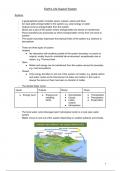
- Water comes in liquid, solid (ice) or gas forms as can be seen
by the diagram on the left
- Latent heat is released or absorbed when there is a change
of state in the water, e.g. heat is absorbed during evaporation as it is
an endothermic reaction
2
, Earth’s Life Support System
- Of all water on the planet, only 3% is freshwater, and so drinkable
● The other 97% is ocean water which covers 72% of the planet
- Of that 3% only 1% is accessible surface fresh water
- So despite there being a vast amount of water on the planet (138,800,000 km3) very
little of it is actually available to humans
- Of the water available, 52% of it can be found in lakes, meaning some areas (e.g.
The Lake District) will be in a water surplus where arid locations like desert areas
may be in a water deficit
- Some areas built reservoirs to combat this while others import water from other areas
(e.g. Wales) through pipes
- The 4 main stores of water on the planet are:
● Oceans
● Terrestrial stores
● Cryosphere
● Atmosphere
- Oceanic stores contain dissolved salts so are not suitable for human consumption
- The average depth of the ocean is 3,682m explaining why it holds so much water
- The current pH of the ocean is 8.14, however 250 years ago it was 8.25 showing ow
the ocean is slowly becoming more acidic
- This is one of the many impacts global warming is having on the ocean, as the rate at
which the pH is becoming more acidic is increasing at an exponential rate as
greenhouse gas emissions (especially CO2) increase
- The ocean is one of the biggest stores of CO2 already and is being forced to absorb
more
- Cryospheric water is stored in many 5 keys ways:
- Sea Ice
● Frozen oceanic water often connected to land to form an ice shelf
● E.g. Yelverton Bay, Canada
- Ice Sheet
● Mass of land ice greater than 50,000km2
● E.g. Greenland
- Ice Cap
● Mass of land ice smaller than 50,000km2
● E.g. Mount Kilimanjaro
3
Systems
- A geographical system includes inputs, outputs, stores and flows
- An input adds energy/matter to the system e.g. solar energy or water
- Outputs remove energy/matter from the system
- Stores are a part of the system where energy/matter are stored or transformed
- Flows (transfers) are processes by which energy/matter moves from one store to
another
- The system boundary expresses the physical limits of the system e.g. bedrock to
atmosphere
- There are three types of system:
- Isolated
● No interaction with anything outside of the system boundary, no inputs or
outputs, mostly found in controlled lab environment, exceptionally rare in
nature, e.g. Thermos flask
- Open
● Matter and energy can be transferred from the system across the boundary
e.g. most ecosystems
- Closed
● Only energy transfers in and out of the system not matter, e.g. global carbon
and water cycles as the total amount of water and carbon in the cycle is
always the same so there has been no transfer of matter
- The Global Water Cycle:
Inputs Outputs Stores Flows
● Energy (sun) ● Energy (sun ● Groundwater ● Transpiration
radiating ● Clouds ● Precipitation
back) ● Lakes, ● Evaporation
oceans
● Atmosphere
- The local water cycle (drainage basin hydrological cycle) is a local open water
system
- Matter moves in and out of the system depending on weather patterns and climate
1
, Earth’s Life Support System
- System operate through the principle of balance: dynamic equilibrium
- The store magnitude will only stay the same if inputs = outputs
- Dynamic equilibrium refers to the constant feedback loops occurring to keep a
system in a stable state
● If inputs increase, then outputs should also increase to match
- Negative feedback dampens the change and helps restore balance
- Positive feedback accelerates the further unbalancing of the equilibrium
- Example of negative feedback:
1. Increase in global atmospheric CO2
2. Global temperatures increase
3. More plant growth
4. Increased take up of CO2
5. Reduced atmospheric CO2
6. Reduced CO2 has dampening effect
7. Reduction in global temperatures
- Example of positive feedback:
1. Atmospheric CO2 increases
2. Oceans absorb extra heat
3. Oceans warm
4. Warmer oceans cannot hold as much CO2
5. CO2 released from oceans
6. Atmospheric CO2 increases
- Major Earth systems include:
- Hydrosphere
● All the water on the Earth’s surface, such as lakes and oceans
- Cryosphere
● Frozen parts of the Earth’s surface including polar ice caps, ice and glaciers
- Lithosphere
● Rigid part of the Earth consisting of the crust and upper mantle
- Biosphere
● Space at the Earth’s surface and within the atmosphere occupied living
organisms
- Atmosphere
● The envelope of gases surrounding the planet
Water and the Water Cycle
- Information on the components of the water cycle can be
found above
- Sources of water vary from oceans and rivers to rocks and
animals, it is a fundamental component of every living thing on the
planet and necessary in almost all Earth processes
- Water comes in liquid, solid (ice) or gas forms as can be seen
by the diagram on the left
- Latent heat is released or absorbed when there is a change
of state in the water, e.g. heat is absorbed during evaporation as it is
an endothermic reaction
2
, Earth’s Life Support System
- Of all water on the planet, only 3% is freshwater, and so drinkable
● The other 97% is ocean water which covers 72% of the planet
- Of that 3% only 1% is accessible surface fresh water
- So despite there being a vast amount of water on the planet (138,800,000 km3) very
little of it is actually available to humans
- Of the water available, 52% of it can be found in lakes, meaning some areas (e.g.
The Lake District) will be in a water surplus where arid locations like desert areas
may be in a water deficit
- Some areas built reservoirs to combat this while others import water from other areas
(e.g. Wales) through pipes
- The 4 main stores of water on the planet are:
● Oceans
● Terrestrial stores
● Cryosphere
● Atmosphere
- Oceanic stores contain dissolved salts so are not suitable for human consumption
- The average depth of the ocean is 3,682m explaining why it holds so much water
- The current pH of the ocean is 8.14, however 250 years ago it was 8.25 showing ow
the ocean is slowly becoming more acidic
- This is one of the many impacts global warming is having on the ocean, as the rate at
which the pH is becoming more acidic is increasing at an exponential rate as
greenhouse gas emissions (especially CO2) increase
- The ocean is one of the biggest stores of CO2 already and is being forced to absorb
more
- Cryospheric water is stored in many 5 keys ways:
- Sea Ice
● Frozen oceanic water often connected to land to form an ice shelf
● E.g. Yelverton Bay, Canada
- Ice Sheet
● Mass of land ice greater than 50,000km2
● E.g. Greenland
- Ice Cap
● Mass of land ice smaller than 50,000km2
● E.g. Mount Kilimanjaro
3