Principles of Management IIA by ProfessorBurgerQueen
Leadership
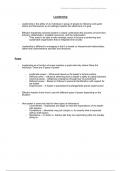
- Leadership is the ability of an individual or group of people to influence and guide
others and themselves to act willingly towards the attainment of a goal
- Effective leadership requires leaders to clearly understand the business environment,
industry, stakeholders, available resources, and the organisation
- They need to be able to take strategic action to ensure a performing and
sustainable organisation that is integrated into society
- Leadership is different to managing in that it is based on interpersonal relationships,
rather than administrative activities and directives
Power
- Leadership as a function of power explains a great deal why others follow tha
individual. There are 5 types of power:
- Legitimate power – Influenced based on the leader’s formal position
- Reward power – Influence stemming from a leader’s ability to satisfy followers
- Coercive power – Obtaining compliance through fear of punishment
- Referent power – Based on follower’s personal identification with respect for
the leader
- Expert power – A leader’s specialised knowledge/skills grants expert power
- Effective leaders know how to use the different types of power depending on the
situation
- How power is used may lead to three types of behaviours:
- Commitment – employees are eager to meet the expectations of the leader
with passion
- Compliance – otherwise may just comply i.e. do exactly what is expected
without enthusiasm.
- Resistance – or resist i.e. behave like they are responding while not actually
doing so
Leadership
- Leadership is the ability of an individual or group of people to influence and guide
others and themselves to act willingly towards the attainment of a goal
- Effective leadership requires leaders to clearly understand the business environment,
industry, stakeholders, available resources, and the organisation
- They need to be able to take strategic action to ensure a performing and
sustainable organisation that is integrated into society
- Leadership is different to managing in that it is based on interpersonal relationships,
rather than administrative activities and directives
Power
- Leadership as a function of power explains a great deal why others follow tha
individual. There are 5 types of power:
- Legitimate power – Influenced based on the leader’s formal position
- Reward power – Influence stemming from a leader’s ability to satisfy followers
- Coercive power – Obtaining compliance through fear of punishment
- Referent power – Based on follower’s personal identification with respect for
the leader
- Expert power – A leader’s specialised knowledge/skills grants expert power
- Effective leaders know how to use the different types of power depending on the
situation
- How power is used may lead to three types of behaviours:
- Commitment – employees are eager to meet the expectations of the leader
with passion
- Compliance – otherwise may just comply i.e. do exactly what is expected
without enthusiasm.
- Resistance – or resist i.e. behave like they are responding while not actually
doing so