Certified Nursing Assistant | CNA State Exam Practice Questions with Answers
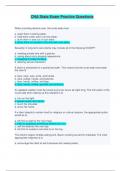
Certified Nursing Assistant | CNA State Exam Practice Questions with Answers When providing denture care, the nurse aide must a. wash them in boiling water. b. hold them under warm running water. c. dunk them in and out of cool water. d. place them on a towel in the sink with cool water. Sexuality in long-term-care clients may include all of the following EXCEPT a. needing private time with a partner. b. caring about one's physical appearance. c. engaging in public fondling. d. desiring sexual interaction A client is scheduled for a partial bed bath. This means that the nurse aide must wash the client's a. face, neck, ears, arms, and hands. b. face, axillae, hands, and buttocks. c. face, hands, axillae, and legs. d. face, hands, axillae, genitals, and buttocks. An agitated resident must be turned every two hours all night long. The first action of the nurse aide when waking up this resident is to a. turn on the light. b. speak quietly and calmly. c. touch her shoulder. d. shout her name. If a client objects to certain food for religious or cultural reasons, the appropriate action would be to a. tell him to wait for the next meal. b. offer to substitute something different for him. c. call the dietician the next day. d. tell him he needs to eat what is on his tray. The client's religion forbids eating pork. Bacon is being served for breakfast. The most appropriate response is to a. encourage the client to eat it because she needs protein. b. tell the client it is all right since her doctor ordered the diet. c. call the kitchen for a tray without bacon. d. tell the client that restrictions are not as important as her health. Which type of communication can often be most powerful? a. written b. verbal c. silent d. tactile A client refuses to allow the nurse aide to bathe her. The nurse aide tells the client that she will not be allowed to eat lunch or go to bingo if she does not have her bath. This is an example of a. rehabilitation. b. discipline. c. verbal abuse. d. physical abuse. On entering a room, an aide notices that the client is not breathing. The aide's first action should be to a. call for help. b. lay the client down on his back. c. give four quick breaths. d. give 8-10 abdominal thrusts. A client's dentures are lost. The first action should be to a. notify the administrator. b. look for them. c. notify the doctor. d. notify the charge nurse. Nursing assistants are responsible for a. planning client care. b. doing tasks assigned by the charge nurse. c. performing without ever asking for help. d. comparing assignments with coworkers. A patient turns on the call light when he needs to urinate. The appropriate action is to a. ignore the light, since he is not the aide's own client. b. announce on the intercom that there are two patients ahead of him. c. answer the call light and get the urinal. d. answer the call light when the aide has the time. A client is on CMR and in the prone position. The nurse aide finds the client vomiting bright red blood. The nurse aide should first a. clean up the vomit. b. place the client in the side-lying position. c. provide the client with an emesis basin. d. call the charge nurse. When performing catheter care, the nurse aide should wash the catheter a. toward the meatus. b. with Betadine soap. c. away from the meatus. d. with alcohol. A nurse aide who applies restraints on a client without directions from the charge nurse may be accused of a. slander. b battery. c. false imprisonment. d. negligence. H.S. care is care that is given a. before meals. b. before bedtime. c. after meals. d. upon awakening. The best food choices for a geriatric client with no teeth would include a. hamburger, french fries, corn, and ice cream. b. baked chicken, dressing, green beans, and coconut macaroons. c. spare ribs, macaroni and cheese, coleslaw, and fruit cocktail. d. baked fish, whipped potatoes, spinach souffle, and tapioca. A client's family wants to talk about the client's impending death, but the client does not want to talk about it. The family should be encouraged to a. carry on the conversation away from the client. b. talk freely in front of the client in order to help the client to accept it.
Written for
- Institution
- CNA - Certified Nursing Assistant
- Course
- CNA - Certified Nursing Assistant
Document information
- Uploaded on
- January 11, 2024
- Number of pages
- 22
- Written in
- 2023/2024
- Type
- Exam (elaborations)
- Contains
- Questions & answers
Subjects
- cna state exam practice
- cna state exam
- cna
-
cna state exam practice questions

Also available in package deal