100% satisfaction guarantee Immediately available after payment Both online and in PDF No strings attached 4.2 TrustPilot
logo-home
Summary

Summary of course Knowledge in Organisations

Rating
-
Sold
-
Pages
68
Uploaded on
11-01-2024
Written in
2023/2024

This summary contains all the lectures + notes, a summary of the article by Schultze & Stable (backbone of the course), notes of the working groups, and all the assignment plus the answers.

Institution
Course


Whoops! We can’t load your doc right now. Try again or contact support.

Written for

Institution
Study
Course

Document information

Uploaded on
January 11, 2024
Number of pages
68
Written in
2023/2024
Type
Summary

Subjects

Content preview

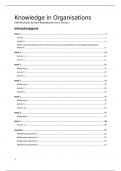
Knowledge in Organisations
MAN-BCU322A, Bachelor Bedrijfskunde Year 3, Period 2

Inhoudsopgave
Week 1.......................................................................................................................................................... 2
Lecture 1...............................................................................................................................................................2
Lecture 2...............................................................................................................................................................4
Article: ‘Knowing What You Don’t Know? Discourses and Contradictions in Knowledge Management
Research’............................................................................................................................................................11

Week 2........................................................................................................................................................ 16
Lecture 3.............................................................................................................................................................16
Lecture 4.............................................................................................................................................................21

Week 3........................................................................................................................................................ 25
Workgroup 1.......................................................................................................................................................25
Lecture 5.............................................................................................................................................................25
Lecture 6.............................................................................................................................................................26

Week 4........................................................................................................................................................ 29
Workgroup 2.......................................................................................................................................................29
Lecture 7.............................................................................................................................................................30
Lecture 8.............................................................................................................................................................33

Week 5........................................................................................................................................................ 37
Workgroup 3.......................................................................................................................................................37
Lecture 9.............................................................................................................................................................37
Lecture 10...........................................................................................................................................................40

Week 6........................................................................................................................................................ 47
Workgroup 4.......................................................................................................................................................47

Week 7........................................................................................................................................................ 48
Lecture 11...........................................................................................................................................................48

Appendix..................................................................................................................................................... 52
Workgroup assignment 1...................................................................................................................................52
Workgroup assignment 2...................................................................................................................................56
Workgroup assignment 3...................................................................................................................................59
Workgroup assignment 4...................................................................................................................................62


1

,Week 1
Lecture 1
What is ‘knowledge’?
3 problems with concept of ‘knowledge’:
1. Ontologically / epistemologically incoherent (not everyone has the same idea on
what knowledge is).
2. Vague: ‘knowledge is everything and everything is knowledge’. While we work, we
use and create knowledge.
3. Not neutral, not even always functional. We often think that we agree on knowledge,
but it depends on who is defining it/using it.

What is ‘management’?
Knowledge management = bit ‘common sense’? designing, coordination, controlling of work
processes. Normative control, community (shared values/norms/ideas), protocols, manuals,
access to information, data repositories.
The more emphasize on ‘management’, the less it is about ‘knowledge’.
The more emphasize on ‘knowledge’ , the less ‘management’ matters.

Epistemology dimension
How knowledge is defined is a matter of epistemology: philosophy addressing the nature of
knowledge. ‘Knowledge about knowledge’. How do we define what is true? What is regarded
as valid knowledge and why?
Dualism  what is knowledge? Objective, frozen-in-time, either/or, subjective/objective,
self/other, macro-micro, binaries, mutually exclusive opposites, uni-directional, every object
has a separate identity.
OR
When is knowledge (Duality)? Both/and/as well, no clear-cut distinction, one does not exist
without the other, pragmatism, theories of practice (knowledge is constructed in the doing),
associated with emergence, cyclical causality, object is continuously shaped by
context/situated practice.

Social order dimension
Social order = continuum bounded by:
a) Sociology of regulation  society tends towards ideal state of integration,
equilibrium and order consensus (trust, common interest, science\knowledge is
neutral).
b) Sociology of radical change  forces of coercion, conflict and change are
continuously challenging the established social order (‘truce’ is only temporary)
dissensus (suspicion, conflict of interest, science\knowledge is political).


2

,Neo-functionalist discourse: knowledge =
asset. Objective, measurable, it can be
acquired, progressive enlightment, reduction
of uncertainty, optimal allocation of
resources.
Constructionist discourse: knowledge =
mind. Socially constructed, in the doing
(practice), shared context, generation of
understanding, coordinating mindful action
of interdependent individuals with only
partial knowledge.
Critical discourse: knowledge = power. Role
of knowledge in organizational underclass:
reformation of social order, domination, and emancipation. Marxism, labor process.
Dialogical discourse: knowledge = discipline. Deconstruction of totalizing knowledge claims,
creation of multiple knowledge, never-ending process of knowing and correcting (the self).

Objectivist perspective: typologies of knowledge
Tacit knowledge: inexpressible in a codifiable form, subjective, personal, context-specific,
difficult to share. Tacit knowledge is ‘knowledge that is nonverbalized, or even
nonverbalizable, intuitive, unarticulated’. It is in someone’s mind because they have learned
it through experience.
Explicit knowledge: codifiable, objective, impersonal, context independent, easy to share,
everything that is written down. Explicit knowledge is easy to replicate and transfer.

Critical discourse on knowledge in organizations
 Dualism: there is a ‘good’ and ‘bad’, the ‘powerful group that is evil’ vs. the
‘powerless groups that are pure, innocent and helpless.
 Knowledge is an object to be owned, bought, sold.
 Connects political issue (labor processes)
 Role of knowledge is to raise awareness of the prevailing social injustices.
 Management of (tacit) knowledge is exploitation of managers (those owning capital)
to own all knowledge relevant to obtain more power and resources (e.g., money)
 Critical discourse is ‘anti-management’ and aligns itself with interests of workers.

Dialogical discourse on knowledge in organizations
 Interested in the role of knowledge in the exercise of power and control, yet lacks the
political agenda and moral stance (does not pick sides, hence ‘duality’)
 Ongoing struggle, dynamically shifting positions (no right or wrong)
 Knowledge is discipline – the disciplinary practices that shape and are shaped by
knowledge.
 Power/knowledge: before something can be controlled/managed, it must first be
known.
 Focus on practices such as performance appraisals, mentoring and practices of the
self, with emphasis on the normalizing thought and actions.
 Aim of this discourse is to deconstruct self-evident concepts and power relations;
prevention of normalization and totalization (enough room for the marginalized.

3

, Lecture 2
The neo-functionalist discourse
What are the assumptions about knowledge that underlie knowledge management research
that fits or uses a neo-functionalist discourse?
 Neo-functionalists ask “what is knowledge?”, which suggests that knowledge is perceived
as an object.
 Epistemology of possession: you either have knowledge or you do not.

Dualism
➔ The world is assumed to be completely and objectively knowable. You need to strive to
know everything about the world.
➔ The world is constructed in terms of binaries or mutually exclusive opposites (e.g.,
either/or, subject/object, self/other, macro/micro, individual/group, true/false).
➔ As a consequence: neo-functionalists favor classification (put into categories/boxes, this is
the basis of AI), taxonomies.
➔ Paradoxes or contradictions are an indication that taxonomies and models need further
refinement.

The basis for commensuration (transformation of qualities into quantities, for example if
someone is working very well, you give them a grade between 0 and 10). We have different
kind of metrics to quantify things, if you take them together you can see how an organization
is doing in reaching its goals etc.

Neo-functionalist perspective: social order dimension
Social order dimension ➔what is the nature of social order as it is perceived in sociological
and organizational research? Consensus versus dissensus  based on the idea of regulation
or based on the idea that the world is continuously evolving.
Hegemonic order as natural state = we can establish something as true or false, this creates
harmony.


4

Get to know the seller

Seller avatar
Reputation scores are based on the amount of documents a seller has sold for a fee and the reviews they have received for those documents. There are three levels: Bronze, Silver and Gold. The better the reputation, the more your can rely on the quality of the sellers work.
Radbouduniversiteit3 Radboud Universiteit Nijmegen
Follow You need to be logged in order to follow users or courses
Sold
75
Member since
4 year
Number of followers
38
Documents
35
Last sold
1 week ago

3.9

17 reviews

5
5
4
7
3
3
2
2
1
0

Recently viewed by you

Why students choose Stuvia

Created by fellow students, verified by reviews

Quality you can trust: written by students who passed their tests and reviewed by others who've used these notes.

Didn't get what you expected? Choose another document

No worries! You can instantly pick a different document that better fits what you're looking for.

Pay as you like, start learning right away

No subscription, no commitments. Pay the way you're used to via credit card and download your PDF document instantly.

Student with book image

“Bought, downloaded, and aced it. It really can be that simple.”

Alisha Student

Frequently asked questions