Med/Surg Periop B & S Test Bank
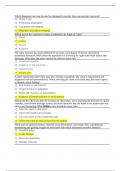
Med/Surg Periop B & S Test Bank 1. A client is admitted to the ED reporting severe abdominal pain and vomiting "coffee-ground" like emesis. The client is diagnosed with a perforated gastric ulcer and is informed that they need surgery. When can the client most likely anticipate that the surgery will be scheduled? A. Within 24 hours B. Within the next week C. Without delay D. As soon as all the day's elective surgeries have been completed C. Without delay 2. The nurse is performing a preoperative assessment on a client going to surgery. The client reports to the nurse drinking approximately two bottles of wine each day for the last several years. What postoperative difficulties should the nurse anticipate for this client? A. Nonadherence to prescribed treatment after surgery B. Increased risk for postoperative complications C. Alcohol withdrawal syndrome upon administration of general anesthesia D. Increased risk for allergic reactions B. Increased risk for postoperative complications 3. In anticipation of a client's scheduled surgery, the nurse is teaching the client to perform deep breathing and coughing to use postoperatively. What action should the nurse teach the client? A. The client should take three deep breaths and cough hard three times, at least every 15 minutes for the immediate postoperative period. B. The client should take three deep breaths and exhale forcefully and then take a quick short breath and cough from deep in the lungs. C. The client should take a deep breath in through the mouth and exhale through the mouth, take a short breath, and cough from deep in the lungs. D. The client should rapidly inhale, hold for 30 seconds or as long as possible, and exhale slowly. C. The client should take a deep breath in through the mouth and exhale through the mouth, take a short breath, and cough from deep in the lungs. 4. The nurse is preparing a client for surgery prior to her hysterectomy without oophorectomy. The nurse is witnessing the client's signature on a consent form. Which comment by the client would best indicate informed consent? A. "I know I'll be fine because the health care provider has done this procedure hundreds of times." B. "I know I'll have pain after the surgery but they'll do their best to keep it to a minimum." C. "The health care provider is going to remove my uterus and told me about the risk of bleeding." D. "Because the health care provider isn't taking my ovaries, I'll still be able to have children." C. "The health care provider is going to remove my uterus and told me about the risk of bleeding." 5. The nurse is planning teaching for a client who is scheduled for an open hemicolectomy. The nurse intends to address the topics of incision splinting and leg exercises during this teaching session. When is the best time for the nurse to provide teaching? A. Upon the client's admission to the postanesthesia care unit (PACU) B. When the client returns from the PACU C. During the intraoperative period D. As soon as possible, and before the surgical procedure D. As soon as possible, and before the surgical procedure 6. The nurse is caring for a hospice client who is scheduled for a surgical procedure to reduce the size of a spinal tumor in an effort to relieve pain. The nurse should plan this client care with the knowledge that this surgical procedure is classified as which of the following? A. Diagnostic B. Laparoscopic C. Curative D. Palliative D. Palliative 7. A nurse is providing preoperative teaching to a client who will soon undergo a cardiac bypass. The nurse's teaching plan includes exercises of the extremities. What is the purpose of teaching a client leg exercises prior to surgery? A. Leg exercises increase the client's muscle mass postoperatively. B. Leg exercises improve circulation and prevent venous thrombosis. C. Leg exercises help to prevent pressure sores to the sacrum and heels. D. Leg exercise help increase the client's level of consciousness after surgery. B. Leg exercises improve circulation and prevent venous thrombosis. 8. During the care of a preoperative client, the nurse has given the client a preoperative benzodiazepine. The client is now requesting to void. What action should the nurse take? A. Assist the client to the bathroom. B. Offer the client a bedpan or urinal. C. Wait until the client gets to the operating room and is catheterized. D. Have the client go to the bathroom. B. Offer the client a bedpan or urinal. 9. The nurse is preparing a client for surgery. The client reports being nervous and not really understanding the surgical procedure or its purpose. What is the most appropriate action for the nurse to take? A. Have the client sign the informed consent and place it in the chart. B. Call the health care provider to review the procedure with the client. C. Explain the procedure clearly to the client and the family. D. Provide the client with a pamphlet explaining the procedure. B. Call the health care provider to review the procedure with the client. 10. The nurse is caring for a client who is admitted to the ER with the diagnosis of acute appendicitis. The nurse notes during the assessment that the client's ribs and xiphoid process are prominent. The client reports exercising two to three times daily, and the client's parent indicates that the client is being treated for anorexia nervosa. How should the nurse best follow up on these assessment data? A. Inform the postoperative team about the client's risk for wound dehiscence. B. Evaluate the client's ability to manage pain level. C. Facilitate a detailed analysis of the client's electrolyte levels. D. Instruct the client on the need for a high-sodium diet to promote healing. C. Facilitate a detailed analysis of the client's electrolyte levels. 11. The nurse is doing preoperative client education with a client who has a 40 pack-year history of cigarette smoking. The client will undergo an elective bunionectomy at a time that fits his work schedule in a few months. What would be the best instruction to give to this client? A. Reduce smoking by 50% to prevent the development of pneumonia. B. Continue smoking so as to help manage stress levels before and after surgery. C. Aim to quit smoking in the postoperative period to reduce the chance of surgical complications. D. Stop smoking as soon as possible before the scheduled surgery to enhance pulmonary function and decrease infection. D. Stop smoking as soon as possible before the scheduled surgery to enhance pulmonary function and decrease infection. 12. The nurse is providing preoperative teaching to a client scheduled for hip replacement surgery in 1 month. During the preoperative teaching, the client gives the nurse a list of medications the client takes, along with their dosage and frequency. What intervention provides the client with the most accurate information? A. Instruct the client to stop taking St. John's wort at least 2 weeks prior to surgery due to its interaction with anesthetic agents. B. Instruct the client to continue taking ephedrine prior to surgery due to its beneficial effect on blood pressure. C. Instruct the client to discontinue levothyroxine sodium due to its effect on blood coagulation and the potential for heart dysrhythmias. D. Instruct the client to continue any herbal supplements unless otherwise instructed, and inform the client that these supplements have a minimal effect on the surgical procedure. A. Instruct the client to stop taking St. John's wort at least 2 weeks prior to surgery due to its interaction with anesthetic agents. 13. The nurse is creating the care plan for a 70-year-old obese client who has been admitted to the postsurgical unit following a colon resection. This client's age and body mass index increase the risk for what complication in the postoperative period? A. Hyperglycemia B. Azotemia C. Falls D. Infection D. Infection 14. The nurse in preadmission testing is educating a client about a scheduled surgery. Which response should the nurse give when the client asks about pain management following surgery? A. "Your nurse will use a pain assessment scale to help rate and treat your pain." B. "Wait to ask for pain medication until the pain becomes intolerable." C. "Lying still in bed will help control your pain." D. "Don't worry—most clients do not have much pain from this surgery." A. "Your nurse will use a pain assessment scale to help rate and treat your pain." 15. The nurse is admitting a client who is insulin dependent to the same-day surgical suite for carpal tunnel surgery. How should this client's diagnosis of type 1 diabetes affect
Written for
- Institution
- Med/Surg Periop B & S
- Course
- Med/Surg Periop B & S
Document information
- Uploaded on
- January 10, 2024
- Number of pages
- 27
- Written in
- 2023/2024
- Type
- Exam (elaborations)
- Contains
- Questions & answers
Subjects
-
medsurg periop b s test bank 1 a client is ad