Professional Nursing Exam 1 Questions & Answers
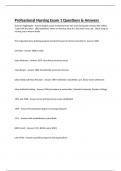
Florence Nightingale - Answer English nurse remembered for her work during the Crimean War (1853). "Lady with the lamp". 1860 published "Notes on Nursing: what if is and what if was not". Black strap on nursing cap to mourn death. First organized nurse training program (London) focused on theory and clinical - Answer 1860 Civil War - Answer 1860 to 1865 Mary Mahoney - Answer 1879- first african american nurse Clara Barton - Answer 1881-founded the american red cross Lillian Wald and Mary Brewster - Answer 1893- believed in wholelistic care. henry street settlement Mary Adelaide Nutting - Answer 1906-promotion of universities. Colombia University Teachers College 1901 and 1908 - Answer Army and Navy Nurse corps established 1909 - Answer first bachelors degree in nursing bestowed 1911 - Answer ANA established by Isabel Robb Edith Covell - Answer 1915, British nurse WW1 Late 1900s - Answer speciality programs and organizations Historical Highlights 21st century - Answer -advancing technology and informatics -acuity level -early discharge -evolving nursing practice and education: culture, ethics, safety, quality, end of life care Health care reform - Answer affordable care act demographic changes - Answer living longer medically underserved - Answer unemployed, underemployed, homeless Influences on today's practice - Answer threat of bioterrorism, rising health care cost, nursing shortage characteristics of a profession - Answer autonomy, accountability, caregiver, advocate, educator, communicator, manager autonomy - Answer independent nursing interventions Accountibility - Answer you are responsible for the type of quality of nursing care provided Nursing is defined as a profession because nurses... - Answer practice autonomy ANA Standards of Nursing Practice, 2010 - Answer 1. Assessment 2. Diagnosis 3. Outcome Identification 4. Planning 5. Implementation 6. Evaluation ANA Standards of Professional Performance - Answer 1. Ethics 2. Education 3. EBP and Research 4. Quality of Practice 5. Communication 6. Leadership 7. Collaboration 8. Professional Practice Evaluation 9. Resources 10. Environmental Health State Boards Nursing Practice Act - Answer -regulate the scope of nursing practice to protect the public -legal regulations Practice Nursing - Answer LPN-beside care Diploma - Answer 3 years, hospital based Associate Degree - Answer 2 years, community college Baccalaureate degree - Answer 4 years, IOM recommendation Master's degree - Answer Nurse Practitioner, Nurse Educator, Non-clinical degree, Clinical nurse specialist Doctorate Degree - Answer PhD, DNP, other The art and science of nursing - Answer -Nursing requires a blend of current knowledge and practice standards with an insightful and humane approach to client care -Care should reflect the needs and values of society -Use critical thinking to integrate information from the science and nursing knowledge bases ANA - Answer American Nurses Association AACN - Answer American Association of Colleges of Nursing. Essentials of Baccalaureate education for Professional Nursing: A final report (1998) QSEN competencies - Answer -patient-centered care -teamwork and collaboration -evidence-based practice -quality improvement -safety -informativs Caregiver - Answer help patients maintain and regain health genomics - Answer study of all genes in a person interactions of these genes with one another and with one another and with the environment nursing - Answer the protection, promotion, and optimization of health and abilities... patient advocate - Answer protect patient's human and legal rights and provide assistance in asserting these rights if the need arises professional organization - Answer deals with issues of concern to those practicing in the profession paradigm - Answer pattern of thought -links science, philosophy, and theories accepted and applied by a discipline 4 links for nursing's paradigm - Answer person, health, environment/isolation, nursing Nursing process - Answer method of applying the theory or knowledge ADPIE - Answer A: Assess D: Diagnosis P: Plan I: Implement E: Evaluate theory - Answer -contains a set of concepts, definitions, and assumptions or propositions that explain a phenomenon -guides the design of nursing interventions -conceptualization of some aspect of nursing -describes, explains, predicts and/or prescribes nursing care concepts - Answer ideas or mental images that help to describe phenomena Assumptions - Answer statements that describe concepts definitions - Answer convey the general meaning of the concepts phenomena - Answer aspects of reality that can be consciously sensed or experienced grand theory - Answer broad scope, complex, require specification middle-range (main) theory - Answer more limited to scope and less abstract descriptive theory - Answer -describe phenomena -speculate on why phenomena occur -describe consequences of phenomena prescriptive theory - Answer -address nursing interventions for a phenomenon -predict consequences of a specific nursing intervention Interdisciplinary theories - Answer -explain systematic views of phenomena specific to the discipline of inquiry: systems, basic human needs, developmental, psychosocial
Written for
- Institution
- ANA
- Course
- ANA
Document information
- Uploaded on
- January 10, 2024
- Number of pages
- 17
- Written in
- 2023/2024
- Type
- Exam (elaborations)
- Contains
- Questions & answers
Subjects
-
professional nursing exam 1 stuvia
-
professional nursing exam 1 questions answers
-
florence nightingale english nurse remembered for
-
first organized nurse training program london fo

Also available in package deal