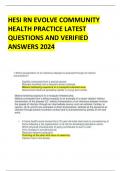
HESI RN EVOLVE COMMUNITY HEALTH PRACTICE LATEST QUESTIONS AND VERIFIED ANSWERS 2024
1. Which presentation of an infectious disease is acquired through an indirect transmission? Syphilis contracted from a sexual partner. Measles resulting from a daycare center outbreak. Malaria following exposure in a mosquito-infested area. Nosocomial influenza spreading rapidly in a long-term center Malaria following exposure in a mosquito-infested area. Malaria contracted from a biting mosquito is an example of a vector-related, indirect transmission of the disease (C). Indirect transmission of an infectious disease involves the spread of infection through an intermediate source, such as vehicles, fomites, or vectors. (A, B, and D) are examples of direct transmission, defined as the spread of an infection through person-to-person contact and is characterized by portals of exit and entry. 1. A home health nurse knows that a 70-year-old male client who is convalescing at home following a hip replacement, is at risk for developing decubitus ulcers. Which physical characteristic of aging contributes to such a risk? 16% increase in overall body fat. Reduced melanin production. Thinning of the skin with loss of elasticity. Calcium loss in the bones. Thinning of the skin with loss of elasticity. Thin, non-elastic skin (C) is an important factor in decubitus formation. Proportion of body fat to lean mass increases with age (A), and might help decrease ulcer tendency. (B) results in grey hair. (D) can contribute to broken bones, but it is probably not a factor in decubitus formation. 2. The nurse is developing a plan to provide quality health care for a certain community. Data obtained from which resources should be helpful to the nurse in developing a community healthcare plan for this community? (Select all that apply.) Census data. Risk management data. Budgeting process information. Available workforce in the community. Client-satisfaction surveys. Changes in the community's demographic data. Census data (A), risk management data (B), budgeting process information (C), data obtained from client-satisfaction surveys (E), and changes in the community's demographic data (F) provide pertinent data for planning for the current and future healthcare needs of the community. Available workforce (D), although a concern, is not a factor in quality-assurance directives. 3. The nursing education coordinator is creating employee orientation materials for staff nurses who plan to work at a clinic that serves a lower socioeconomic neighborhood. What information should the educator include regarding the clinic's client population? (Select all that apply.) Most of the clients are unemployed or disabled. Access to mass transit may be an issue. Clients will need reminders to bring insurance cards. Basic physiologic needs of this population are often unmet. Clients who are homebound will qualify for Medicaid. Nonadherence to healthcare recommendations is likely. The unemployed or disabled will likely comprise a majority of this clinic's clients (A); the lack of access to mass transit may affect the population's ability to keep health care appointments (B); and low-income clients are at risk for basic physiologic needs being left unmet (D). Most clients are not likely to have health insurance (C) because they lack the funds to pay the insurance premiums. Homebound status is not a defining qualification for public assistance, such as Medicaid (E). To state that a low-income population is more likely to be non-compliant with healthcare recommendations is an example of stereotyping (F). 4. While discussing the science of nursing, the nurse identifies the domain of nursing theory. Which linkages should the nurse provide to describe nursing's paradigm? The person, the environment or situation, and health. Stress reduction, self-care, and a systems model. Curative care, restorative care, and terminal care. Self-actualization, fundamental needs, and belonging. The person, the environment or situation, and health. Nursing theories serve to describe, explain, predict, or prescribe nursing care measures. Any science has a domain, which is the view or perspective of the discipline. The elements of nursing's paradigm direct the activity of the nursing profession, including knowledge development, philosophy, theory, educational experience, research, practice, and literature identified with the profession. Nursing identified its domain in a paradigm that includes four linkages: the person, health, environment/situation, and nursing (A). (B, C, and D) are not linkages of the domain. 5. Which topic should the nurse include in planning a secondary prevention project for the local retirement community? Safety measures in the home. Adult immunization program
Written for
- Institution
- HESI RN EVOLVE COMMUNITY HEALTH
- Course
- HESI RN EVOLVE COMMUNITY HEALTH
Document information
- Uploaded on
- January 9, 2024
- Number of pages
- 17
- Written in
- 2023/2024
- Type
- Exam (elaborations)
- Contains
- Questions & answers
Subjects
-
hesi rn evolve community health
-
hesi rn evolve community health practice
-
hesi rn evolve community health practice latest
-
hesi rn evolve community health practice latest qu

Also available in package deal