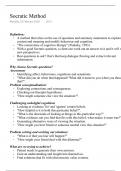
Socratic Method
Monday, 25 February 2019 10:17
Definition:
- A method that relies on the use of questions and summary statements to explore
content and meaning and modify behaviour and cognition.
- "The cornerstone of cognitive therapy" (Padesky, 1993).
- With a good Socratic question, a client can work out an answer to it and it will r
new perspectives.
- Best questions to ask? One's that keep dialogue flowing and extract relevant
information.
Why choose Socratic questions?
Assessment
- Identifying affect, behaviours, cognitions and sensations.
- "What did you do when that happened? What did it mean to you when you thoug
that?".
Problem conceptualisation:
- Exploring connections and consequences.
- Checking out therapist hypotheses.
- "How might someone else view the situation?".
Challenging unhelpful cognitions
- Looking at evidence 'for' and 'against' certain beliefs.
- "How helpful is it to hold this particular belief?".
- "What is the downside of looking at things in this particular way?"
- "What evidence can you find that fits with this belief, what makes it seem true?"
- Generating alternative ways of viewing the situation.
- "How might you best friend or someone neutral view this situation?"
Problem solving and working out solutions:
- "What is it that you fear will happen?"
- "How might your friend deal with this dilemma?"
What are we trying to achieve?
- Patient needs to generate their own answers.
- Gain an understanding and insight into themselves.
- Find solutions that fit with idiosyncratic value systems.
- Develop skills to do it on their own.
- "Own one's own discovery".
- Build a model of critical thinking that the patient can apply to other situations.
Monday, 25 February 2019 10:17
Definition:
- A method that relies on the use of questions and summary statements to explore
content and meaning and modify behaviour and cognition.
- "The cornerstone of cognitive therapy" (Padesky, 1993).
- With a good Socratic question, a client can work out an answer to it and it will r
new perspectives.
- Best questions to ask? One's that keep dialogue flowing and extract relevant
information.
Why choose Socratic questions?
Assessment
- Identifying affect, behaviours, cognitions and sensations.
- "What did you do when that happened? What did it mean to you when you thoug
that?".
Problem conceptualisation:
- Exploring connections and consequences.
- Checking out therapist hypotheses.
- "How might someone else view the situation?".
Challenging unhelpful cognitions
- Looking at evidence 'for' and 'against' certain beliefs.
- "How helpful is it to hold this particular belief?".
- "What is the downside of looking at things in this particular way?"
- "What evidence can you find that fits with this belief, what makes it seem true?"
- Generating alternative ways of viewing the situation.
- "How might you best friend or someone neutral view this situation?"
Problem solving and working out solutions:
- "What is it that you fear will happen?"
- "How might your friend deal with this dilemma?"
What are we trying to achieve?
- Patient needs to generate their own answers.
- Gain an understanding and insight into themselves.
- Find solutions that fit with idiosyncratic value systems.
- Develop skills to do it on their own.
- "Own one's own discovery".
- Build a model of critical thinking that the patient can apply to other situations.