Person-Centred Therapy:
Monday, 14 January 2019 10:00
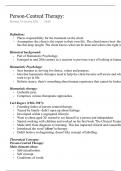
Definition:
- Places responsibility for the treatment on the client.
- Assumption: the client is the expert in their own life. The client knows best- they
has this deep insight. The client knows what can be done and what is the right w
Historical background:
- Part of Humanistic Psychology.
- Emerged in mid 20th century as a reaction to previous ways of looking at human
Humanistic Psychology:
- Sees humans as striving for choice, values and purpose.
- Idea that humanistic therapies need to help the client become self aware and wha
want to go in life.
- Holistic stance: there's something about human experience that cannot be broken
Humanistic therapy:
- Umbrella term.
- Comprises various therapeutic approaches.
Carl Rogers (1902-1987):
- Founding father of person-centred therapy.
- Teased by family- didn’t open up about feelings.
- Developed within a segregated lifestyle.
- Went to china aged 20: started to see himself as a person and independent.
- Started working with children and worked on his first book 'The Clinical Treatm
- Made shift from diagnosis to listening. This has impacted clinical and counsellin
- Introduced the word 'client' in therapy.
- Didn't believe in diagnosing: doesn't like concept of labelling.
Theoretical Concepts:
Person-Centred Therapy:
Main elements ideas:
- Self-actualisation.
- Self concept.
- Conditions of worth.
- Organismic valuing process.
- Locus of evaluation.
, y know what's wrong and is the only one that
way to feel better.
n nature.
at they need, who they are and where they
n down into single components.
ment of the Problem Child' in 1928.
ng psychology.
Monday, 14 January 2019 10:00
Definition:
- Places responsibility for the treatment on the client.
- Assumption: the client is the expert in their own life. The client knows best- they
has this deep insight. The client knows what can be done and what is the right w
Historical background:
- Part of Humanistic Psychology.
- Emerged in mid 20th century as a reaction to previous ways of looking at human
Humanistic Psychology:
- Sees humans as striving for choice, values and purpose.
- Idea that humanistic therapies need to help the client become self aware and wha
want to go in life.
- Holistic stance: there's something about human experience that cannot be broken
Humanistic therapy:
- Umbrella term.
- Comprises various therapeutic approaches.
Carl Rogers (1902-1987):
- Founding father of person-centred therapy.
- Teased by family- didn’t open up about feelings.
- Developed within a segregated lifestyle.
- Went to china aged 20: started to see himself as a person and independent.
- Started working with children and worked on his first book 'The Clinical Treatm
- Made shift from diagnosis to listening. This has impacted clinical and counsellin
- Introduced the word 'client' in therapy.
- Didn't believe in diagnosing: doesn't like concept of labelling.
Theoretical Concepts:
Person-Centred Therapy:
Main elements ideas:
- Self-actualisation.
- Self concept.
- Conditions of worth.
- Organismic valuing process.
- Locus of evaluation.
, y know what's wrong and is the only one that
way to feel better.
n nature.
at they need, who they are and where they
n down into single components.
ment of the Problem Child' in 1928.
ng psychology.