BULLETPOINTS AND GLOSSARY: VICTIMOLOGY
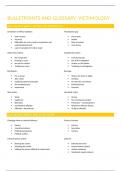
BULLETPOINTS WEEK 2: HISTORY AND PERSPECTIVES
Limitations of official statistics: Moralization gap:
Dark number Moral tone
Accuracy Impact
Difficulties for cross-country comparison and Role of context
understanding trends Time frame
Lack of variables for further study
Adversarial system: Inquisitorial system:
No civil parties Civil prosecutors
Hearing in court Pre-trial investigation
No role for victims Victims as civil parties
Testifying in court Testifying in investigation
Retribution: Revenge:
For a wrong May be for harm or slight
Sets a limit Limitless
Guided by general principles No need for consistency
No emotional tone Emotional tone
Impersonal Personal
Ideal victim: Non-ideal victim:
Weak Strong
Legitimate Not carrying any project
Blameless Protection = not being there
Unrelated to offender Related to offender (close)
Offender = big and bad As big as offender
BULLETPOINTS WEEK 3: WHO IS THE VICTIM?
Changing views on criminal offences: Circles of victims:
History Primary
Countries/cultures Secondary
Political perspectives Tertiary
Political conflict
Criminal justice system: Johnson:
Blaming the victim Intimate terrorism
Excluding the victim Mutual violent control
Making the process difficult to understand Violent resistance
Situational couple violence
, BULLETPOINTS WEEK 4: BECOMING A VICTIM – RISK AND LABELLING
Crime data sources: Fear of crime:
Official statistics Risk
Victim surveys Consequences
Self-report studies Control
Problems with victim surveys:
Not knowing
Forgetting/not mentioning
Inaccurate information
Differences in productivity
Increasing difficulty of achieving a representative sample
Main risk factors: CRAVED principle:
Young Concealable
Middle class Removable
Single Available
Outgoing Valuable
Male Enjoyable
Young females Disposable
Victimization risk: Repeat victimization:
Lifestyle exposure theory Risk heterogeneity (flag)
Routine activities theory Event dependency (boost)
Child victimization: Complexities of child victimization:
Pandemic Crime
Acute Child maltreatment
Extraordinary Non-crimes
BULLETPOINTS WEEK 5: THE CONSEQUENCES OF VICTIMIZATION
Consequences and needs: Issues to traumatic stress:
Protection and prevention Blaming
Medical assistance Control
Financial consequences Support
Emotional and psychological consequences
Kinds of victimization: Bias related/hate crime victimization
Traumatic stress Cyber enabled crime:
Victimization by rape
Co-victim by homicide Financial
Victims of cybercrime Interpersonal
Sexual
BULLETPOINTS WEEK 2: HISTORY AND PERSPECTIVES
Limitations of official statistics: Moralization gap:
Dark number Moral tone
Accuracy Impact
Difficulties for cross-country comparison and Role of context
understanding trends Time frame
Lack of variables for further study
Adversarial system: Inquisitorial system:
No civil parties Civil prosecutors
Hearing in court Pre-trial investigation
No role for victims Victims as civil parties
Testifying in court Testifying in investigation
Retribution: Revenge:
For a wrong May be for harm or slight
Sets a limit Limitless
Guided by general principles No need for consistency
No emotional tone Emotional tone
Impersonal Personal
Ideal victim: Non-ideal victim:
Weak Strong
Legitimate Not carrying any project
Blameless Protection = not being there
Unrelated to offender Related to offender (close)
Offender = big and bad As big as offender
BULLETPOINTS WEEK 3: WHO IS THE VICTIM?
Changing views on criminal offences: Circles of victims:
History Primary
Countries/cultures Secondary
Political perspectives Tertiary
Political conflict
Criminal justice system: Johnson:
Blaming the victim Intimate terrorism
Excluding the victim Mutual violent control
Making the process difficult to understand Violent resistance
Situational couple violence
, BULLETPOINTS WEEK 4: BECOMING A VICTIM – RISK AND LABELLING
Crime data sources: Fear of crime:
Official statistics Risk
Victim surveys Consequences
Self-report studies Control
Problems with victim surveys:
Not knowing
Forgetting/not mentioning
Inaccurate information
Differences in productivity
Increasing difficulty of achieving a representative sample
Main risk factors: CRAVED principle:
Young Concealable
Middle class Removable
Single Available
Outgoing Valuable
Male Enjoyable
Young females Disposable
Victimization risk: Repeat victimization:
Lifestyle exposure theory Risk heterogeneity (flag)
Routine activities theory Event dependency (boost)
Child victimization: Complexities of child victimization:
Pandemic Crime
Acute Child maltreatment
Extraordinary Non-crimes
BULLETPOINTS WEEK 5: THE CONSEQUENCES OF VICTIMIZATION
Consequences and needs: Issues to traumatic stress:
Protection and prevention Blaming
Medical assistance Control
Financial consequences Support
Emotional and psychological consequences
Kinds of victimization: Bias related/hate crime victimization
Traumatic stress Cyber enabled crime:
Victimization by rape
Co-victim by homicide Financial
Victims of cybercrime Interpersonal
Sexual