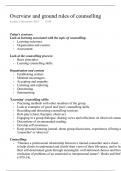
Overview and ground rules of counselling
Sunday, 4 November 2018 19:00
Today's sessions:
Look at learning associated with the topic of counselling:
- Learning outcomes.
- Organisation and content.
- Assessment.
Look at the counselling process:
- Basic principles.
- Learning counselling skills.
Organisation and content
- Establishing contact.
- Minimal encouragers.
- Accepting and empathy.
- Listening and exploring.
- Questioning.
- Summarising.
'Learning' counselling skills:
- Practising methods with other members of the group.
- Look at examples of 'good' and 'poor' counselling skills.
- Recording and discussing counselling sessions.
- Role play (client, therapist, observer).
- Engaging in a group dialogue, sharing views and reflections on observed counse
- Discussions of recommended reading.
- Develop self awareness.
- Keep personal learning journal: about group discussions, experiences of being a
'counsellor' or 'observer'.
Counselling:
- "Denotes a professional relationship between a trained counsellor and a client…
to help clients to understand and clarify their views of their life-space, and to lea
their self-determined goals through meaningful, well-informed choices and throu
resolution of problems of an emotional or interpersonal nature"- Burks and Steff
(1979:14).
- Professional relationship: different from friendship or other types of relationship
have in life engage us emotionally and we sometimes want to give emotional su
help some.
, elling skills.
a 'client',
… it is designed
arn to reach
ugh
flre
ps. Many we
upport and
Sunday, 4 November 2018 19:00
Today's sessions:
Look at learning associated with the topic of counselling:
- Learning outcomes.
- Organisation and content.
- Assessment.
Look at the counselling process:
- Basic principles.
- Learning counselling skills.
Organisation and content
- Establishing contact.
- Minimal encouragers.
- Accepting and empathy.
- Listening and exploring.
- Questioning.
- Summarising.
'Learning' counselling skills:
- Practising methods with other members of the group.
- Look at examples of 'good' and 'poor' counselling skills.
- Recording and discussing counselling sessions.
- Role play (client, therapist, observer).
- Engaging in a group dialogue, sharing views and reflections on observed counse
- Discussions of recommended reading.
- Develop self awareness.
- Keep personal learning journal: about group discussions, experiences of being a
'counsellor' or 'observer'.
Counselling:
- "Denotes a professional relationship between a trained counsellor and a client…
to help clients to understand and clarify their views of their life-space, and to lea
their self-determined goals through meaningful, well-informed choices and throu
resolution of problems of an emotional or interpersonal nature"- Burks and Steff
(1979:14).
- Professional relationship: different from friendship or other types of relationship
have in life engage us emotionally and we sometimes want to give emotional su
help some.
, elling skills.
a 'client',
… it is designed
arn to reach
ugh
flre
ps. Many we
upport and