Caring for Central Vascular Access Devices (CVAD) - EXAM Questions With Complete Solutions.
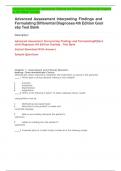
Which of the following patients may benefit from a long-term vascular access device? (SATA) - Indications for a vascular access device include IV therapy anticipated for longer than 7 days, including transfusions, total parenteral nutrition (TPN) administration, long-term antibiotics, or continuous infusions such as opioids; infusion of vesicants or irritants, such as in chemotherapy; poor peripheral venous circulation; and frequent long-term phlebotomy. A child undergoing tonsillectomy, and a pregnant woman with nausea and vomiting would most likely only require short-term IV therapy, and therefore a long-term vascular access device would be unnecessary. Choose the supplies the nurse will need to perform a dressing change of a central vascular access device (CVAD). (SATA) - The equipment the nurse will need to perform a dressing change of a central vascular access device includes the following: sterile and clean gloves, antimicrobial swabs, transparent occlusive dressing or sterile gauze dressing/tape, and mask(s). Because the patient's central vascular access device is used intermittently for fluid administration, the nurse flushes the infusion port with a 3-mL syringe filled with heparin flush solution to maintain patency. What action made by the nurse was incorrect? - The nurse should avoid using a syringe less than 10 mL to minimize pressure during injection. A 3-mL syringe exerts too much psi pressure. If continuous infusion is not indicated, the nurse should heparinize the port to prevent thrombus formation by flushing with 5 mL heparin (100 units per mL or institution policy). What is the purpose of the heparin flush solution in regard to care of a vascular access device? - The heparin flush solution is used to prevent clot formation at the catheter tip and thus prevent occlusion. The primary concern at the exit site is the development of infection. Incompatibility of medications results in precipitate formation. The catheter should be flushed well with normal saline before and after medication administration. Heparin prevents clot formation. A thrombolytic such as streptokinase may be ordered to dissolve a clot. The nurse is sampling blood from an implanted venous port to be followed with a continuous IV infusion. Assuming all other steps are performed correctly, which of the following would require correction? - The noncoring needle should be inserted at a 90-degree angle. All other steps are correct. Matching - A tunneled CVAD is inserted through subcutaneous tissue, then into a large vein and threaded into the distal end of the superior vena cava. It is held in place with a Dacron cuff. These catheters have single, double, or triple lumens. They carry less risk of infection than a percutaneous CVAD. An implanted infusion port rests below the skin in a subcutaneous pocket. Thecatheter is inserted into a large vein and threaded the superior vena cava. It requires a noncoring needle to access the device. A percutaneous central venous catheter is inserted directly through the skin into a large vein. A peripherally inserted central catheter is inserted, usually in the antecubital space with the distal end in the central circulation. Matching - A preventive measure for avoiding catheter damage or breakage is to avoid having sharp objects near the catheter and to access the port with a needleless system. Routine flushing with positive pressure should be followed, as well as flushing well between medications to avoid precipitate formation or occlusion. Strict hand hygiene and aseptic technique should always be followed to avoid infection. Some health care providers prefer the application of antibiotic or antimicrobial ointment at the exit site of the catheter as a preventive measure against infection. Avoiding trauma to the catheter and avoiding placement of the catheter near a site of local disease prevent catheter migration. The nurse should not leave the catheter hub open to air and should engage clamps for catheters without valves to prevent an air embolism.
Written for
- Institution
- Caring for Central Vascular Access Devices
- Course
- Caring for Central Vascular Access Devices
Document information
- Uploaded on
- January 7, 2024
- Number of pages
- 4
- Written in
- 2023/2024
- Type
- Exam (elaborations)
- Contains
- Questions & answers
Subjects
-
caring for central vascular access devices cvad

Also available in package deal