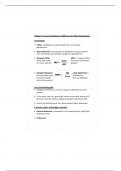
Chapter 5: Consumer Behaviour Indifference & Utility Maximization
Terminology:
Utility = satisfaction or pleasure got from consuming a
good/service.
Total utility (TU) = total amount of satisfaction a person derives
from consuming some specific quantity of a good/service.
Marginal utility (MU) = change of total
utility that results from the consumption
of 1 more unit of a product.
Weighted Marginal utility (MU/Price) =
per-rand value extra satisfaction a
consumer realizes from an additional
unit of that product.
Law of diminishing MU:
Satisfaction declines as consumer acquires additional units of a
product.
If successive units of a good yield smaller and smaller amounts of
MU, the consumer will buy additional product only if price falls.
Hence, the demand curve for a given product slopes downward.
Consumer choice and budget constraint:
Rational behaviour = Consumers try to maximise their utility with
available income.
Preferences
, Budget
constraint = any point in time the consumer has a fixed, limited
amount of money income.
Prices = Goods are scarce relative the demand so every good carry
a price tag.
Theory of consumer behaviour:
Numerical example:
Utility-maximizing combination of products A and B obtainable
with an income of R10
Terminology:
Utility = satisfaction or pleasure got from consuming a
good/service.
Total utility (TU) = total amount of satisfaction a person derives
from consuming some specific quantity of a good/service.
Marginal utility (MU) = change of total
utility that results from the consumption
of 1 more unit of a product.
Weighted Marginal utility (MU/Price) =
per-rand value extra satisfaction a
consumer realizes from an additional
unit of that product.
Law of diminishing MU:
Satisfaction declines as consumer acquires additional units of a
product.
If successive units of a good yield smaller and smaller amounts of
MU, the consumer will buy additional product only if price falls.
Hence, the demand curve for a given product slopes downward.
Consumer choice and budget constraint:
Rational behaviour = Consumers try to maximise their utility with
available income.
Preferences
, Budget
constraint = any point in time the consumer has a fixed, limited
amount of money income.
Prices = Goods are scarce relative the demand so every good carry
a price tag.
Theory of consumer behaviour:
Numerical example:
Utility-maximizing combination of products A and B obtainable
with an income of R10