(@problem 1)
;;
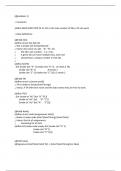
;; Write the BSL expression that most clearly represents the following
;; arithme>c expression:
;;
;; 3^2 + 6 * (6 - 10) / 3
;;
;; which equals 1
;;
;; There is a single BSL expression that both produces the correct result,
;; and most closely matches the structure of the equa>on given above.
;; Although 1 is an expression that evaluates to 1, that is not the
;; correct answer, because it doesn't show the structure of the expression
;; above.
;;
(+ (sqr 3)(/ (* 6 (- 6 10)) 3))
(@problem 2)
;;
;; Given the defini>ons below (LOWER, UPPER and foo),
;; write the step-by-step evalua>on of the following expression:
;;
;; (foo (* 3 4) (+ 0 2))
;;
;; Be sure to show every intermediate evalua>on step, including the original
;; expression and the final result. The steps should NOT be in comments.
;;
;; Stepping ques>ons like this one have only one correct answer. The goal
;; of this problem is to assess whether you have learned the exact BSL step
;; by step evalua>on rules; not whether you can figure out the final
;; result of an expression.
;;
(define LOWER 10)
(define UPPER 20)
(define (foo x y)
(if (and (> x LOWER) (< x UPPER))
(- x (* y 2))
(+ x (* y 3))))
(foo (* 3 4) (+ 0 2))
(foo 12 (+ 0 2))
;;
;; Write the BSL expression that most clearly represents the following
;; arithme>c expression:
;;
;; 3^2 + 6 * (6 - 10) / 3
;;
;; which equals 1
;;
;; There is a single BSL expression that both produces the correct result,
;; and most closely matches the structure of the equa>on given above.
;; Although 1 is an expression that evaluates to 1, that is not the
;; correct answer, because it doesn't show the structure of the expression
;; above.
;;
(+ (sqr 3)(/ (* 6 (- 6 10)) 3))
(@problem 2)
;;
;; Given the defini>ons below (LOWER, UPPER and foo),
;; write the step-by-step evalua>on of the following expression:
;;
;; (foo (* 3 4) (+ 0 2))
;;
;; Be sure to show every intermediate evalua>on step, including the original
;; expression and the final result. The steps should NOT be in comments.
;;
;; Stepping ques>ons like this one have only one correct answer. The goal
;; of this problem is to assess whether you have learned the exact BSL step
;; by step evalua>on rules; not whether you can figure out the final
;; result of an expression.
;;
(define LOWER 10)
(define UPPER 20)
(define (foo x y)
(if (and (> x LOWER) (< x UPPER))
(- x (* y 2))
(+ x (* y 3))))
(foo (* 3 4) (+ 0 2))
(foo 12 (+ 0 2))