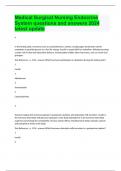
Medical Surgical Nursing Endocrine System questions and answers 2024 latest update.
4 In the fasting state, hormones such as catecholamines, cortisol, and glucagon break down stored complexes to provide glucose as a fuel for energy. Insulin is responsible for anabolism. Aldosterone plays a major role in fluid and electrolyte balance. Somatostatin inhibits other hormones, such as insulin and glucagon. Text Reference - p. 1140 Which hormone participates in catabolism during the fasting state? 1 Insulin 2 Aldosterone 3 Somatostatin 4 Catecholamines 2 Oxytocin targets the mammary glands in postpartum patients and stimulates milk secretion. Insulin is the hormone that helps with glucose regulation in the body. Epinephrine is the hormone that helps augment and prolong the sympathetic nervous system effects. Parathormone helps maintain calcium and phosphorus levels in the body. Text Reference - p. 1136 Which hormone stimulates milk secretion in a postpartum patient? 1 Insulin 2 Oxytocin 3 Epinephrine 4 Parathormone Brainpower Read More Previous Play Next Rewind 10 seconds Move forward 10 seconds Unmute 0:00 / 0:00 Full screen 1 Cortisol is a glucocorticoid that protects the body from stress; it is also called as stress hormone. Cortisol helps to maintain vascular integrity and fluid volume; cortisol levels are increased in patients with burns, infections, fevers, and acute anxiety. The level of oxytocin, aldosterone, and antidiuretic hormone does not increase in response to stress. Text Reference - p. 1140 A patient is admitted to the hospital with severe burns. Which hormone level does the nurse expect to be elevated in the patient's laboratory reports? 1 Cortisol 2 Oxytocin 3 Aldosterone 4 Antidiuretic hormone Cortisol A glucocorticoid that protects the body from stress; it is also called as stress hormone. Helps to maintain vascular integrity and fluid volume by acting on mineralocorticoid receptors; levels are increased in patients with burns, infections, fevers, and acute anxiety. Levels increase during hypoglycemia. This chemical decreases the inflammatory response by reducing the effects of proteolytic enzymes on surrounding tissue. Works via negative feedback mechanism. 2 Thyroid hormone is produced by the thyroid gland; it acts on all of the body tissues. Parathormone acts on the bones, intestines, and kidneys. Luteinizing hormone acts on the reproductive organs. Antidiuretic hormone acts on the renal tubules and vascular smooth muscles. Text Reference - p. 1136 Which hormone acts on all of the body tissues? 1 Parathormone 2 Thyroid hormone 3 Luteinizing hormone 4 Antidiuretic hormone 1 Oxytocin helps stimulate uterine contractions during labor. Low levels of this hormone during pregnancy may lead to complications during the labor process. Lower levels of glucagon may lead to the suppression of glycogenolysis and gluconeogenesis in the body. Low levels of calcitonin may lead to an imbalance in the calcium and phosphorus levels in the patient. Low levels of somatotropin may lead to a decrease in protein anabolism, which leads to growth suppression. Text Reference - p. 1136 The nurse identifies that a patient may have ineffective uterine contractions during labor based on what laboratory result? 1 Low levels of oxytocin 2 Low levels of glucagon 3 Low levels of calcitonin 4 Low levels of somatotropin Oxytocin Helps stimulate uterine contractions during labor. Low levels of this hormone during pregnancy may lead to complications during the labor process. Also targets the mammary glands in postpartum patients and stimulates milk secretion. 4 The anterior pituitary is the target tissue of the releasing hormones (corticotropin releasing hormone, thyrotropin releasing hormone, growth hormone releasing factor, gonadotropin releasing hormone, and prolactin releasing factor) and the inhibiting hormones (somatostatin, prolactin inhibiting factor). These hormones release or inhibit other hormones that affect the thyroid, adrenal cortex, pancreas, reproductive organs, and all body cells. The pineal gland is not affected directly by the releasing and inhibiting hormones from the hypothalamus. The posterior pituitary releases antidiuretic hormone (ADH) in response to plasma osmolality changes that are not affected directly by the hypothalamus hormones. Text Reference - p. 1137 The hypothalamus secretes releasing hormones and inhibiting hormones. What is the target tissue of these releasing hormones and inhibiting hormones? 1 Pineal 2 Adrenal cortex 3 Posterior pituitary 4 Anterior pituitary 1 Cortisol level increases if a patient has fever, stress, burns, infection, acute anxiety, or hypoglycemia. A body temperature of 104o F indicates that the patient has fever. The normal white blood cell count is 4500 to 10,000/microliter. A white blood cell count of 14,000/microliter indicates that the patient may have an infection. The normal fasting blood glucose levels of a patient are 70 to 100 mg/dL. Blood glucose levels of 65 mg/dL indicate that the patient has hypoglycemia. Therefore, the nurse expects to find high levels of cortisol in the patient. Fever, infection, and hypoglycemia may not enhance the secretion of aldosterone. Androstenedione and dehydroepiandrosterone are adrenal hormones. They are not elevated because of fever, infection, or hypoglycemia. Text Reference - p. 1140 The nurse reviews a patient's medical record and notes assessment findings. Which endocrine hormone level does the nurse expect to be increased in the patient? 1 Cortisol 2 Aldosterone 3 Androstenedione 4 Dehydroepiandrosterone 4 Increased fibrosis and fatty acid deposits in the pancreas may lead to an increased risk for diabetes mellitus in geriatric patients. Decreased secretion of estrogen leads to symptoms associated with menopause in women, which increases the risk for atherosclerosis and osteoporosis. A decreased β-adrenergic response to norepinephrine leads to an increased risk for hypertension. An increased secretion of parathyroid hormone leads to an increased calcium reabsorption from the bone, which causes hypercalcemia. Text Reference - p. 1141 What change in the aging process helps the nurse determine that a geriatric patient is at an increased risk for diabetes mellitus? 1 Decreased secretion of estrogen 2 Increased secretion of parathyroid hormone 3 Decreased β-adrenergic response to norepinephrine 4 Increased fibrosis and fatty acid deposits in the pancreas 2 Cortisol level increases when a person experiences hypoglycemia and stimulates gluconeogenesis process. Cortisol maintains fluid volume by acting on mineralocorticoid receptors. This chemical decreases the inflammatory response by reducing the effects of proteolytic enzymes on surrounding tissue. Cortisol works via negative feedback mechanism. Text Reference - p. 1140 Which statement is true about cortisol? 1 It does not regulate fluid volume. 2 Its levels are increased during hypoglycemia. 3 It increases the inflammatory response. 4 Its control is through a positive feedback mechanism. 5, 4, 1, 2, 3 An increase in plasma osmolality stimulates the posterior pituitary gland to release antidiuretic hormone. This antidiuretic hormone regulates urine concentration by reabsorbing the water into the kidney tubules. Due to this, there will be an increase in the plasma volume. This again results in decreased plasma osmolality, and the release of antidiuretic hormone is inhibited. Text Reference - p. 1139 What is the order of events associated with the body's response to increased plasma osmolality? 1. Increase in plasma volume 2. Decrease in plasma osmolality 3. Inhibition of antidiuretic hormone 4. Reabsorption of water in the kidney tubules 5. Antidiuretic hormone release by posterior pituitary gland 1 Oxytocin is released by the posterior pituitary gland, and stimulates milk secretion. An oxytocin deficiency can result in reduced milk secretion during the postpartum period. Calcitonin regulates blood levels of calcium and phosphorus. Vasopressin promotes water reabsorption and vasoconstriction. Parathormone promotes bone demineralization and intestinal calcium absorption. Text Reference - p. 1136 The nurse finds that a postpartum patient does not have sufficient milk secretion. Which hormonal deficiency does the nurse suspect in this patient? 1 Oxytocin 2 Calcitonin 3 Vasopressin 4 Parathormone 2 With a TBI, the anterior pituitary is likely to be damaged. The anterior pituitary gland secretes tropic hormones that control the secretion of hormones by other endocrine glands (the thyroid, adrenal cortex, and reproductive organs). The parathyroids secrete parathyroid hormone, which regulates serum calcium level by acting on bone, the kidneys, and, indirectly, the gastrointestinal tract. The pineal gland secretes melatonin, which helps regulate circadian rhythm and reproduction. The thyroid glands secrete thyroxine (T4) and triiodothyronine (T3), which regulate the cell processes of cell growth and tissue differentiation, and calcitonin, which affects bone tissue to regulate serum calcium and phosphorus levels. Text Reference - p. 1136 When caring for the patient with a traumatic brain injury (TBI), the nurse knows that damage to which endocrine gland can affect the hormone secretion from some of the other endocrine glands? 1. 1 2. 2 3. 3 4. 4 Anterior pituitary Secretes tropic hormones that control the secretion of hormones by other endocrine glands (thyroid, adrenal cortex, reproductive organs). Likely to be injured in traumatic brain injury. Parathyroid Secrete parathyroid hormone which regulates serum calcium level by acting on bone, kidneys, and indirectly on the GI tract. Catecholamines Epinephrine, norepinephrine, and dopamine secreted by the medulla. An essential part of the body's "fight or flight" response to stress. Break down stored complexes in the fasting state to provide glucose as a fuel for energy. Insulin Produced from the pancreas. Responsible for anabolism, has a hypoglycemic effect because it promotes the entry of glucose into the cells. Helps with glucose regulation in the body. Glucagon Stimulates glycogenolysis and gluconeogenesis. 2 Exophthalmos is a condition in which the eyeballs protrude from the orbits. Exophthalmos occurs in hyperthyroidism due to accumulation of fluid in the eye and the retroorbital tissue. Moon face is periorbital edema and facial fullness, which is associated with Cushing syndrome due to an increase in cortisol secretion. Striae are purplish-red marks below the skin surface also associated with Cushing syndrome. Thick, dry skin is not a clinical manifestation of hyperthyroidism; the patient with hyperthyroidism has warm, smooth skin due to increased metabolism. Test-Taking Tip: Identify option components as correct or incorrect. This may help you identify a wrong answer. Text Reference - p. 1146 The nurse suspects that a patient has hyperthyroidism. Which finding supports the nurse's suspicion? 1 Moon face 2 Exophthalmos 3 Striae on skin 4 Thick, dry skin 2 Estrogen helps in developing secondary sexual characteristics, such as breast development, in females. Therefore, low levels of estrogen may lead to abnormal development of breasts in the female patient. Low levels of insulin may lead to decreased glucose levels in the blood. Low levels of testosterone may lead to decreased spermatogenesis (in men). Low levels of corticosteroids may lead to decreased lipid metabolism. Test-Taking Tip: Avoid looking for an answer pattern or code. There may be times when four or five consecutive questions have the same letter or number for the correct answer. Text Reference - p. 1136 The nurse is caring for a female patient with abnormal development of breasts. What does the nurse expect to find in the patient's diagnostic reports? 1 Low levels of insulin 2 Low levels of estrogen 3 Low levels of testosterone 4 Low levels of corticosteroids 1 Estrogen is secreted from the woman's ovaries and stimulates the development of secondary sex characteristics. It prepares the uterus for fertilization and stimulates bone growth. Decreased estrogen secretion increases the risk for atherosclerosis and osteoporosis. Progesterone maintains the lining of the uterus for successful pregnancy. Epinephrine and norepinephrine increase in response to stress and enhance the effects of the sympathetic nervous system. Test-Taking Tip: You have at least a 25 percent chance of selecting the correct response in multiple-choice items. If you are uncertain about a question, eliminate the choices that you believe are wrong and then call on your knowledge, skills, and abilities to choose from the remaining responses. Text Reference - p. 1136 An adult patient is experiencing menopause-related symptoms. Which hormone decline results in an increased risk of atherosclerosis and osteoporosis? 1 Estrogen 2 Epinephrine 3 Progesterone 4 Norepinephrine
Written for
- Institution
- Medical-Surgical Nursing
- Course
- Medical-Surgical Nursing
Document information
- Uploaded on
- January 5, 2024
- Number of pages
- 14
- Written in
- 2023/2024
- Type
- Exam (elaborations)
- Contains
- Questions & answers
Subjects
-
medical surgical nursing endocrine system

Also available in package deal