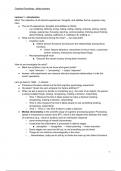
Cognitive Psychology - slides summary
Lecture 1 - introduction
Mind: The collection of all internal experiences, thoughts, and abilities that an organism may
have
● The set of experiences, thoughts and abilities is infinite:
○ e.g. breathing, blinking, loving, hating, eating, tasting, chewing, seeing, seeing
orange, seeing blue, focusing, ignoring, communicating, thinking about thinking
about thinking, walking, walking to A, walking to B, walking to...
● What are the mechanisms driving the mind? → we need both!
○ Cognitive route
■ Define all brain functions and discover the relationships among those
functions
● Vision, feature detectors, mechanism to focus vision, oculomotor
control, memory, interactions among these things
○ Neurophysiological route
■ Discover the neural circuitry driving brain functions
How do we investigate the mind?
● Black box problem: how do we know what goes inside?
○ Input “stimulus” → “processing” → output “response”
● Answer: with experiments we measure stimulus-response relationships to infer the
mind’s operations
Let’s go back to 1868… in Utrecht
● Franciscus Donders carried out the first cognitive psychology experiment
● He asked: “Quam diu eam accipere hoc facere arbitrium?”
● When we ask a person to decide on something (e.g., the color of an object), the person
is doing multiple things: looking, recognizing, making a decision, responding
○ Time 1: Measure the time it takes people to make a decision (looking,
recognizing, making a decision, responding)
○ Time 2: Also measure the time it takes people to see something (looking,
recognizing, responding)
○ Time 1 - Time 2 = the time it takes to make a decision
● Mental chronometry is the scientific study of cognitive processing speed. Processing
speed is measured by reaction time (RT), which is the elapsed time between the onset
of a stimulus (e.g., visual or auditory) and an individual's response
○ some shortcomings of mental chronometry:
○ It assumes that information is processed in distinct stages
■ perception → recognition → motor planning → motor execution
○ Some stages can never be left out, so not everything can be timed
○ Things do not unfold so chronologically in the mind
○ ...Nevertheless, today we do still try to divide the brain up into distinct functions
1
,Cognitive Psychology - slides summary
Interim recap: what are the mechanisms driving the mind? - Cognitive psychology:
● assumes mental processes exist
● constructs models of internal processing
● examines observable behavior
● uses observable behavior to test/adapt models
Inspired by the first computers...
● We conceptualize the brain as an information processing system
● How is information carried and represented in the brain?
Looking inside the brain
● fMRI: functional magnetic resonance imaging → tells us nicely where something
happens but not what happens precisely, or how the brain does it.
○ Active areas of the brain demand oxygen
○ Blood (and thus oxygen) travels to those areas
○ Hemoglobin (a component of blood) changes the magnetic properties of an area
○ Using very strong magnetic field, we can trace those areas
● … but the brain presumably does many things at once
○ How would you know which brain area is responsible for, say, motion?
■ Use Donder’s subtraction method!
Just as in a computer, all info in the brain is carried in the form of electrical signals
● Neurons are our electrical wires
○ Dendrites are excited by surroundings (at the synapses of other neurons),
causing activity to build up in the cell body. When this reaches a threshold, an
electrical signal is released, which travels through the axon to the synapse.
○ A threshold must be reached to release an electrical signal → action potential
● Somehow, the collection of pulses across neurons represents our world
○ A representation is a code for some property of the external world
2
,Cognitive Psychology - slides summary
How many neurons do you need to code for something?
● The “Jennifer Aniston” cell…
● Specificity vs. distributed processing
○ Specificity
■ 24 neurons, each neuron specifically represents one shape
■ Disadvantages:
● Limited capacity: can handle only 24 objects
● If a neuron dies you lose recognition
○ Distributed
■ 24 neurons, nowe very shape is represented by a unique combination of
5 neurons (and each neuron is allowed to participate in multiple codes):
■ Advantages:
● higher capacity: 24!/(5!*19!) = 42504 shapes
● If a neuron dies, the rest of the distributed pattern still gives you a
pretty good idea of what the object is
Recap
● The mind is..
○ the system that generates representations of our world
■ so to allow us to act within that world
○ the collection of all internal experiences, thoughts and abilities that an organism
may have.
● The cognitive approach: view the brain as an information processor
○ Use experimental methods for measuring what’s going on inside
○ (e.g., Donders’ subtraction method)
● Neurons are the brain’s information carriers.
● Most of our cognitive functions rely on distributed processing (neural networks) rather
than single cells.
Lecture 2 - Perception
What is perception?
● Sensation:
○ The registration of a physical stimulus by receptive neurons
○ A physical, factual thing, not susceptible to interpretation etc.
■ Example: activation of olfactory bulb; activation of visual cortex
● Perception:
○ the process of interpreting sensations
■ Example: Smelling
● An analogy...
○ Sensation ≈ the process of owning a car
○ Perception ≈ driving
● The goal:
○ Interpreting, recognizing, understanding (‘what is it?’)
○ Interacting with the world (‘How to respond?’)
3
, Cognitive Psychology - slides summary
● There’s a thin line between sensation and perception…
○ Pupillary light response is not just triggered by incoming light... but also by
thinking about bright objects!
The core challenge in perception:
● to resolve ambiguity
○ The inverse projection problem:
■ From sensory processing alone we cannot say anything
conclusive about the world!
● An auditory example: Green needle vs. Brainstorm
○ The likelihood principle: “perception corresponds to the most likely
physical event that could’ve caused the sensations” (Helmholtz,
1866)
Bottom-up versus top-down processing
● Bottom-up: Sensory organs provide activation of ‘low’ cortical regions,
cascades to ‘higher’ regions
○ everything that is seemingly automatic, without the involvement of (conscious)
decisions
● Top-down: ‘higher’ regions influence activation of ‘lower’ regions
○ everything else.
Bottom-up processing: perceptual organization
● Let’s see why bottom-up processing might be not just
sensation…
○ in terms of simple sensation, these two things would be
approximately identical
○ Grouping of local features into global structures seems
to proceed automatically (see cat)
○ Gestalt principles: A set of assumptions about things that happen in an
automatic, bottom-up fashion
■ ...a mere product of the system’s architecture
■ similarity, proximity, symmetry, closure, continuity, common fate
○ But are all these ‘effects’ really the result of bottom-up processes?
■ Probably not. Our life experiences bolster the expectation that:
● Similar-looking things belong together
● Objects are most often symmetrical
● The cat’s body will extend behind the laptop
● etc.
4
Lecture 1 - introduction
Mind: The collection of all internal experiences, thoughts, and abilities that an organism may
have
● The set of experiences, thoughts and abilities is infinite:
○ e.g. breathing, blinking, loving, hating, eating, tasting, chewing, seeing, seeing
orange, seeing blue, focusing, ignoring, communicating, thinking about thinking
about thinking, walking, walking to A, walking to B, walking to...
● What are the mechanisms driving the mind? → we need both!
○ Cognitive route
■ Define all brain functions and discover the relationships among those
functions
● Vision, feature detectors, mechanism to focus vision, oculomotor
control, memory, interactions among these things
○ Neurophysiological route
■ Discover the neural circuitry driving brain functions
How do we investigate the mind?
● Black box problem: how do we know what goes inside?
○ Input “stimulus” → “processing” → output “response”
● Answer: with experiments we measure stimulus-response relationships to infer the
mind’s operations
Let’s go back to 1868… in Utrecht
● Franciscus Donders carried out the first cognitive psychology experiment
● He asked: “Quam diu eam accipere hoc facere arbitrium?”
● When we ask a person to decide on something (e.g., the color of an object), the person
is doing multiple things: looking, recognizing, making a decision, responding
○ Time 1: Measure the time it takes people to make a decision (looking,
recognizing, making a decision, responding)
○ Time 2: Also measure the time it takes people to see something (looking,
recognizing, responding)
○ Time 1 - Time 2 = the time it takes to make a decision
● Mental chronometry is the scientific study of cognitive processing speed. Processing
speed is measured by reaction time (RT), which is the elapsed time between the onset
of a stimulus (e.g., visual or auditory) and an individual's response
○ some shortcomings of mental chronometry:
○ It assumes that information is processed in distinct stages
■ perception → recognition → motor planning → motor execution
○ Some stages can never be left out, so not everything can be timed
○ Things do not unfold so chronologically in the mind
○ ...Nevertheless, today we do still try to divide the brain up into distinct functions
1
,Cognitive Psychology - slides summary
Interim recap: what are the mechanisms driving the mind? - Cognitive psychology:
● assumes mental processes exist
● constructs models of internal processing
● examines observable behavior
● uses observable behavior to test/adapt models
Inspired by the first computers...
● We conceptualize the brain as an information processing system
● How is information carried and represented in the brain?
Looking inside the brain
● fMRI: functional magnetic resonance imaging → tells us nicely where something
happens but not what happens precisely, or how the brain does it.
○ Active areas of the brain demand oxygen
○ Blood (and thus oxygen) travels to those areas
○ Hemoglobin (a component of blood) changes the magnetic properties of an area
○ Using very strong magnetic field, we can trace those areas
● … but the brain presumably does many things at once
○ How would you know which brain area is responsible for, say, motion?
■ Use Donder’s subtraction method!
Just as in a computer, all info in the brain is carried in the form of electrical signals
● Neurons are our electrical wires
○ Dendrites are excited by surroundings (at the synapses of other neurons),
causing activity to build up in the cell body. When this reaches a threshold, an
electrical signal is released, which travels through the axon to the synapse.
○ A threshold must be reached to release an electrical signal → action potential
● Somehow, the collection of pulses across neurons represents our world
○ A representation is a code for some property of the external world
2
,Cognitive Psychology - slides summary
How many neurons do you need to code for something?
● The “Jennifer Aniston” cell…
● Specificity vs. distributed processing
○ Specificity
■ 24 neurons, each neuron specifically represents one shape
■ Disadvantages:
● Limited capacity: can handle only 24 objects
● If a neuron dies you lose recognition
○ Distributed
■ 24 neurons, nowe very shape is represented by a unique combination of
5 neurons (and each neuron is allowed to participate in multiple codes):
■ Advantages:
● higher capacity: 24!/(5!*19!) = 42504 shapes
● If a neuron dies, the rest of the distributed pattern still gives you a
pretty good idea of what the object is
Recap
● The mind is..
○ the system that generates representations of our world
■ so to allow us to act within that world
○ the collection of all internal experiences, thoughts and abilities that an organism
may have.
● The cognitive approach: view the brain as an information processor
○ Use experimental methods for measuring what’s going on inside
○ (e.g., Donders’ subtraction method)
● Neurons are the brain’s information carriers.
● Most of our cognitive functions rely on distributed processing (neural networks) rather
than single cells.
Lecture 2 - Perception
What is perception?
● Sensation:
○ The registration of a physical stimulus by receptive neurons
○ A physical, factual thing, not susceptible to interpretation etc.
■ Example: activation of olfactory bulb; activation of visual cortex
● Perception:
○ the process of interpreting sensations
■ Example: Smelling
● An analogy...
○ Sensation ≈ the process of owning a car
○ Perception ≈ driving
● The goal:
○ Interpreting, recognizing, understanding (‘what is it?’)
○ Interacting with the world (‘How to respond?’)
3
, Cognitive Psychology - slides summary
● There’s a thin line between sensation and perception…
○ Pupillary light response is not just triggered by incoming light... but also by
thinking about bright objects!
The core challenge in perception:
● to resolve ambiguity
○ The inverse projection problem:
■ From sensory processing alone we cannot say anything
conclusive about the world!
● An auditory example: Green needle vs. Brainstorm
○ The likelihood principle: “perception corresponds to the most likely
physical event that could’ve caused the sensations” (Helmholtz,
1866)
Bottom-up versus top-down processing
● Bottom-up: Sensory organs provide activation of ‘low’ cortical regions,
cascades to ‘higher’ regions
○ everything that is seemingly automatic, without the involvement of (conscious)
decisions
● Top-down: ‘higher’ regions influence activation of ‘lower’ regions
○ everything else.
Bottom-up processing: perceptual organization
● Let’s see why bottom-up processing might be not just
sensation…
○ in terms of simple sensation, these two things would be
approximately identical
○ Grouping of local features into global structures seems
to proceed automatically (see cat)
○ Gestalt principles: A set of assumptions about things that happen in an
automatic, bottom-up fashion
■ ...a mere product of the system’s architecture
■ similarity, proximity, symmetry, closure, continuity, common fate
○ But are all these ‘effects’ really the result of bottom-up processes?
■ Probably not. Our life experiences bolster the expectation that:
● Similar-looking things belong together
● Objects are most often symmetrical
● The cat’s body will extend behind the laptop
● etc.
4