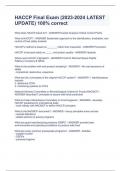
HACCP Final Exam ( LATEST UPDATE) 100% correct
What does HAACP stand for? - ANSWER Hazard Analysis Critical Control Points What is HACCP? - ANSWER Systematic approach to the identification, evaluation, and control of food safety hazards HACCP's method is based on _______ rather than inspection - ANSWER Prevention HACCP is focused solely on _____ not product quality - ANSWER Hazards Where was HACCP originated? - ANSWER Food for Manned Space Flights Pillsbury Company & NASA What is the problem with end-product sampling? - ANSWER - No real assurance of safety - Impractical, destructive, expensive What are the 3 principles of the original HACCP system? - ANSWER 1. identify/assess hazards 2. determine CCPs 3. monitoring systems to CCPs National Advisory Committee on Microbiological Criteria for Foods (NACMCF) - ANSWER described 7 principles to assure safe food production What is Codex Alimentarius Committee on Food Hygiene? - ANSWER - develops HACCP guidelines for international trade - work closely with NACMCF to define HACCP principles What is the NACMCF document? - ANSWER - haccp principles more concise - revised definitions - added sections to prereq programs What are good manufacturing practices (GMP)? - ANSWER provide basic environmental and operating conditions to produce safe food What are some common prerequisite programs? - ANSWER - facilities - supplier control - SSOPs - personal hygiene What are the five preliminary tasks in developing a HACCP plan? - ANSWER - Assemble HACCP team - describe food and its distribution - Develop a flow diagram - Verify the flow diagram What are the 7 steps of HACCP? - ANSWER 1. conduct hazard analysis 2. determine CCPs 3. establish critical limits 4. establish monitoring procedures 5. establish corrective action 6. establish verification procedures 7. establish record keeping/documentation procedures Step 1: conduct hazard analysis - ANSWER two steps: hazard identification and hazard evaluation (severity/likelihood) Step 2: determine critical control points (CCPs) - ANSWER - points where hazard can be eliminated/prevented - uses decision tree (ex: thermal processing, chilling) Step 3: establishing critical limits - ANSWER - the maximum or minimum value to which a hazard must be controlled at a ccp (ex: time, temp, pH, Aw) Step 4: establish monitoring procedures - ANSWER trends in operation recorded to determine if CCP is under control
Written for
- Institution
- HACCP
- Course
- HACCP
Document information
- Uploaded on
- January 1, 2024
- Number of pages
- 4
- Written in
- 2023/2024
- Type
- Exam (elaborations)
- Contains
- Questions & answers
Subjects
-
haccp final exam latest update 100 co
-
haccp final exam latest update stuvia

Also available in package deal